
One of the best parts about my return to New Orleans is that I have not been sick as much as I was in Japan. My first winter in Fukushima I caught pneumonia. The second year I had the flu or something similar. The third year my nose completely closed up and I went on nasal steroids (which became an annual thing). I loved the healthcare system in Japan – the doctors were friendly and everything was really affordable – but it’s better not to get sick. I say this on a day in early January in New Orleans where it was overcast and rainy but still in the upper 70s: I had the air conditioner on. Two days ago I went for a jog along my normal jogging route in a sleeveless T. Life is good. I occasionally get a bit sickish, but my body has had fewer catastrophic failures than it did in Japan.
Part of this could be that I’m exercising more. My normal jogging route takes me along the Mississippi River, but back in November I was blocked by the train and ran back to Magazine Street rather than along “the Fly” (the park area in a batture along the river). This resulted in one of those 何かの縁 moments that life surprises you with every now and then. My Japanese conversation partner happened to be walking in the park with her mother and newborn son. I hadn’t seen her for about a month since she gave birth.
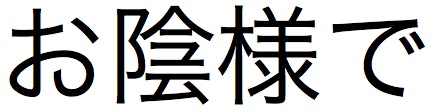
She said, おお、偶然だね。何している?ジョギング? I replied, お久しぶりです。はい、ジョギング。おめでとうございます。 無事に生まれた? (Or something like that. I was a little winded and surprised, so I’m sure my Japanese was crap.) Then she said one of the best get-used to it phrases in Japanese: お陰様で無事に生まれた。
I’m not sure if that’s the exact verb/verb form she used, but I want to focus on the お陰様で (おかげさまで). This is a great phrase. Forget about what it means. Let’s focus on some context.
My first encounter with this phrase was on the very first day of the second semester of my third year – so the first day of class after the New Year holiday. The teacher said, お元気ですか? We began to reply 元気です and the teacher tilted her head to the side like we were making a mistake. No one could figure out what the mistake was was until she fed us the answer – お陰様で元気です。 I remember being baffled. I had no idea what it meant. I wish I could go back and shake myself and say, “It doesn’t matter what it means! It’s just what they say! Just say it! Say it all the time!”
Now the question becomes when do they say it. These two examples have at least one thing in common: a certain length of time has passed since the speakers last met. It had been a few weeks since I’d seen my teacher and about a month since I’d seen my friend. Things happened since the speakers met.
Now is there any similarity between these things? And here is where I give some background context: I’d given my friend a baby gift before she gave birth. And then she gave birth. So yes, some things happened. In the case of my teacher, not much happened. We had a week of vacation between exams and the start of the new semester. I’m going to say no, the things that happened are not similar. This is good. This shows us two different uses of the phrase.
In my teacher’s case, the お陰様で is used almost exclusively as a set 挨拶 (あいさつ). Get used to it, use お陰様で元気です all the time, especially after using しばらく or 久しぶり.
In my friend’s case, it’s used as a way to express thanks. Not that the baby blanket I gave her helped her give birth at all (at least I hope not…the hospital should have enough blankets), but I’d done something nice, and then she’d gone and done something successfully. お陰様で is a useful way to report an accomplishment and indirectly express thanks for the accomplishment. It’s also a very polite phrase. Simply say お陰様で and add whatever you accomplished. You passed a test? お陰様で合格 (ごうかく)しました! You were accepted into the JET Program or some other job? お陰様で就職(しゅうしょく)しました! Your friend fed you ramen when you were wasted and you didn’t get a hangover? お陰様で二日酔い(ふつかよい)になりませんでした! This phrase has all sorts of great usages.
There are places on teh Internetz where you can read about the origin of the phrase, but it’s advisable to just get used to it. Or Google it and then get used to it.
Nice one. Here’s something we translated last year on this phrase: http://japanecho.net/society/0025/
Pingback: East Asia Blog Round-Up : 15/1/2012 | Eye on East Asia
Pingback: How to Japanese» Blog Archive » おかげで vs. せいで
The Ramen example really made me laugh.
I really like this blog – both the writing style and those tidbits of knowledge that grease the wheels and allow you to move forward.