The Japanese are a curious set of folks. Endlessly courteous and patient in most normal circumstances, when they get behind the wheel, they are transformed into vicious tailgating demons. Yes, this is a blanket statement and I realize that it’s not exactly fair, but after spending three years driving every day in this country, I feel qualified to make the claim that Japanese drivers are at least creative with their interpretations of traffic laws. Red lights don’t really count for the first couple seconds. The speed limits are actually 30km faster than actually posted. Hazard lights instantly make any location a parking space.
One of the funniest things is the highway patrol cars. Because they aren’t the police, they don’t have the authority to give out tickets, so they drive their SUVs at the speed limit (generally 80km/h) with lights flashing, suggesting that drivers slow down. People zip around them at speeds up to 150km/h.
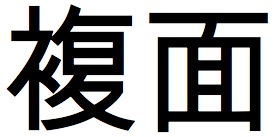
The actual police drive unmarked white cars. There are a couple signs that give them away. One, there are always two guys in the car. Two, the guys are always wearing helmets – no joke. And three, there are two rearview mirrors, one for each of the dudes. Japanese refer to these guys as 複面 (ふくめん), 面 referring to the flat plane of a mirror, and 複 doubling it. These dudes mean business, and everyone knows this. If you ever come across a single line of cars going the speed limit in the left lane, more than likely one of these unmarked cars is at the front of the line; best to follow along until the 複面 exits, at which point everyone speeds up again. It’s hilarious to watch some drivers speed past everyone, realize they just passed the cops, quickly move to the left, and then slam on the brakes.
I believe this blog post has one of the few photos of a 複面 (and proof that I wasn’t just hearing things when a friend explained this to me). The caption above the photo of cars says that the driver was warned by a 複面 over a microphone.
Update:
Oops. Looks like I messed up here. I my defense, I swear that a friend taught me the set of kanji above. I vividly remember his explanation and writing down the kanji in a notebook…that I am not able to locate at the moment. *gulp* Also in my defense, a Google search that reveals 複面パトカー is a somewhat uncommon input mistake. Not nonexistent, though.
As Gulab has noted in the comments, the correct kanji is 覆面. Here, let me make that enormous for you:
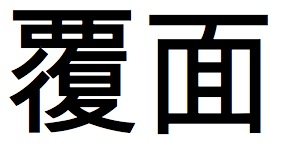 Booyah. As he noted, it means concealed or, in this case, unmarked. Thanks, Gulab. Sorry it took me so long to update this post!
Hi Daniel,
I’ve been enjoying your blog for a while but this is my first time commenting.
It seems to me that you are a little off on this. The kanji should be 覆面, not 複面. The character 覆 means covered, so literally, covered face. According to my dictionary, 覆面 is a mask, veil, or disguise. And 覆面パトカー is an unmarked patrol car.
Regards,
Gulab
The above correction does sound convincing …
Mistake or not, I really like this entry. Fascinating and USEFUL stuff that wouldn’t be found in textbooks.
Like yourself, I have also experienced the joy of “less aware” drivers getting nailed on this account. Actually, whenever we spotted one of these on a highway it was always good to hang around to see what would unfold – made the trip go faster!!
Gulab – thanks for the comment and correction. I think you’re right and I plan on updating the post to reflect that (just got back from a matsuri and am exhausted), but I think it might not be uncommon as a mistake made by Japanese. I learned the word from a friend I was teaching English conversation, and I can’t find the notebook, but I vividly remember him telling me about the two mirrors.