
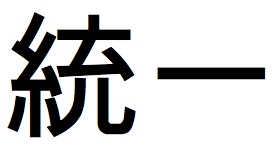
統一 (とういつ) isn’t an in-game term per se, but it is a vital concept in video game translation and really all translation in general. It literally means “uniform” or “uniformity.” I personally think of it as “consistent” or “consistency.” This is common sense, but when translating you have to make sure that the spelling, word choices and style are consistent throughout a text.
You don’t want to have a character drinking “Cutty Sark Whiskey” in one scene and then “Cutty Sark Whisky” in another (the latter is correct). You don’t want to have “Oohashi-san” on one page (or any page, really) and then Ōhashi-san (there, that’s better) on another page. Proper nouns should always be kept consistent, and video game translation is an entirely different animal when it comes to proper nouns.
One place where 統一 rears its anal retentive head in video games is with controls. Almost every video game console uses the same little rocker pad, often shaped like a +, to control movement, but the terminology is different for different systems. The Nintendo DS uses “+Control Pad,” the Xbox “D-pad,” and the PlayStation®3 system “directional button.” Should players be pressing the “A button” or the “A Button”? Do they “tilt” or “press” or “tap” or “tap repeatedly” the button or control device?
Naming of the systems themselves is another place where terminology is often set by the companies. PlayStation uses the word “system” after every instance of Playstation®3 or PSP®, and they also include the restricted mark (no spaces before or after the 3). Nintendo lets you use “Nintendo DS” and also “DS.” Xbox 360 is not “XBox 360.”
Nintendo is by far the most picky, and failure to abide by their terminology guide can cause a company to lose millions if Nintendo of America or Europe finds fault with their game during the checking process and sends it back to the company. The company has to fix whatever problems there were (re-master the game) and make another appointment with NOA and NOE to have their game checked, possibly delaying the release of the game.
Japanese does have a high tolerance for repetition, way more so than English, so you should be flexible enough to realize that not every word needs to be 統一されている. Forget 様々, ignore など, realize that が・けど don’t always mean “but,” but also know where you have to maintain consistency even when it’s painful. There are tons of examples of translation so bad it’s good, but when a term gets set, sometimes it should stay that way. Metal Gear games use “sneaking mission” for 潜入任務, a lot of the Bubble Bobble (in the Japanese “Puzzle Bobble”) remakes use the same cheesy beginning (you loves it, I can tell), and Nintendo still doesn’t ever use “the” before Nintendo Wi-Fi Connection ever.
If you’re really serious about translating video games, one of the best things you can do to prepare is to read your video game manuals very carefully. There are also some websites you can look at. Notice what terms they are using. Start to catalog phrases and wordings that could be useful. Your command and consistency of English is just as important as your Japanese comprehension.
the circle with the R in it means Registered Trademark not, as you said, Restricted.
http://en.wikipedia.org/wiki/Registered_trademark_symbol
Thanks for the correction!
Pingback: How to Japonese» Blog Archive » Game Lingo – クリア ( = clear?)