
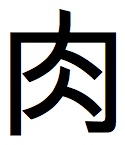
肉 (にく) – the character for meat. It always reminds me of a ribcage or a little rack of lamb or something. Maybe a bizarro chicken tulip.
The concept of meat in Japan is slightly different from that in the U.S. Here, to the great collective unhappiness of all vegetarian expats, it refers to mammal meat – beef and pork, mostly – and not the flesh of living things in general (at least when talking about food). So, saying you don’t eat meat (肉は、食べません) won’t always earn you a meal that meets (har har) your dietary restrictions, especially if you take into account broths and pastes and flakes (many of which are fish-based).
(On a side note, I once knew a “vegetarian” who ate ramen and just gave away the チャーシュー on top – what a joke! Ramen broth is, more or less, pig rendered into a delicious liquid form.)
When I was a CIR on JET, I was forced to explain strict vegetarianism to Japanese people for expats on a number of occasions. (Including one Lithuanian artist who wouldn’t eat mushrooms for some reason. His English was really bad, but from what I could gather, spores are little people.) I found the best way to explain it is to say that you don’t eat 動物 (どうぶつ, doubutsu) – animals in general. But even that was not general enough sometimes, so I would always bastardize the pronunciation to 動き物 (うごきもの, ugokimono) – things that move – and then add the sentence, 動くのなら、食べません. If it moves on its own (and not in search of photons to photosynthesize), they don’t eat it. This always gets the point across and makes people laugh as an added bonus.
Although I gave up a few years ago and now (happily) eat fish, on several occasions waiters have assured me that there is no 肉 in a particular menu item, only to deliver a salad or other dish filled with bacon or ground meat. I don’t know whether it is a linguistic thing or just these waiters, but they don’t seem to consider ベーコン or what one waiter referred to as ミンス to be “meat.”
One phrase that I have used provoked a double-take but seemed to convey what I meant pretty effectively: 菜食主義。
There are things like 精進料理 that tend to meet even strict vegetarians’ requirements; bringing them into the conversation can help Japanese listeners to understand. (In my experience, even just a ダシでもだめです comment will often be enough.)
Facebook friend Wake says: I knew a vegan in Japan once who pretty much lived on combini donuts and potato chips because she couldn’t find anything fishless. I love 肉 (the kanji). It’s so easy to visualize. But you have to explain to me how they came up with 皮肉 for sarcasm, irony, cynicism.
Helen says: I thought it was rude to say (sorry, I don’t have Japanese characters enabled) “Niku wa tabemasen” and that you’re supposed to say, “Niku ga heta desu” (I am not skilled at eating meat.)
Isaac says: Yes, telling people about meat will do the job, as these ‘new age’ ideas will come as a shock…
If a Japanese person walked up to me in a street overseas and said, “I don’t eat living creatures” (or moving creatures). Yes, it’s understandable of course, but 野菜しか食べられません。is much better. Of course, the concept of that is astonishing to some people so you will have to nicely elaborate in regards to eggs, or even fish, for people who have no idea.
Wake: Interesting question about irony. Wikipedia is no help. Found this site which attributes it to Buddhist stuff from China: http://gogen-allguide.com/hi/hiniku.html Looks like “skin” and “muscle” was somehow “not true understanding,” which I guess because “irony.”
Helen: Interesting, I hadn’t heard that. I’ll have to look into it. I personally would never have a chance to use it, heh.
Isaac: Yeah, it’s definitely a strange way to explain it. Mostly just me having a laugh, poking fun at the vegetarians.
Durf: Yeah, I’ve definitely used that dashi line, too. Personally, my strategy has been to just eat everything, try everything. I rarely ate red meat and pork before coming to Japan 8 years ago, and living here has really opened my mind to a lot of food I would have been picky about.
This is a great example of how a concept which you believe to be so simple, when translated into that of another culture, is completely meaningless and becomes more trouble than its worth to attempt to make somebody comprehend.
I wouldn’t call it completely meaningless. There are definitely areas of overlap between the concepts. And it’s definitely worth explaining – especially if you’re a vegetarian! That said, it’s much easier just to eat the meat.
Pingback: How to Japonese» Blog Archive » “Veggie” Dog