How to Japanese

How to Japonese
How to "Get Used to" Japanese

« Encounter Two – No Way Jose
Monday Puzzle – Presidents »

Monday Puzzle – Identify This – Answer

As many of you were able to correctly guess, this:
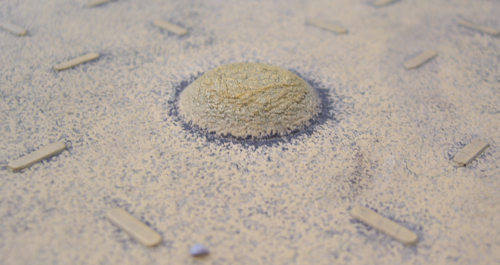
block1

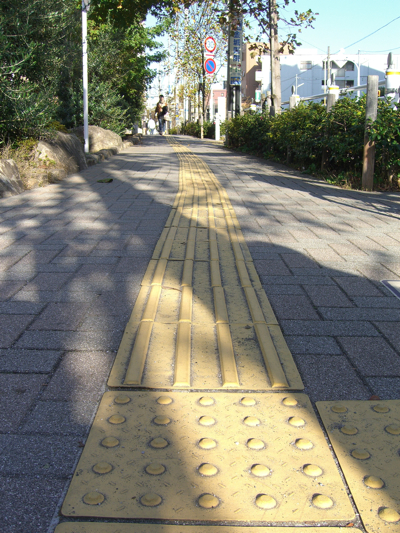
Is an extreme close-up of this:

tenjiblock1

The official name is 視覚障害者誘導用ブロック (しかくしょうがいしゃゆうどうようぶろっく). They are also known as 点字ブロック (てんじぶろっく, literally “Braille Blocks”), but Wikipedia notes that they do not actually use Braille as the name suggests.

They do, however, have meaning. This website does a great job of illustrating how the blocks with grooved lines (in Japanese, 誘導ブロック or 線状ブロック) mean walk forward but the dotted blocks (警告ブロック or 点状ブロック) signify a stop or a turn – somewhere that requires caution like a train platform or a big street.

It’s always amazes me how ubiquitous these are. They have been installed just about everywhere in Japan in an attempt to create the most バリアフリー country ever. Oh, and if you were wondering, バリアフリー ≠ “barrier-free” (or at least I don’t think it should in translation unless you are talking specifically about Japanese efforts to promote accessibility). バリアフリー = “handicapped accessible” or whatever the appropriate PC term is in English.

Julian, Doug, Jerry, Thomas, and William all get Google Wave invites, and Thomas gets the beer. Nice work, guys! It should take a few days for the invites to go through, but I’ve put your names in. Julian also let me know that the term 点字タイル is used by the Nankai Railway. Very cool – I like the alliteration, and “tile” is probably more accurate than “block.”

This entry was posted on Monday, November 16th, 2009 at 7:12 am and is filed under puzzle. You can follow any responses to this entry through the RSS 2.0 feed. You can leave a response, or trackback from your own site.

2 Responses to “Monday Puzzle – Identify This – Answer”

  1. Daniel Says:
    November 17th, 2009 at 10:17 pm

    Facebook friend Jerry posted a really interesting comment on my feed: One of my roommates my last year at university was a blind exchange student from Japan. I thought it was interesting that (apparently) the canes used by the visually impaired in the US are longer than the ones used in Japan. During his orientation at the university, they gave him a new cane that was notably longer — like 20 cm or so. He said it was much easier to use, and compared it to having improved “vision”.

    A woman I saw on the train yesterday had a cane that came up to about her waist. I wonder if there is a reason for shorter canes in Japan?

    And my response: That’s a really interesting story! I can only imagine that it would be like suddenly being able to see that much further in all directions. I wonder if it’s because cities like Tokyo are so crowded that it forces people to use shorter canes.

  2. lastarial Says:
    November 19th, 2009 at 11:34 am

    That was so obvious I thought I couldn’t be right!

Leave a Reply

 
  • Follow @howtojapanese How to Japonese

    Promote Your Page Too
  • Pages

    • About
    • Contact
    • Portfolio
  • Archives

    • January 2012
    • December 2011
    • November 2011
    • October 2011
    • September 2011
    • August 2011
    • July 2011
    • June 2011
    • May 2011
    • April 2011
    • March 2011
    • February 2011
    • January 2011
    • November 2010
    • October 2010
    • September 2010
    • August 2010
    • July 2010
    • June 2010
    • May 2010
    • April 2010
    • March 2010
    • February 2010
    • January 2010
    • December 2009
    • November 2009
    • October 2009
    • September 2009
    • August 2009
    • July 2009
    • June 2009
    • May 2009
    • April 2009
    • March 2009
    • February 2009
    • January 2009
    • December 2008
    • November 2008
    • October 2008
    • September 2008
    • August 2008
    • July 2008
    • June 2008
    • May 2008
    • April 2008
    • March 2008
    • February 2008
  • Categories

    • airbag expressions (5)
    • appear (2)
    • beer (28)
    • body parts (7)
    • casual (30)
    • causality (3)
    • causative (10)
    • class notes (3)
    • comedy (25)
    • conjunctions (2)
    • custom (2)
    • dictionaries (5)
    • food (53)
    • gerund-related (6)
    • get used to it! (66)
    • giving (3)
    • kanji (88)
    • literature (45)
    • Murakami (56)
    • onomatopoeia (4)
    • particles (2)
    • passive (11)
    • phone (1)
    • podcast (1)
    • polite (27)
    • politics (3)
    • probability / possibility (3)
    • project management (5)
    • puzzle (38)
    • random (95)
    • reading (15)
    • receiving (3)
    • refusal (10)
    • reporting (1)
    • requesting (6)
    • research (2)
    • Resources (16)
    • theory (8)
    • travel (14)
    • TV (17)
    • Uncategorized (8)
    • underrated japan (5)
    • video (39)
    • video games (19)
    • vocab (110)
    • wordplay (31)
    • 変換 (2)

How to Japanese powered by WordPress | minimalism by www.genaehr.com
Entries (RSS) and Comments (RSS).