
How to Japanese

How to Japonese
How to "Get Used to" Japanese

« Spinning Around and Around
号外 – 1Q84 Book 3, Summer 2010 (Update) »

Keep Your Eyes Open – Assistant Vegetables

I was back in Fukushima over the weekend to carry a mikoshi in a festival. I had a really good time. It’s always nice to get out of the city for a few days, eat a few home-cooked meals at my homestay family’s place, and sleep on a real bed.

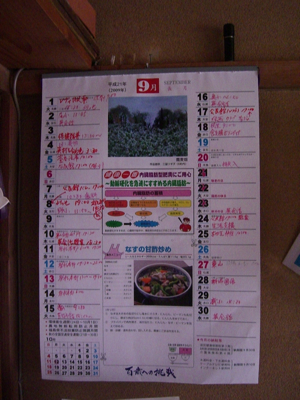
While I was there I noticed the calendar on the wall:
veggies1

It’s produced by the town’s health/public welfare center. Up until about 10 years ago or so, supposedly the diet in my town was extremely high in salt. They started promoting a more healthy diet by making better school lunches, giving 100万円 to anyone who lives to be 100 (although I heard they were going to get rid of this), and by giving out calendars with healthy recipes. I used to have one of these on the wall of my apartment.

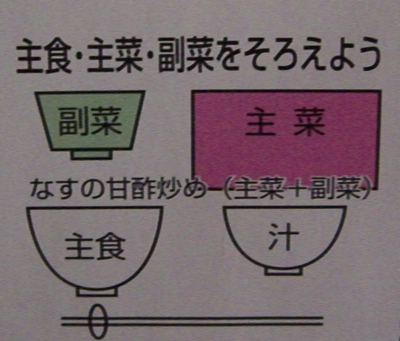
I looked a little closer and saw this:
veggies2

Not only does it have 主食, it’s got 主菜 – you’re main vegetable. It also shows 副菜, which is so much fun to translate poorly. Assistant vegetable, auxiliary vegetable, vice-vegetable. Take your pick.

Speaking of healthy eating, I’ve been doing quite a bit myself this past month, along with jogging just about every day. This was to ensure I did not experience death by mikoshi and so that I have a good excuse to fatten myself up back in the States next week. I’m heading to New York on Thursday for the holidays, so the next post will be Friday after I get back. Have a good Silver Week.

This entry was posted on Wednesday, September 16th, 2009 at 7:39 am and is filed under food, vocab. You can follow any responses to this entry through the RSS 2.0 feed. You can leave a response, or trackback from your own site.

One Response to “Keep Your Eyes Open – Assistant Vegetables”

  1. Andy Says:
    September 18th, 2009 at 2:10 am

    I forgot to mention last time that it amuses me that おかず also means “masturbation material,” at least according to jisho.org

Leave a Reply

 
  • Follow @howtojapanese How to Japonese

    Promote Your Page Too
  • Pages

    • About
    • Contact
    • Portfolio
  • Archives

    • February 2012
    • January 2012
    • December 2011
    • November 2011
    • October 2011
    • September 2011
    • August 2011
    • July 2011
    • June 2011
    • May 2011
    • April 2011
    • March 2011
    • February 2011
    • January 2011
    • November 2010
    • October 2010
    • September 2010
    • August 2010
    • July 2010
    • June 2010
    • May 2010
    • April 2010
    • March 2010
    • February 2010
    • January 2010
    • December 2009
    • November 2009
    • October 2009
    • September 2009
    • August 2009
    • July 2009
    • June 2009
    • May 2009
    • April 2009
    • March 2009
    • February 2009
    • January 2009
    • December 2008
    • November 2008
    • October 2008
    • September 2008
    • August 2008
    • July 2008
    • June 2008
    • May 2008
    • April 2008
    • March 2008
    • February 2008
  • Categories

    • airbag expressions (5)
    • appear (2)
    • beer (28)
    • body parts (7)
    • casual (31)
    • causality (3)
    • causative (10)
    • class notes (3)
    • comedy (26)
    • conjunctions (2)
    • custom (2)
    • dictionaries (5)
    • food (53)
    • gerund-related (6)
    • get used to it! (66)
    • giving (3)
    • kanji (88)
    • literature (45)
    • Murakami (56)
    • onomatopoeia (4)
    • particles (2)
    • passive (11)
    • phone (1)
    • podcast (1)
    • polite (27)
    • politics (3)
    • probability / possibility (3)
    • project management (5)
    • puzzle (38)
    • random (95)
    • reading (15)
    • receiving (3)
    • refusal (10)
    • reporting (1)
    • requesting (6)
    • research (2)
    • Resources (16)
    • theory (8)
    • travel (14)
    • TV (17)
    • Uncategorized (8)
    • underrated japan (5)
    • video (39)
    • video games (19)
    • vocab (110)
    • wordplay (31)
    • 変換 (2)

How to Japanese powered by WordPress | minimalism by www.genaehr.com
Entries (RSS) and Comments (RSS).