Week 2 of Murakami Fest 2026. See previous entries here.
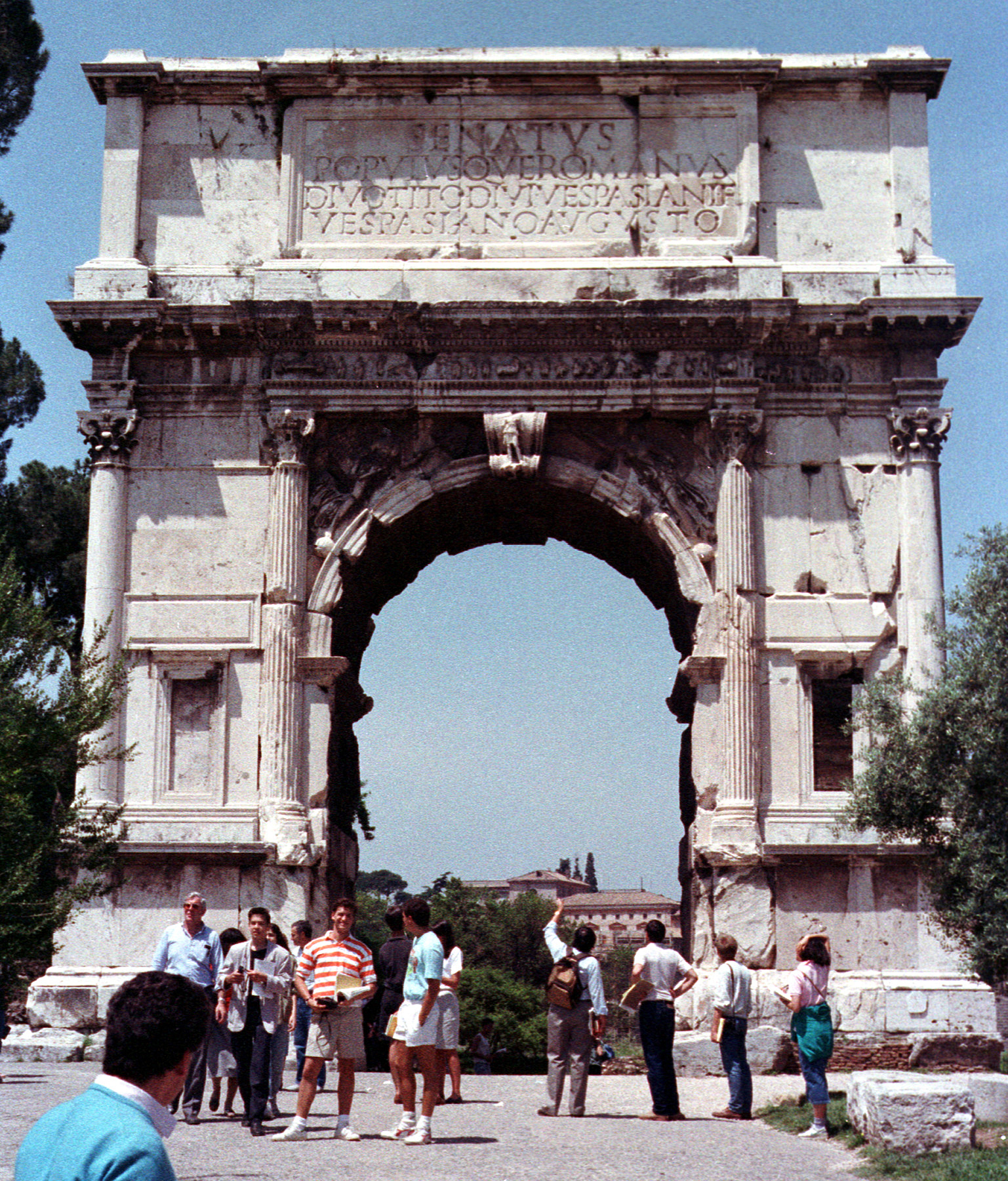
General view of the Arch of Titus in Rome. by Tom Elliott (1988)
copyright: 1988 Tom Elliott (used with permission)
photographed place: Roma (Rome) [http://atlantides.org/batlas/roma-43-b2]
Published by the Institute for the Study of the Ancient World as part of the Ancient World Image Bank (AWIB). Further information: [http://www.nyu.edu/isaw/awib.htm].
The next section of the book is called “1988, Year of Recovery” (1988年、回復の年), and the first essay is “Canali’s Apartment” (カナーリさんのアパートメント). After living in an inconvenient location in Rome previously, the Murakamis are determined to live somewhere more convenient and end up in a basement apartment of a man named Canali, mostly because they like the guy. He’s a tall Italian in his mid-70s who rides around on a Vespa wearing a “funky” green jacket. He’s also extremely nice, so when they meet him after stumbling upon the apartment and calling to see if there are any availabilities, they take the half basement unit.
Canali does have a first floor unit, but it’s currently occupied by an American businessman who is in the process of moving back to Torino, a process that seems to be interminable. So the Murakamis rent a Mitsubishi Pajero (the same one that Murakami drove to Turkey) and drive around Italy rather than put up with the cold, wet apartment (which Canali is quick to repair for them whenever something goes wrong). It seems like the worst part of their setup is having to do laundry by hand.
They do go back to Japan temporarily during this part of their trip, during which Murakami turns 40 and the Showa Emperor dies (January 7, 1989).
The first floor apartment eventually opens up, and they are able return to a refreshing location with a view of the street below and a lot more light. Murakami puts together a makeshift office and seems to be in a much better position to write. He ends the section writing about how cars can have “expressions,” and how Italian cars have expressions that can change based on circumstances, as opposed to Mercedes Benz and BMW, which only have set expressions.
This is a great chapter and a return to form, so there are a lot of things I could quote from, but I think the death of the Emperor and its effect on Japan is probably the most interesting, so I’ll share this passage:
日本に帰ると、日本のマスコミは天皇報道で埋めつくされていた。大喪の礼というのがあって、日本中の警官が東京に集まって、マンホールの蓋を開けてはそれに封印を貼っていた。たぶん過激派のテロ封じのためなのだろうけれど、イタリアから帰ってきてすぐにそういうのを目にすると、なんだか神経の具合がおかしくなってしまう。我々は日本に帰ったときはずっと渋谷区のアパートに住んでいたのだが、東京で繰り広げられているその手の気違い沙汰にうんざりしたし、しょっちゅう警官が訪ねてくるのがうっとうしかったし、新幹線に乗って九州に行って、騒ぎがおさまるまでのんびり由布院の温泉につかっていることにした。こう言っては語弊があるかもしれないけれど、九州の普通の人たちは大喪の礼のことなんてとくに気にせずに生きていたみたいだった。東京にいると、世界がそれ一色に染まってしまっているみたいに見える。誰に会ってもその話になるし、みんなそれぞれに何のかんのと意見を言う。いろんな意見やら感想やらが細かい塵のように空中を舞って、ぴりぴりと震えている。そういう話をしているだけでなんだかうんざりしてくる。でもありがたいことに、九州ではそういうことはなかった。天皇のお葬式も日常生活とはあまり関係のない「遠くの話」という感じだった。 (364-365)
When we returned to Japan, the mass media was completely saturated with coverage of the emperor. There was his funeral service, and police officers from across Japan had gathered in Tokyo and were opening manhole covers and then affixing seals to them. This was likely to close them off from extremist terrorists, but seeing this right after returning from Italy put me in a bizarre state of mind. We were living in an apartment in Shibuya after returning to Japan, and I got fed up with seeing this madness unfold in Tokyo, plus it was depressing having the police around all the time, so we decided to get on the shinkansen, go to Kyushu, and take it easy at an onsen in Yufuin until everything died down. This might not be completely accurate, but your average person in Kyushu didn’t seem to be fussed about the emperor’s funeral procession. In Tokyo, the entire world was dominated by that single event. Anyone you ran into would end up talking about it and had this or that opinion about it. All these opinions and thoughts and whatnot danced around like a fine dust shimmering in the air. Even just talking about it started to frustrate me. But thankfully there was none of that in Kyushu. The emperor’s funeral felt like “something from afar” without anything to do with daily life.
I don’t think I’d realized that the funeral was taken this seriously (notably before the 1995 subway attacks). Also, very cool that Murakami decided to go down to Yufuin to relax. I mentioned this as one of my favorite spots in Japan on a recent podcast.
It’s interesting that Murakami uses the word うんざり (unzari, tedious/boring/be fed up with) so frequently. This is a word I called out as important in his second novel, Pinball, 1973, when I did my podcast series about his books back in 2023 ahead of The City and Its Uncertain Walls. Just as Murakami was likely sick of the politics of Japan after the end of the student movement, I can see that he was sick of the politics of the emperor’s funeral, describing them both with this word.