Lancia Delta 1600 GTie

Week 4 of Murakami Fest 2026. See previous entries here.
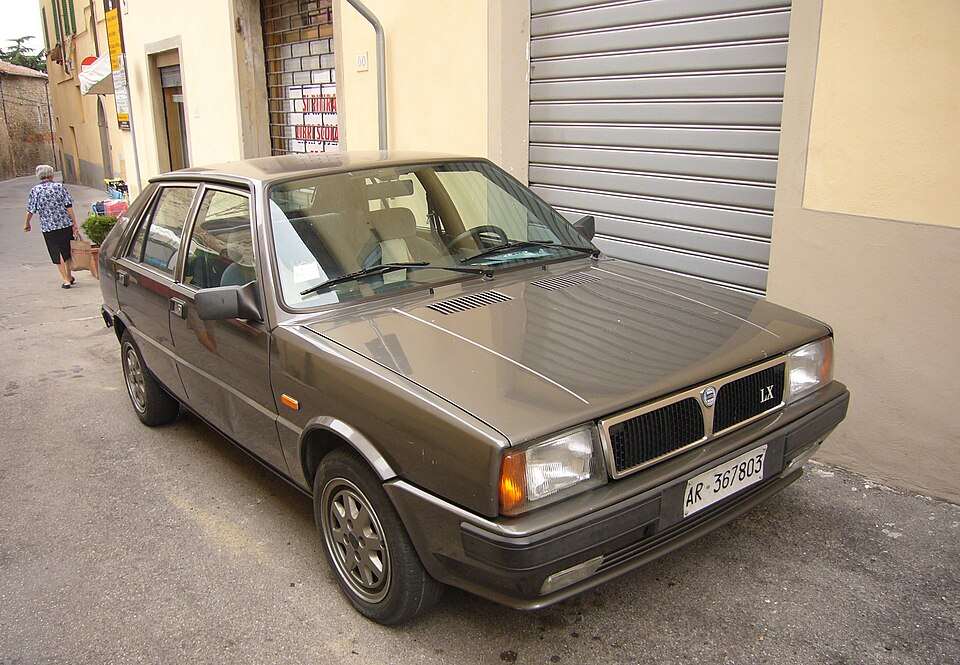
A gray 1988 Lancia Delta LX parked on the street in front of a building with a few shuttered doorways.
A 1988 Lancia Delta LX via WikiMedia Commons. The closest example I could find.

The next chapter is “Lancia” (ランチア), the make of the car Murakami buys. He goes with a Delta 1600 GTie (shown in the photo above), and he notes that it’s the first car he’s ever owned.

He chooses it over a classic Cinquecento (Fiat 500) because they want something that can handle highway driving, and Murakami goes over the process of tracking it down which seems quite difficult. He also details all the car’s inadequacies and challenges, including a very tricky theft alarm.

It’s interesting to see how much protectionism was on the minds of people around the world at the time. The dealer he works with is convinced that Italian cars would sell in Japan if not for protectionist policies, but Murakami is decidedly not convinced.

It’s also interesting that the cost is equivalent to 200,000 yen but Murakami is able to get it tax free at 150,000 yen. Even given the change in currency purchasing power, that feels quite cheap.

The chapter is another filler chapter, but it ends quite nicely:

内装についてぶつぶつ文句を言ったあとで、ふと燃料計を見ると、燃料がまったくのゼロになっている。針が左端までびよーんと振りきれてしまっている。「燃料ほとんど入れてないから、すぐその辺で入れてくださいね。あまり走ると切れちゃいますよ」とファクトリーの人が軽く言う。冗談じゃないよ、まったく。時計はもう一時過ぎをさしている。ガソリン・スタンドが閉まる時間である。自動式のセルフ・サービスのスタンドはあるが、いずれにせよこれからそれを捜さなくてはならない。ひどい話である。親切気というものがまるでない。

でもまあなんとかガソリンが切れる前にセルフ・サービスのスタンドを見つけてとりあえず一万リラ(約千円)分のガソリンを入れた。これでオーケーである。ヴィアレ・マンツォーニの通りから、壁際の地下道に入り、ポポロ門の脇を通ってテヴェレ河を渡り、コーラ・ディ・リエンツオからリソルジメント広場に行き、そして家に戻る。昼休みのラッシュ・アワーの最中だ。そして昼前から激しい雨がローマの町に降りつづけている。おかげで買ったばかりの車がどろどろになる。

車の調子そのものはとてもいい。いかにもホヤホヤの新車という雰囲気である。アクセルを踏みこむと、エンジンはトゥィーーーンというとても気持ちのいい音を立てているし、ハンドルの切れは明瞭で、ブレーキはびしっと効く。サスペンションは少し硬めだが、コリコリとしていて気持ちがいい。

ランチア・デルタ1600GTie、まあとにかくこれが僕の買った記念すべき最初の車である。さて、うまく行きますかどうか。 (382-383)

After grumbling about the interior, I glance at the fuel gauge and happen and to see that it’s completely empty. The needle is glued to the left edge of the fuel gauge. “It’s just about empty, so fill it up somewhere nearby right away,” the guy from the factory says casually. “You’ll run out of gas if you go very far.” And he wasn’t kidding, at all. It’s already past 1:00 p.m. Gas stations are closed. There are automated self-service stations, but we were going to have to look for one. Pretty awful treatment. Like they had no compassion whatsoever.

But we somehow manage to find a self-service gas station before we run out of gas, and I fill up with 10,000 lira (around 1,000 yen) of gas. Now we should be fine. From Viale Manzoni, I take the underground road along the city walls, pass by the Porta del Popolo and cross the Tiber River, take Cola di Rienzo to Piazza del Risorgimento, and then go home. All in the middle of the lunch break rush hour. And Rome was covered by heavy rain from just before noon. Thanks to which my brand new car was filthy.

The car itself ran very well. Rip roaring, and ready to go, just like you’d expect of a new car. When I stepped on the pedal, the engine made a satisfying vroooom, the turns were crisp, and the brakes extremely tight. The suspension was a little stiff, but it was pleasantly firm.

The Lancia Delta 1600 GTie, this is the very first car I get to celebrate purchasing. I hope everything goes well.

I was able to track down just about every landmark that Murakami mentions, but the “underground road” near/along the walls is a bit unclear. It seems like it’s the Aurelian Walls, but I’m not quite sure. At any rate, this is the center of the historic district in Rome that Murakami seems to be skirting around. If anyone knows better, please let me know.

The only other tidbit of interest that I have is that there’s a cafe near me in Osaka named Cinquecento that has a Fiat 500 parked out front. It’s a great little neighborhood spot! Not worth going out of your way to find, but definitely worth including in your regular spots if you live in the neighborhood like I do.

In the next chapter, we’ll see Murakami head back to Greece.

The Roman Parking Situation

Week 3 in Murakami Fest 2026! See the other entries here.

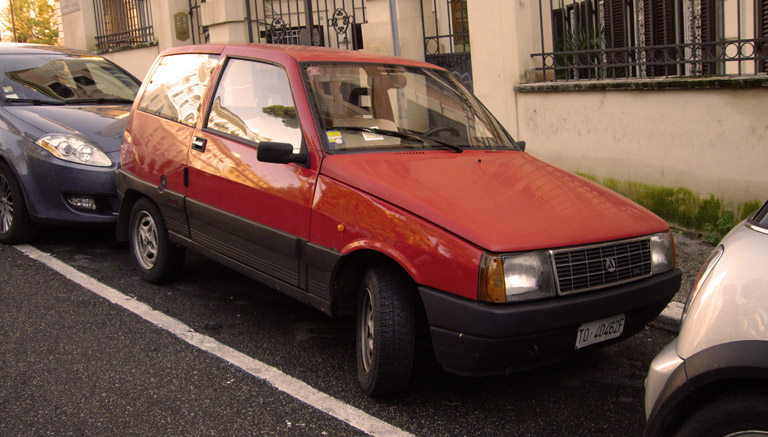
An Autobianchi Y10 parked on the streets of Rome. Via WikiMedia Commons.

The next chapter is “The Roman Parking Situation” (ローマ駐車事情), a mostly filler chapter that Murakami uses, as the title suggests, to describe the parking situation in Rome.

He goes over how and why the parking is so difficult (historic buildings that can’t be torn down) and why cars are still necessary (public transportation isn’t as good as other major cities). He then gets into how Italian cars fit the Italian cityscape (smaller cars for smaller roads), and the importance of sidewalks and parallel parking skills (many drivers end up parking on the sidewalk, double- and even triple-parking happens regularly).

I imagine this must be interesting to anyone in Japan and potentially anyone who didn’t grow up in an older city, but being from New Orleans originally, I was totally familiar with this scene that he describes:

ぎりぎりに車が一台入るか入らないかというくらいのスペースがあれば、これはもう見物として言うことない。そのうちに車がやってくる。ドライヴァーがスピードを緩める。「入るかなあ?」と目測する。「やってみるか」と思う。少し前で停めて、ハザード・ランプをつけて、ゆつくりバックを始める。そのあたりで見物人が出てくる。だいたいは暇そうなおじさんである。僕のように妻が買い物しているあいだ、ぼんやり時間潰しをしているという人間もいる。日本でよく工事現場なんかを腕組みしてぼおおっと見物しているお暇おじさんがいるけれど、なんとなくあの雰囲気に似ている。ドライヴァーはアウトビアンキY10に乗って商店街に買い物に来た普通のシニョーラ(奥さん)だったりするわけだが、これがまた上手い。慣れた手付きですっとお尻をつっこんで、きゅっきゅっと素早く何度か切りかえす。そしてぎりぎりにすぽっと収めてしまう。こういうのは「ブラーヴァ!」である。ものすごく上手いと、ぱちぱちと手を叩く人もいる。みんな肯いたり、「ベルフェット(最高)」と声をかけたりする。イタリア・オペラのアリアと同じである。シニョーラもにこっとして、賞賛に素直に答える。おかしい国である。 (374-375)

There’s no spectacle greater than a space that’s just large enough to be uncertain whether or not a car will fit. Soon enough, a car comes along. The driver slows down. They eyeball the spot: “Wonder if I’ll fit.” And then decide: “Let’s give it a shot.” They stop slightly ahead of the space, turn on their hazards, and start to slowly back up. This is around the point at which spectators start to appear. Usually they are old men who seem to have too much time on their hands. And others like me who are just killing time while their wife shops. In Japan, there are these bored old men who spend all day watching construction sites with their arms crossed. That’s kind of what this resembles. It’s even better when the driver is someone like a regular signora who’s come to shop on the market in her Autobianchi Y10. She points the rear of the car into the spot with an experienced handle and nimbly cuts the wheel back and forth a couple times. And then just barely slides the car in. “Brava!” is what you’d say here. Some people even clap out of admiration. Everyone nods, and someone shouts out “Perfetto!” Just like with an aria at the Italian opera. The signora smiles, a modest response to the praise. It’s a funny country.

My mother drove an El Camino for many years in New Orleans and was able to impress people with her parking skills in the French Quarter. Murakami cites 5.1m as the length of a Mercedes 560 (2.1m longer than the Italian Fiat 500), and an El Camino is just over 5.3 meters. European and Japanese minds cannot conceive of parallel parking a beast like this.

This chapter is a nice transition to the next chapter, in which Murakami will buy a car of his own to cruise around Europe.

In Which the Showa Does not Go On

Week 2 of Murakami Fest 2026. See previous entries here.

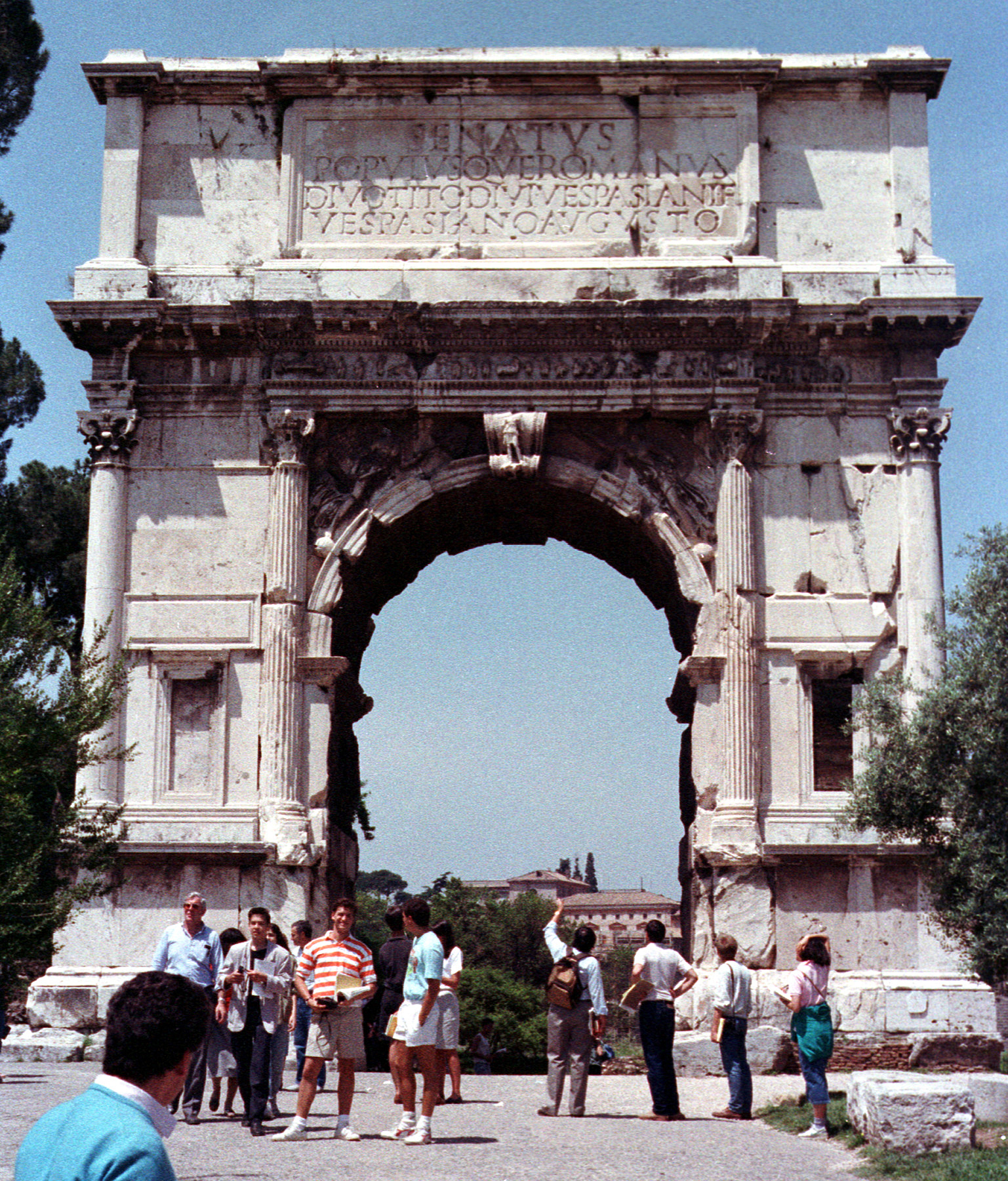
AWIB-ISAW: The Arch of Titus (IV)
General view of the Arch of Titus in Rome. by Tom Elliott (1988)
copyright: 1988 Tom Elliott (used with permission)
photographed place: Roma (Rome) [http://atlantides.org/batlas/roma-43-b2]

Published by the Institute for the Study of the Ancient World as part of the Ancient World Image Bank (AWIB). Further information: [http://www.nyu.edu/isaw/awib.htm].

The next section of the book is called “1988, Year of Recovery” (1988年、回復の年), and the first essay is “Canali’s Apartment” (カナーリさんのアパートメント). After living in an inconvenient location in Rome previously, the Murakamis are determined to live somewhere more convenient and end up in a basement apartment of a man named Canali, mostly because they like the guy. He’s a tall Italian in his mid-70s who rides around on a Vespa wearing a “funky” green jacket. He’s also extremely nice, so when they meet him after stumbling upon the apartment and calling to see if there are any availabilities, they take the half basement unit.

Canali does have a first floor unit, but it’s currently occupied by an American businessman who is in the process of moving back to Torino, a process that seems to be interminable. So the Murakamis rent a Mitsubishi Pajero (the same one that Murakami drove to Turkey) and drive around Italy rather than put up with the cold, wet apartment (which Canali is quick to repair for them whenever something goes wrong). It seems like the worst part of their setup is having to do laundry by hand.

They do go back to Japan temporarily during this part of their trip, during which Murakami turns 40 and the Showa Emperor dies (January 7, 1989).

The first floor apartment eventually opens up, and they are able return to a refreshing location with a view of the street below and a lot more light. Murakami puts together a makeshift office and seems to be in a much better position to write. He ends the section writing about how cars can have “expressions,” and how Italian cars have expressions that can change based on circumstances, as opposed to Mercedes Benz and BMW, which only have set expressions.

This is a great chapter and a return to form, so there are a lot of things I could quote from, but I think the death of the Emperor and its effect on Japan is probably the most interesting, so I’ll share this passage:

日本に帰ると、日本のマスコミは天皇報道で埋めつくされていた。大喪の礼というのがあって、日本中の警官が東京に集まって、マンホールの蓋を開けてはそれに封印を貼っていた。たぶん過激派のテロ封じのためなのだろうけれど、イタリアから帰ってきてすぐにそういうのを目にすると、なんだか神経の具合がおかしくなってしまう。我々は日本に帰ったときはずっと渋谷区のアパートに住んでいたのだが、東京で繰り広げられているその手の気違い沙汰にうんざりしたし、しょっちゅう警官が訪ねてくるのがうっとうしかったし、新幹線に乗って九州に行って、騒ぎがおさまるまでのんびり由布院の温泉につかっていることにした。こう言っては語弊があるかもしれないけれど、九州の普通の人たちは大喪の礼のことなんてとくに気にせずに生きていたみたいだった。東京にいると、世界がそれ一色に染まってしまっているみたいに見える。誰に会ってもその話になるし、みんなそれぞれに何のかんのと意見を言う。いろんな意見やら感想やらが細かい塵のように空中を舞って、ぴりぴりと震えている。そういう話をしているだけでなんだかうんざりしてくる。でもありがたいことに、九州ではそういうことはなかった。天皇のお葬式も日常生活とはあまり関係のない「遠くの話」という感じだった。 (364-365)

When we returned to Japan, the mass media was completely saturated with coverage of the emperor. There was his funeral service, and police officers from across Japan had gathered in Tokyo and were opening manhole covers and then affixing seals to them. This was likely to close them off from extremist terrorists, but seeing this right after returning from Italy put me in a bizarre state of mind. We were living in an apartment in Shibuya after returning to Japan, and I got fed up with seeing this madness unfold in Tokyo, plus it was depressing having the police around all the time, so we decided to get on the shinkansen, go to Kyushu, and take it easy at an onsen in Yufuin until everything died down. This might not be completely accurate, but your average person in Kyushu didn’t seem to be fussed about the emperor’s funeral procession. In Tokyo, the entire world was dominated by that single event. Anyone you ran into would end up talking about it and had this or that opinion about it. All these opinions and thoughts and whatnot danced around like a fine dust shimmering in the air. Even just talking about it started to frustrate me. But thankfully there was none of that in Kyushu. The emperor’s funeral felt like “something from afar” without anything to do with daily life.

I don’t think I’d realized that the funeral was taken this seriously (notably before the 1995 subway attacks). Also, very cool that Murakami decided to go down to Yufuin to relax. I mentioned this as one of my favorite spots in Japan on a recent podcast.

It’s interesting that Murakami uses the word うんざり (unzari, tedious/boring/be fed up with) so frequently. This is a word I called out as important in his second novel, Pinball, 1973, when I did my podcast series about his books back in 2023 ahead of The City and Its Uncertain Walls. Just as Murakami was likely sick of the politics of Japan after the end of the student movement, I can see that he was sick of the politics of the emperor’s funeral, describing them both with this word.

Murakami’s Place

Year 19 of Murakami Fest! Unbelievable. See previous entries on this page. This year I’m continuing my read through Murakami’s travel memoir Distant Drums. I would really like to be getting through it at a faster pace, but there’s so much else to do, so this yearly activity might be the only way I do.

The next chapter is titled “1988, A Blank Year” (1988年、空白の年), and Murakami explains that the year is blank because he’s drained after writing Dance Dance Dance. He stops writing the travel sketches that he’s been gradually accumulating over the course of his trip to recover, but because the book is a chronological account of his travels in Europe, he summarizes the period from April to October 1988.

It’s a really interesting period! He’s become a celebrity in Japan and is putting out his next big novel. He’s gone from selling 10,000 copies of his books to selling hundreds of thousands, and several million in the case of Norwegian Wood.

He returns to Japan to go over the proofs for DDD, to work on a book about F. Scott Fitzgerald, and to get his driver’s license because he’s planning to drive in Turkey that fall. While in Japan, Murakami feels isolated. Norwegian Wood is on the bestseller lists, and Kodansha headquarters is draped in green and red, inspired by the covers of the book. It’s impossible for him to gauge his readers, and he feels isolated and even hated, despite the fact that everything is coming up Murakami. He can’t even write, so he translates. He calls translation a 治療行為 (chiryō kōi, a therapeutic act).

He and his wife go to Hawaii to warm up for a month, and he later goes on a writing trip with a photographer and editor to Mt. Athos and to Turkey, but he notes that it isn’t until he translates Tim O’Brien’s The Nuclear Age that he is really able to kick the chill from the Roman winter. He’s so inspired from the book, his translation of which doesn’t sell quite as well as he expects.

The whole chapter is pretty interesting. It’s not as scene-driven as the rest of the book, which is what makes it such strong writing, but it’s so interesting to get inside his mind at that point in time, so I think the piece that I’ll quote from is at the end that ties together translation with how he felt about being a writer:

この作品を訳したあとで、僕はもう一度小説を書きたいという気持ちになっていた。僕という人間の存在証明はおそらく生きながらえ、書きつづけるという行為そのものの中にあるのだと僕は思った。それが何かを失いつづけ、世界に憎まれつづけることを意味するとしても、僕はやはりそのようにして生きていくしかないのだ。それが僕という人間であり、それが僕の場所なのだ。 (355)

After I finished translating this book (The Nuclear Age), I felt like writing a novel again. I started to believe that my proof of existence might be located within the act of living and writing as long as I can. That’s the only way for me to live in the end, even if it means I’ll go on losing things and being hated. That is me as a person, and that is my place.

Murakami refers back to feeling lost on return to Japan. Of not having a “place” after returning from the road. He’s able to find himself in the work, and this is really just the beginning. I’d have to go through and count, but from this point in time onward, he does spend long periods of time outside of Japan. He goes to the U.S. a number of times, including when he was writing Wind-up Bird and some of his essay collections in the 90s, and then he’s back again in the 2000s.

Mix Tapes

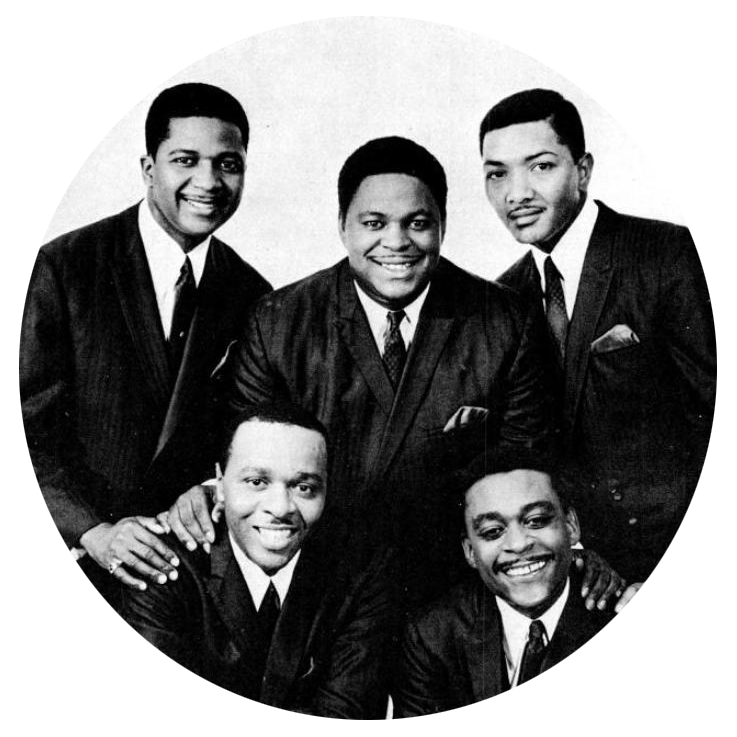
A black and white photo of the R&B band The Dells.
The Dells

Week 4 of Murakami Fest 2025. See past posts here.

In the last chapter, we got an episodic look at a few days before Christmas in Rome. Next Murakami gives us an overall view of the whole winter in this chapter titled “Winter Deepens” (冬が深まる). He starts writing Dance Dance Dance on December 17 and spends all winter writing as he battles off multiple colds. But the writing goes pretty well.

年も押し迫った十二月十七日から『ダンス・ダンス・ダンス』という長編小説を書き始める。

長編小説を書くときはいつも同じパターンである。「書きたいな」というぼんやりとした気持ちが自分の中で少しずつ高まってきて、そしてある日「さあ、今日から書こう」ときっぱりと思う。僕の場合、細かい構成とか筋書きよりは、この臨界点の見極めを大事にする。

『ノルウェイの森』とは違って、『ダンス・ダンス・ダンス』の場合は書き始める前にまずタイトルが決まった。このタイトルはビーチボーイズの曲から取ったと思われているようだが、本当の出所は(どちらでもいいようなものだけれど)ザ・デルズという黒人パンドの古い曲である。

日本を出発する前に、家にある古いレコードをひっかき集めて自家製オールディーズ・テープを作っていったのだが、その中にこの曲がたまたま入っていた。いかにも昔風リズム・アント・ブルースというタイプの曲である。のんびりとしていて、ざらっとした雑な感じで、その辺が不思議に黒っぽい。その曲をローマで毎日聴くともなくぼんやり聴いているうちに、タイトルにふとインスパイアされて書き始めたのだ。もちろんピーチポーイズにも同じ題の曲があることは知っていたけれど(高校生のときによく聴いた)、直接的な始まりはこのデルズの曲の方である。

この小説は始めから終わりまでだいたいすんなりと気持ち良く書けたと思う。『ノルウェイの森』は僕としてもそれまでに書いたことのないタイプの作品だったし、「この小説はいったいどういう風に受け入れられるんだろう」とあれこれ考えながら書いたのだけれど、この『ダンス・ダンス・ダンス』に関しては、そんなことはまったく考えずに、自分の書きたいようにのびのびと好きに書いた。隅から隅まで僕自身のスタイルの文章だし、登場してくる人物も『風の歌を聴け』『1973年のピンポール』『羊をめぐる冒険』と共通している。だから久し振りに自分の庭に戻ってきたみたいで、すごく楽しかった。というか、書くという行為をこれほど素直に楽しんだことは、僕としても稀である。(334-335)

As the year drew to a close, I began writing a novel titled Dance Dance Dance on December 17.

Whenever I write a novel, it’s the same pattern. The feeling that “I want to write” gradually builds somewhere within me, and then one day, I decide, “All right, today we start to write.” For me, being able to discern this critical point is more important than having a detailed structure or a plot.

Unlike Norwegian Wood, with Dance Dance Dance, I chose the title before I started writing. Many believe I took this title from the Beach Boys song, but the actual source was an old song by the African-American band The Dells (although it doesn’t matter much which of the two it was).

Before I left Japan, I made some homemade oldies tapes from old records I scratched together around the house, and that song was on one of them. It’s an old school R&B song through and through. It’s relaxed and kind of rough, which gives it a strange darkness. I just kind of had that song on in the background every day when I was in Rome, and I started writing inspired by the title. Of course I knew that the Beach Boys had a song with the same title (I listened to it when I was in high school), but the direct beginning was this Dells song.

From start to finish, writing this novel was a smooth, pleasant experience. Norwegian Wood was a kind of writing I’d never done before, so while I was writing, I kept wondering, “What the heck are people going to think of this?” but with Dance Dance Dance, that never entered my mind and I wrote without any worries exactly the way I wanted to write. Every last sentence is my own style, and the characters are the same as in Hear the Wind Sing, Pinball, 1973, and A Wild Sheep Chase. So it felt like returning to a garden I’d kept after a long while. It was a lot of fun. I guess even for me it’s rare to enjoy the act of writing in such a straightforward way.

Such an interesting, rich passage. Murakami’s experience strikes me as both very modern and at the same time ancient. Music had become more portable than it would have been 20 and maybe even just 10 years prior (the Walkman came out in 1979) when he would have had to bring all his records, but it still requires Murakami to do some work. These days we have access to our entire collections—and basically the entirety of all human musical output—in a single pocketable device. Music conversion concerns are extinct when it comes to international moves, except for very niche and marginal exceptions.

The idea of Murakami wandering around Europe hooked up to a constant cycle of jazz, classical, and R&B, on the other hand, is an idea that feels very familiar and is basically identical to my experience living in Japan from 2003-2010, more or less. From around 2008 or so onward, I did start to include podcasts in my regular rotation, but I had a Discman when I studied abroad and rented CDs from Tsutaya. On JET, I was still collecting CDs (and went notably deep into Thelonious Monk) but had iPods I could stock with songs.

I wonder about distraction. Murakami must’ve been distracting himself with music to a certain extent, just as I was/am. It makes me want to seek boredom, in a very Craig Mod-inspired way. Maybe that would be best.

The rest of the chapter is about the miserable winter. They end up catching a cold after standing in line for four hours to get tickets to see Maurizio Pollini, who ends up being underwhelming. Murakami mentions a superlative Tokyo performance by Sviatoslav Richter as a contrast.

He notes that writing in the cold is the opposite of what writing Norwegian Wood was like, and mentions he’s writing on a word processor:

僕はあまりに寒いのでオーパーコートを着て机に向かい、ぱたぱたとワートプロセッサーのキイを叩きつづけた。シシリーで『ノルウェイの森』を書いたときとは正反対である。あのときは暖かくて暖かくて、机に向かいながら、頭がぼおっとしていた。今回は寒くて、ワードプロセッサーのキィを打ちそこねるくらいである。(336)

I was so cold that I wore an overcoat at my desk as I punched away at the keys on the word processor. It was the polar opposite of writing Norwegian Wood in Sicily. It was so, so hot then that I found my mind wandering off while sitting there. This time it was so cold that I thought I might break the keyboard.

The Murakamis spend the winter dreaming of onsen and life in Hawaii, which is actually the reason that Dance Dance Dance features scenes in Hawaii; Murakami was trying to mentally stave off the cold. But he notes that he cannot return to Japan until the novel is complete. Once he starts, he has to keep going: 日本に帰ったら、またペースが乱されてしまう (337). (If I went back to Japan, my pace would be totally thrown off.)

A couple other very minor notes. Murakami mentions the bombing of Korean Air 858 and the dollar weakening to 123 yen. They were keeping their cash in dollars, so this affects their day to day to a certain extent, although I assume most of Murakami’s earnings were in yen, which would have been to his benefit. This is the period of time when the dollar-yen exchange rate dropped into the range that we’re currently familiar with after spending decades in the 200-360 yen/dollar range.

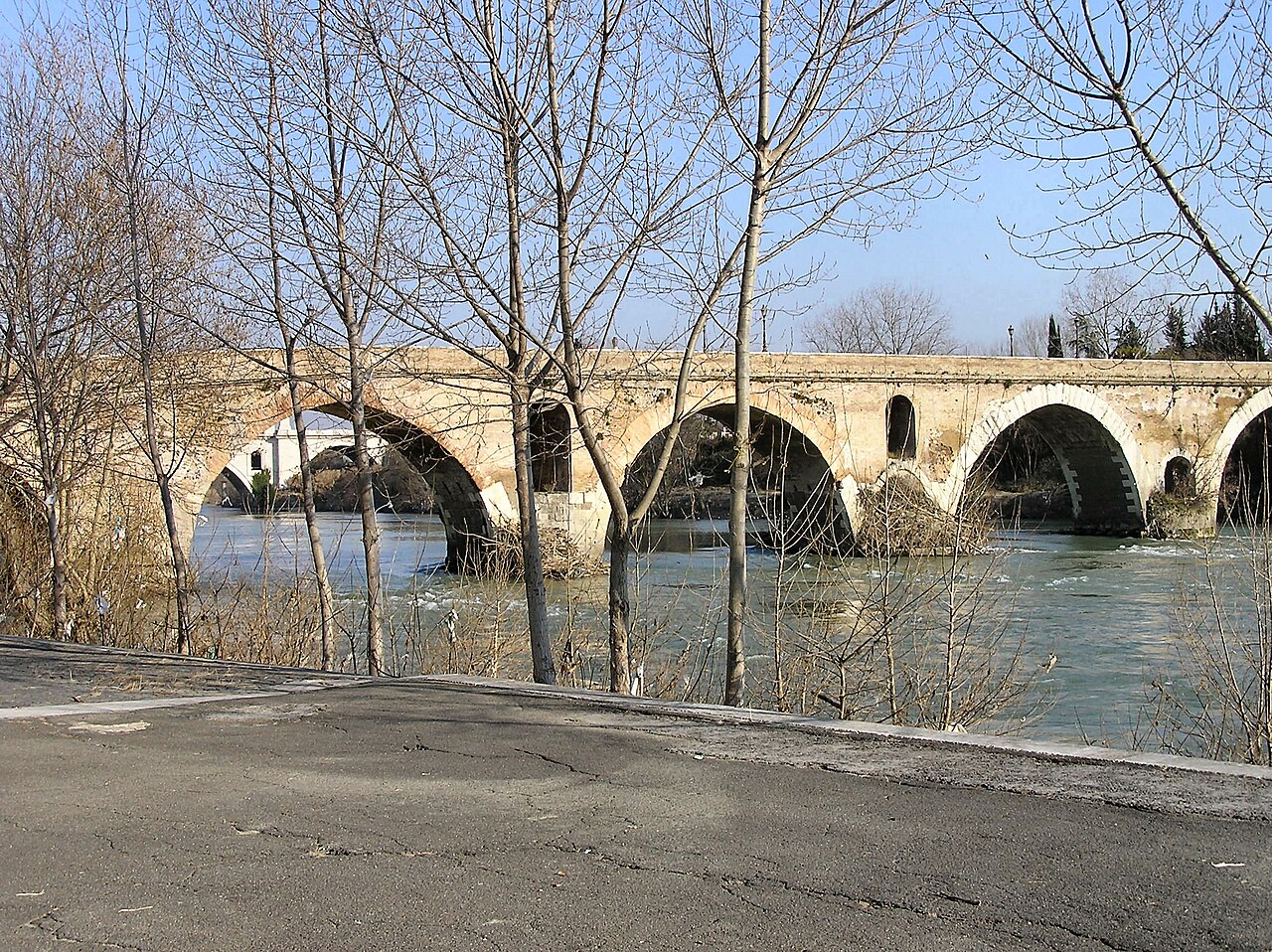
Ponte Milvio Market

A photo of Ponte Milvio in Rome.

Week 3 of Murakami Fest 2025. Check out the previous entries here.

The next chapter is a very short essay titled ポンテ・ミルヴィオの市場 (Ponte Milvio Market). It’s December 22, and the Murakamis are doing some pre-Christmas shopping because all the stores in Rome close on Christmas Day and Boxing Day, much like New Year’s in Japan, Murakami notes.

This is still the case in 2025 in Japan. Both of the major supermarkets near my old apartment closed from January 1-3 a few years ago. This site from Nagoya provides an interesting grid breakdown for the city’s supermarkets, and I think this is probably representative of Japan more widely.

This is all to say, I wonder if things in Rome are still like this or if more and more stores have started to remain open during the holidays as in the United States.

So the Murakamis head to Ponte Milvio and stock up on salmon (2,500 yen for just under a kilogram), sardines and squid (7 and 5 respectively for 1,400 yen altogether), and a ton of vegetables. Murakami highlights the restaurants in the area, of which there are a number with varying service but all pretty tasty. After shopping, they have a quick standing coffee before heading home on the bus.

At home, they start to put away/prep the food, and there’s a definite sense that they’re missing the flavors from home:

家に戻るとさっそく下ごしらえにかかる。

僕がいんげんの頭をむしって、茹でる。女房が出刃で(これは日本から持参した)鮭をしわける。すごくいいとろが出たので、わさび醤油につけて台所に立ったまま食べる。こういうのをもぐもぐと食べているとご飯が食べたくなる。ちょうど昨日の残りの冷飯があったので、このとろの刺身と梅干しをおかずにして食べる。じゃあ、イカもも切っちゃおうかということになって、イカも刺身で食べてしまう。このイカは実にとろりとして美味しかった。ゆであがったいんげんも漬物がわりにぽりぽりと食べる。インスタント味噌汁も作る……という具合に台所で立ったまま、簡単に昼食が終わってしまう。こういうのはけっこう美味しいものである。(332-333)

When we get home, we immediately began the prep work.

I tear off the ends of the green beans and boil them. My wife cleans the salmon with a knife (one that we brought from Japan). The resulting toro is extremely good, so we stand around the kitchen and eat it with wasabi and soy sauce. Stuffing ourselves like this makes us want some rice. We happen to have leftover rice from yesterday, so we eat the salmon toro and umeboshi as sides. Might as well cut into the squid, we think, so we have squid sashimi as well. The squid is truly melt-in-your-mouth delicious. We munch on the boiled green beans in place of tsukemono. And as we’re standing there in the kitchen…we decide to mix up some instant miso soup, too. We finish our simple meal. Things like this are pretty delicious.

Murakami goes on to note that they eat more sushi, grilled sardines, and tsukemono for dinner, which is an exception. They mostly live off of pasta.

It’s a nice visual. The two of them standing around their apartment in Rome, devouring this fresh seafood. I do wonder about eating it raw. I’m not sure I’d be bold enough to eat sashimi prepared from a random outdoor market. Although I guess I probably have without realizing it. Most of the raw fish I’ve eaten in Japan probably traveled through any number of markets, and I did see what Tsukiji was like before it moved, as far back as 2003 when it was truly a Wild West and you risked your life to get a glimpse of the giant frozen maguro. So maybe this isn’t quite as much of a gastronomic risk as I initially thought.

It does look like the Ponte Milvio Market is still alive and kicking, with both produce and antiques.

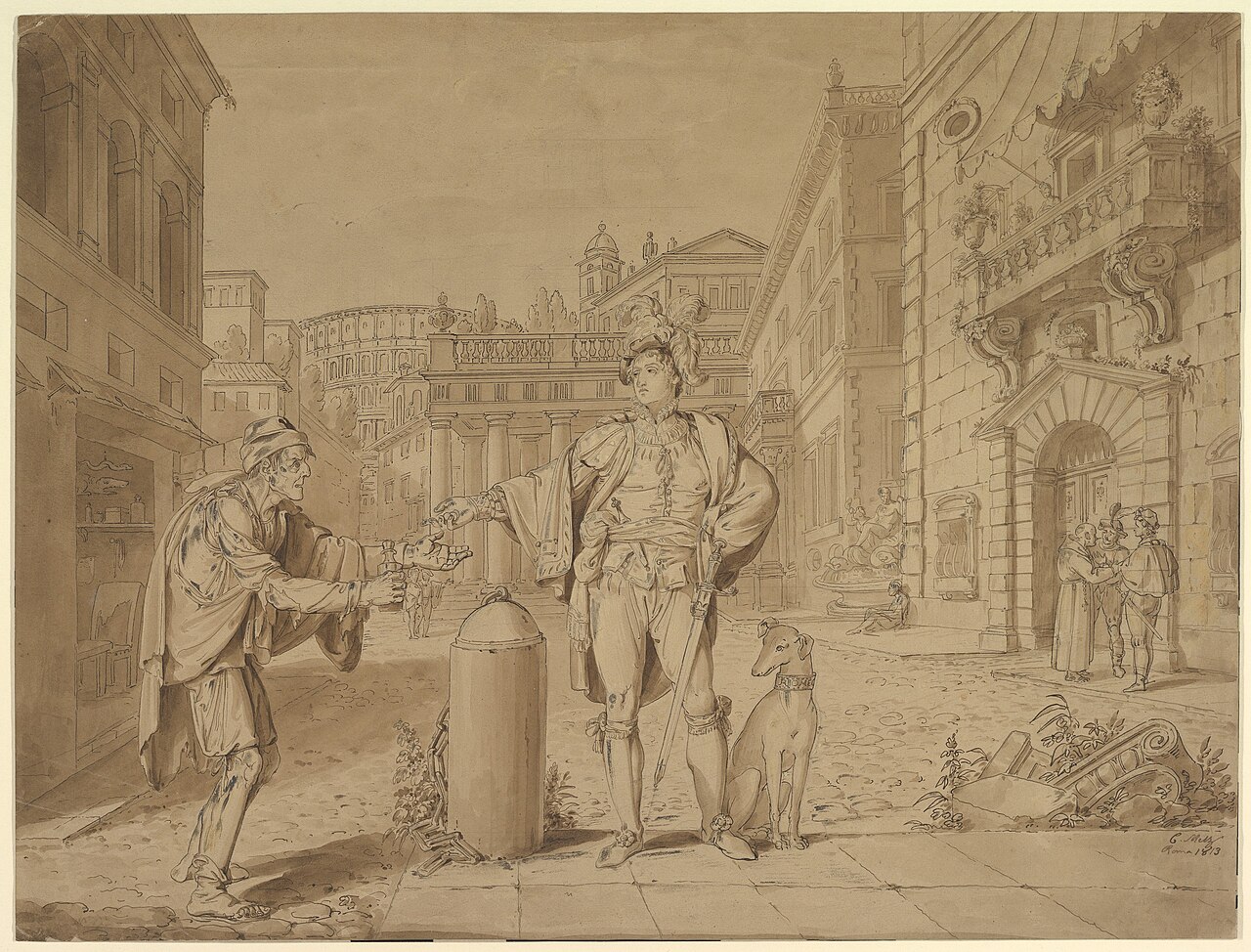
Beggars in Rome

An image of the drawing "Nobleman Giving Alms to Beggar in Piazza near the Coliseum" by Conrad Martin Metz in the Metropolitan Museum of Art.

Week 2 of Murakami Fest 2025. Check out previous entries here.

The next chapter is “What exactly is the end of the year in Rome?” (ローマの歳末とはいかなるものか), and Murakami spends it discussing exactly what the title suggests. Italy, like Japan, exchanges a lot of presents at the end of the year and gets very crowded with shoppers, but mercifully there is no Christmas music. Murakami buys bottles of wine for the doormen at his apartment and sees immediate effects when they are extremely courteous for the next week.

The rest of the chapter, other than a short section at the end, is about the beggars in Italy that seem to increase greatly in number at the end of the year. Murakami highlights the different varieties of beggars (mothers with small children, old women, those who pretend to be hurt, and people who play instruments). It’s difficult to tell exactly what tone Murakami is taking here. Clearly this is something he notices because of how distinct it is from the situation in Japan, where you rarely see anyone begging on the streets. However, he does seem to make light of them in several places, asking what they do the rest of the year, noting that all the mothers with children look alike, and passing on a story from a friend that suggests they “rent” children to help with begging.

Murakami ends the chapter with a very short profile of his landlady Lynne, an Englishwoman who has married a man from Naples and is living in Rome. He brings her up after an aside noting how exhausting it is to go out in the city—just as it is in Tokyo. And then the chapter ends in a very abrupt fashion. This could be Murakami poking fun at himself, but I doubt it. Lynne is a caricature of sorts of the disaffected expat. Someone who’s been away from home forever yet is miserable in their chosen home.

The chapter isn’t really Murakami complaining in the same sense. I think instead he sees himself in a reporting mode and just happened to encounter his landlady, who is then subject to his gaze.

At any rate, here’s Murakami discussing this view that he seems to be taking:

世の中はさまざまな実際的な哲学がある。じっと街をみているとなにかしら学ぶことがある。東京の街で立ち止まってじっと何かを見ていたりしたら、変な顔をされることが多いけれど、ここローマではそういうことはない。みんなよく立ち止まって何かをじっと見ている。女房がマックス・マーラやらポリーニやらのウィンドウをじっともの欲しげに見ているあいだ、僕は通りを向いてじっと乞食の様子を観察する。ひとにはそれぞれの人生の方向性というのものがある。 (327-328)

There are countless pragmatic philosophies out there. Look hard enough at a city and you’ll learn something. If you come to a stop in Tokyo and stare at something, you get a lot of strange looks, but that’s not the case here in Rome. Everyone stops and stares at things. While my wife looks longingly at the items in the windows of Max Mara or Pollini, I turn toward the street and closely observe the beggars. Everyone has their own direction in life.

Less than stellar material, but there will be more interesting sections in the coming weeks.

TV and Beethoven Tickets

Year 18 of Murakami Fest. Murakami Fest can legally vote. Wild. See the previous entries in Murakami fest here. This year, I’m continuing my look at his travel memoir Distant Drums.

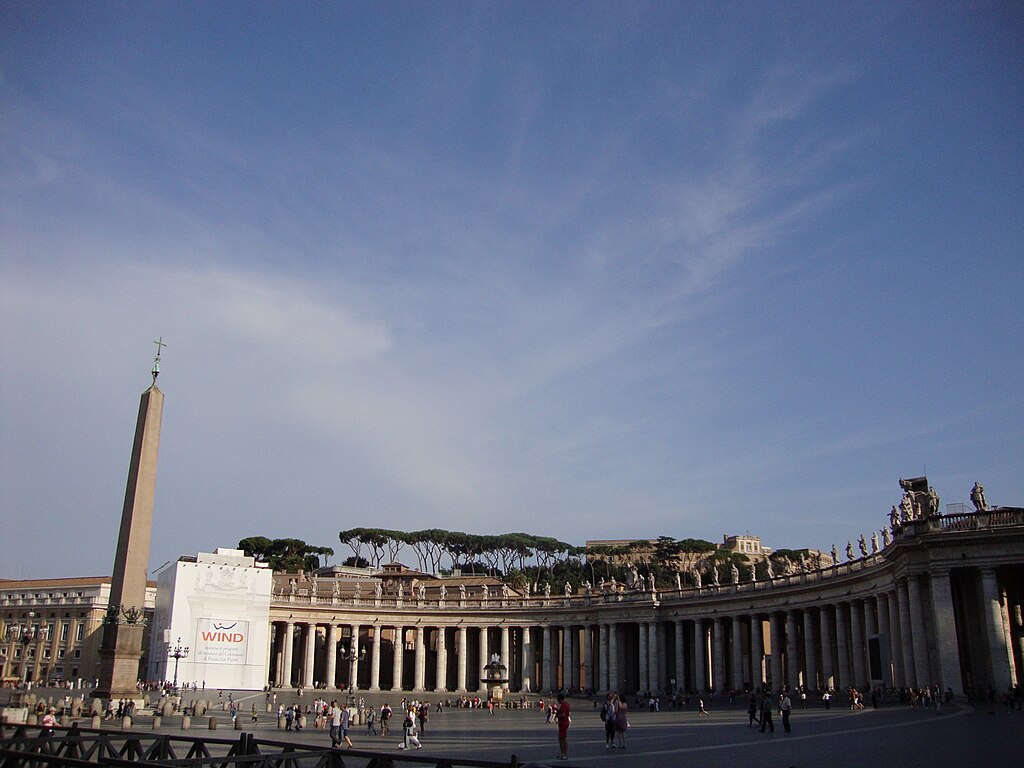
A view of Piazza San Pietro with blue sky, taken in 1987.
Rome in 1987, via Wikimedia Commons.

The Murakamis are back in Rome for the winter, and the first thing on the to-do list is buying a television in this chapter titled “TV, Gnocchi, Prêtre” (テレビ、ニョッキ、プレートル). Murakami says he needs a more active source of news, particularly for the transportation information (there are lots of strikes) and the weather. In Japan he could just dial a number on the phone to get access to the information.

Strangely enough, it looks like this service may have just ended. NTT, at least, ended their 177 service on March 31 of this year after being in service for 70 years. An NHK news article notes that the usage of this service peaked in 1988 (the last year of Murakami’s trip to Europe) at over 300 million calls and fell to 5.56 million by 2023 (which still seems like a lot!). Thus, our bizarre look at Japan’s history through Murakami’s travel memoir continues.

Murakami spends some time describing Italian public TV and the newscasters who are all quite animated and colorful (which he claims to be able to detect despite the fact that he buys a black and white TV).

He then shifts into a trip to Bologna for gnocchi. He highlights how pleasant it is to travel there because there are fewer tourists and because he’s found some decent restaurants. He ends the chapter with two music anecdotes. After watching The Sicilian in Bologna, he walks through town and stumbles on a Lee Konitz concert in the basement of a random osteria. Unfortunately it’s sold out. Later, back in Rome, he and his wife go to see Georges Prêtre conducting the Orchestra dell’Accademia Nazionale di Santa Cecilia.

This chapter is only OK. The sections on Italian TV—in particular the dramatic, aging weatherman—are probably the most interesting, but they border on caricature. The Bologna trip is mostly told in exposition. But taken together, there are two interesting stories that speak to the buying power of the yen, the economic mindset that Murakami was in at the time, and the (universal-ish?) experience of having life in a foreign country influence your perception of costs.

First, Murakami talks about buying a TV, and he’s operating on a particularly Japanese mindset:

でもわざわざ高いテレビを買うのもばかばかしいから、まず近所の中古電気屋をのぞきにいく。日本の量販店なんかだと小さいテレビなら二万円くらい出せば買えるからそのつもりで行ったのだが、これが思ったよりかなり高い。やたらでかくって古色蒼然としたのが三万円もする。画像もちょっとぼけてる。日本だったら絶対にスクラップという代物である。僕は昔、これよりずっと鮮明に映るやつを国分寺駅近くのごみ捨て場で拾って帰ったことがある。仕方ないから一番安い白黒の新品を買うことにした。ニュースと天気予報がわかりゃいいんだから色なんてあってもなくても同じである。 (314-315)

But it would also be ridiculous to buy an expensive television, so first I checked out the local used electronics store. At the big box stores in Japan, you could pick up a small TV for about 20,000 yen, so that’s what I had in mind when I went, but they were much more expensive than I thought. A TV much larger than I needed with a dim, faded screen ran 30,000 yen. The picture was a little warped as well. If this was Japan, it would’ve been on the scrapheap. A long time ago, I managed to go home with a TV with much clearer picture that I picked up at a garbage drop off near Kokubunji Station. Now I didn’t have a choice, so I decided to but the cheapest new black and white model. All I needed it for was the news and weather report, so it made no difference if it was color or not.

This reminds me of an anecdote from Matt Alt’s book Pure Invention of being able to score very lightly used electronics on trash day in Bubble-era Japan. Interesting to see Italy in a very different situation when it comes to the ubiquity of electronics and their costs.

It does seem like living in Italy has started to influence Murakami’s perception of costs a bit. He’s potentially started to anchor toward the cheaper cost of living, as shown when he goes to get tickets for the orchestra:

十二月六日、日曜日、ローマでジョールジュ・プレートル指揮の聖テチリア・オーケストラを聴きに行く。演奏曲目はベートーヴェンの交響曲の五番と六番という凄まじいというか何というか、かなりのものだけれど、年末でもあることだしベートーヴェンをまとめて聴くのも悪くないんじゃないかという感じで前日にヴァチカンの前にある聖チェチリアのホールまで切符を買いに行った。値段は5500円、3900円、2200円だが残念ながらいちばん高い券しか残っていない。それも前例のはしっこの方である。それで女房と二人で随分迷ったのだけれど、年末だからまあいいか(何がどういいのかよくわからないけど)、とあきらめて買ってしまう。どうしてかはわからないけれど、外国にいると知らず知らずだんだん生活がつつましくなってくる。東京にいると一万円のチケットでもさっさっと買っちゃうのに。 (321)

On Sunday, December 6, we went to hear Georges Prêtre conducting the Orchestra dell’Accademia Nazionale di Santa Cecilia in Rome. The selection was Beethoven’s 5th and 6th Symphonies—which I guess you might qualify as staggering works, at any rate quite major—it was the end of the year, and hearing a number of Beethoven pieces at once sounded like it would be nice, so the day before we went to Saint Cecilia Hall in front of the Vatican to buy tickets. The prices were 5,500 yen, 3,900 yen, and 2,200 yen, but unfortunately only the most expensive were left. And those were on the edge of the front row. My wife and I had a lot of trouble making up our minds, but it was the end of the year so we thought it was fine (what was fine, I couldn’t say exactly), so we ended up buying them. I don’t know why, but when we’re living in a foreign country, our lifestyle gets increasingly frugal without even realizing it. Despite the fact that in Tokyo we’d shell out 10,000 yen for a ticket without a second thought.

So the cost of electronics is expensive in Italy, but the orchestra is relatively affordable. The opposite of in Japan. To provide some reference, in December 1987, the yen was around 130 JPY/USD.

Petra

Year 1: Boobs, The Wind, Baseball, Lederhosen, Eels, Monkeys, and Doves
Year 2: Hotel Lobby Oysters, Condoms, Spinning Around and Around, 街・町, The Town and Its Uncertain Wall, A Short Piece on the Elephant that Crushes Heineken Cans
Year 3: “The Town and Its Uncertain Wall” – Words and Weirs, The Library, Old Dreams, Saying Goodbye, Lastly
Year 4: More Drawers, Phone Calls, Metaphors, Eight-year-olds, dude, Ushikawa, Last Line
Year 5: Jurassic Sapporo, Gerry Mulligan, All Growns Up, Dance, Mountain Climbing
Year 6: Sex With Fat Women, Coffee With the Colonel, The Librarian, Old Man, Watermelons
Year 7: Warmth, Rebirth, Wasteland, Hard-ons, Seventeen, Embrace
Year 8: Pigeon, Edits, Magazines, Awkwardness, Back Issues
Year 9: Water, Snæfellsnes, Cannonball, Distant Drumming
Year 10: Vermonters, Wandering and Belonging, Peter Cat, Sushi Counter, Murakami Fucks First
Year 11: Embers, Escape, Window Seats, The End of the World
Year 12: Distant Drums, Exhaustion, Kiss, Lack of Pretense, Rotemburo
Year 13: Murakami Preparedness, Pacing Norwegian Wood, Character Studies and Murakami’s Financial Situation, Mental Retreat, Writing is Hard
Year 14: Prostitutes and Novelists, Villa Tre Colli and Norwegian Wood, Surge of Death, On the Road to Meta, Unbelievable
Year 15: Baseball on TV, Kindness, Murakami in the Asahi Shimbun – 日記から – 1982, The Mythology of 1981, Winning and Losing
Year 16: The Closet Massacre, Booze Bus, Old Shoes, Editing Norwegian Wood, Prophecy
Year 17: Athens Marathon 1987, Infinite Appetites, Black Monday, Vibes-cation

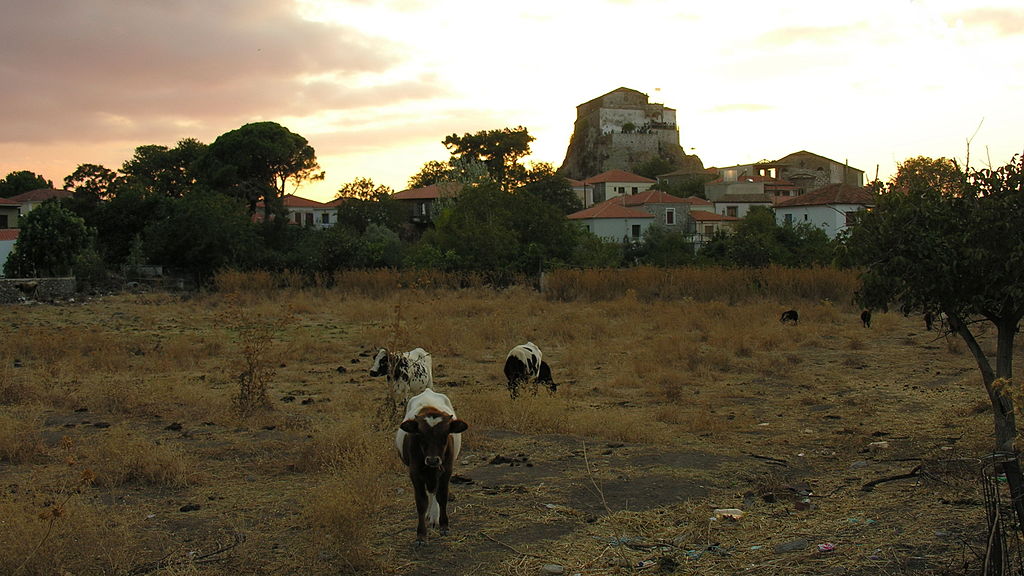
Image of cows in a field in Petra near a monastery.

Photo from Wikimedia Commons.

The final week of Murakami Fest 2024.

This next chapter, ペトラ (Petra), is a bit of a return to form. It’s a few pages longer than the previous chapters and Murakami hits the ennui notes that he’s been going for over most of the book, painting a subtle, muted portrait of offseason travelers taking things as they come in Europe.

After exhausting the sights in Mitilini, they take a bus to Petra where they take a room with a family through what may be the Women’s Cooperative of Petra. Murakami refers to it as 農業婦人会 (Nōgyō fujin kai, women’s agricultural association). They have lunch at a restaurant, see an uzo distillery, buy postcards, have coffee, watch the sunset, and then return to their hotel room where Murakami drinks brandy and reads Faulkner’s The Sound and the Fury. Not a bad way to spend the vacation.

It’s a nice chapter, with a few delicate portraits of the people they run into. Here’s how he ends things:

“You’re Japanese?” she said. “I met a lot of Japanese in Australia. They’re a clever people.” She shook her head sadly. Then she gazed out past the fields, almost like she could make out Australia just past the horizon. “Visit again sometime,” she said. “It’s quiet here. Next time you can take it easy.”

We will, I said. We want to visit during the summer next time.

“You don’t have children?” she asked, like she’d suddenly remembered.

We don’t, I responded.

She looked at us and then smiled. “But you’re still young.”

We packed our things and paid the bill. She seemed very embarrassed to take the money. I don’t know why. Maybe she hadn’t yet adjusted to working with customers like that. I gave her some coins from Japan and told her it was for the girl who had shown us the way. She thanked me and stared at the coins in her palm. “Sayonara,” we said. Then we left her behind in her silent, puddle of sadness.

That’s everything that happened in Petra.

「日本の方ですね。オーストラリアで沢山日本の人見ました。クレヴァーな人達」そして彼女は哀しげに首を振る。それから畑の向こうの方に目をやる。そのむこうにオーストラリアが見えるかしら、という風に。「また来て下さい」と彼女は言う。「ここは静かでいいところです。今度はゆっくりと来てくださいね」

そうする、と僕らは言った。今度は夏に来たいものですね。

「お子さんはいらっしゃらないの?」とふと思いついたように彼女は尋ねる。

いない、と僕らは答える。

彼女は僕らの様子を見て、それからにっこりと笑う。「でもまだお若いですものね」

僕らは荷物をまとめ、勘定を払う。お金を受け取る時、彼女はとても恥ずかしそうにする。どうしてかはよくわからない。まだそういう客を相手にする仕事に慣れていないのだろうか。僕は案内してくれた女の子にと言って日本から持ってきた小銭をあげる。彼女は礼を言って、手のひらに乗せたその小銭をじっと見る。「さよなら」と僕らは言った。そして彼女をその物静かなみずたまりのような哀しみのなかにそっと置き去りにした。

それがペトラの町で起こったことの全てである。 (310)

It’s starting to become more apparent that this is Bubble Era Japan. Obviously, the whole book is premised on this fact. Murakami, a mid-tier writer with a small but dedicated readership, could afford to close up shop in Japan, giving up many if not all of his regular writing gigs (one of the main points of the trip), and move to the Mediterranean for three years, living on a restricted budget. Room and board is 1,800 yen for the night and 500 yen for breakfast for two. Dinner for two is 1,300 yen and includes fish, salad, and wine. This only works if the yen is super strong. I’m sure that Norwegian Wood’s runaway success changed the equation a little, but it doesn’t seem to have hit yet. Something to watch for in coming chapters.

Vibes-cation

Year 1: Boobs, The Wind, Baseball, Lederhosen, Eels, Monkeys, and Doves
Year 2: Hotel Lobby Oysters, Condoms, Spinning Around and Around, 街・町, The Town and Its Uncertain Wall, A Short Piece on the Elephant that Crushes Heineken Cans
Year 3: “The Town and Its Uncertain Wall” – Words and Weirs, The Library, Old Dreams, Saying Goodbye, Lastly
Year 4: More Drawers, Phone Calls, Metaphors, Eight-year-olds, dude, Ushikawa, Last Line
Year 5: Jurassic Sapporo, Gerry Mulligan, All Growns Up, Dance, Mountain Climbing
Year 6: Sex With Fat Women, Coffee With the Colonel, The Librarian, Old Man, Watermelons
Year 7: Warmth, Rebirth, Wasteland, Hard-ons, Seventeen, Embrace
Year 8: Pigeon, Edits, Magazines, Awkwardness, Back Issues
Year 9: Water, Snæfellsnes, Cannonball, Distant Drumming
Year 10: Vermonters, Wandering and Belonging, Peter Cat, Sushi Counter, Murakami Fucks First
Year 11: Embers, Escape, Window Seats, The End of the World
Year 12: Distant Drums, Exhaustion, Kiss, Lack of Pretense, Rotemburo
Year 13: Murakami Preparedness, Pacing Norwegian Wood, Character Studies and Murakami’s Financial Situation, Mental Retreat, Writing is Hard
Year 14: Prostitutes and Novelists, Villa Tre Colli and Norwegian Wood, Surge of Death, On the Road to Meta, Unbelievable
Year 15: Baseball on TV, Kindness, Murakami in the Asahi Shimbun – 日記から – 1982, The Mythology of 1981, Winning and Losing
Year 16: The Closet Massacre, Booze Bus, Old Shoes, Editing Norwegian Wood, Prophecy
Year 17: Athens Marathon 1987, Infinite Appetites, Black Monday

A view of Mitilini, Greece, from the south.

Mitilini in 2010, via Wikimedia Commons.

In the next chapter, レスボス (Lesbos), Murakami continues his vibes-cation. He’s on Lesbos, as the title suggests, and there isn’t much to do. So they take a taxi outside the main town to see the Museum of Theophilus, a museum dedicated to the Greek folk artist.

Murakami seems impressed with the amateurish paintings and the way Theophilus is able to capture the awkward and frightening and suggestive, but part of the appeal is the moment in which he’s viewing the works. The Murakamis are the only people in the museum on a warm October day during the offseason.

They go to another museum right next door, which seems to be the Museum-Library Stratis Eleftheriadis-Tériade. Murakami describes it as containing works of Picasso, Matisse and others collected by a publisher who lived in Paris, which seems to correspond to Tériade.

They take their time, and when they finish, they head up the hill for a beer. Murakami ends the chapter in a nice way.

We go outside and up the hill a bit, go into the first kafenio we see, and order a cold beer. The beer is so cold it makes my eye sockets rattle. The afternoon is quiet, the light is warm. A tourist pamphlet notes, “Lesbos is known for having the most clear days in all of Greece.” I see a patrol boat heading into the port. A blue and white Greek flag flutters in the wind. Today feels like one of life’s sunny patches.

I wonder if someone could paint our picture. A 38-year-old writer and his wife, far from home. Beer on the table. Life is pretty good. And occasionally there are patches of sun in the afternoon.

外に出て少し丘を上がり、最初にみかけたカフェニオンに入って、冷たいビールを注文する。目の奥が痛くなるくらいよく冷えたビールである。静かな午後、暖かい光。「レスボス島はギリシャでいちばん晴天日の多いことで知られています」と観光パンフレットにはある。パトロール・ボートが港に入ってくるのが見える。青と白のギリシャの旗が風に揺れる。まるで人生の日だまりのような一日。

誰かが僕らの絵を描いてくれないかな、と思う。故郷から遠く離れた三十八歳の作家とその妻。テーブルの上のビール。そこそこの人生。そしてときには午後の日だまり。 (302)

It doesn’t feel as substantive as some of the other writing in the book, but it’s a nice little chapter. I do feel like the chapters have gotten shorter as we pass the midpoint of the book, which makes me wonder whether Murakami was writing these contemporaneously. We know that he kept a journal, so he very well could have written these out after the fact; the book wasn’t published until 1990. If he was writing them contemporaneously, however, it might make sense that we get these short, sparse vignettes rather than the extended travel writing at the beginning of the trip. These are maintenance pieces. Written after he finished literal and figurative marathons.

I think it again highlights exactly how quickly Murakami works. He left on the trip without having started Norwegian Wood, and finished it in less than a year. While traveling and writing (or at least journaling/taking notes) about everything he did while abroad. Say what you will about Murakami, but he’s not a slacker. These chapters, however, do feel a bit vibey and muted, but perhaps that’s what Murakami was going for.