不完全な述語

The newsletter is online which means there must be a podcast:

It’s an even month which means I’m revisiting past topics, which this month is my Japan Times article on incomplete sentences from May 2016. This is one of my favorites. I go through all the examples on the podcast.

At the very end of the newsletter this month I touch upon an interesting topic which is that English and Japanese seem to have different ways of referring to incompleteness when it comes to sentences.

English uses the following:

incomplete sentence

This gets rendered into Japanese as 不完全な文 (fukanzen na bun).

Based on what I’m seeing online, Japanese uses:

不完全な述語 (fukanzen na jutsugo)

This gets rendered into English as “incomplete predicates.”

And I think it’s interesting to note that in the article I mention in the newsletter, Naoko Taguchi refers to them as “incomplete utterances,” avoiding the sentence/predicate decision entirely, which I think may be more of a result of her focus on the spoken language. At any rate, for the blog, I thought I’d take a quick look at what exactly constitutes a Japanese 述語 (jutsugo, “predicate”).

I wrote about Japanese grammatical terms in Japanese back in October 2021 over on the old newsletter site, so I guess technically I’m looking back at two articles today. Unfortunately my copy of 日本語の文法 入門 (Nihongo bunpō nyūmon) by Murata Mizue (you can actually preview a good bit of it over on Google Books), the book I referred to for that newsletter, didn’t make it over to Japan with me this time.

Fortunately for me there was a very cheap copy available on Mercari, and I picked it up the other day. Since first reading this book, I’ve spent more time reading about Japanese grammar in Japanese, so I feel confident saying this book is one of the clearest and easiest to understand and at the same time presents all the complexities of Japanese grammar. I highly recommend it.

So what does this book say about 述語?

I do feel like predicates can’t be captured simply, which is evident if you look at the Japanese Wikipedia entry for 述語. So unfortunately there’s not one section with a super clear definition. I did manage to find two sentences near the beginning that sum up what’s going on:

述語は文を締めくくる大切な要素であり、それには、動詞、形容詞のほかに、「名詞+判定詞(だ/である/です)」があります。 (30)

Jutsugo are an important element that conclude a sentence and include verbs and adjectives as well as nouns combined with hanteishi (copula) (da/de aru/desu).

So essentially, a predicate is a verb, adjective, or noun + 判定詞 that come at the end of a sentence.

Murata offers this summary as well:

文は、述語の種類によって、動詞文(動詞述語文)、形容詞文(形容詞述語文)、名詞文(名詞述語文)と呼ばれます。 (30)

Depending on the type of predicate, sentences are referred to as verb sentences (verb-predicate sentences), adjective sentences (adjective-sentence predicates), or noun sentences (noun-predicate sentences).

I think this is an incredibly helpful way to think about Japanese. We all know the important bit comes at the end, but this really puts that into black and white. You can only have three types of Japanese sentences, and they are divided up based on the predicate (what comes at the end).

Although I guess an incomplete sentence/predicate is the fourth type of sentence you can have, and as I go over in the podcast, there are a ton of varieties. I’d like to write about them and about predicates in further detail at some point in the future.
More on だけ

Quick follow-up on my newsletter from last month about the particle だけ (dake).

I mostly discussed the non-“only” meaning of the word, which can be replaced with くらい (kurai) or ほど (hodo), but I do want to mention an aspect of the “only” だけ that I think is subtle and takes a while to fully digest.

And that point is this: だけ does not imply any value judgement or evaluation. I think in effect this means that, on its own, だけ doesn’t inherently express “merely X”/“no more than X.” It’s a more objective delineater…perhaps closer to “exclusively.”

There isn’t much out there about this particular aspect. The closest I can find is this JLPT website, which compares the usages of だけ and にすぎない (ni suginai, no more than/merely). Take a look:

– 「~にすぎない」と置き換え可能。(例)ちょっと手伝った(〇だけだ 〇にすぎない)よ。

– 名詞の場合は、置き換え不可。(例)アルバイトの給料は、ほんの3万円(×だけだ 〇にすぎない)。

– 「~にすぎない」との違いは、「~だけだ」は話者のつまらない・価値が低いという気持ちを含まない。

But let’s look at the example sentences provided in the first point; I think there’s a slight difference:

ちょっと手伝っただけだよ。 (I only helped a little.)

ちょっと手伝ったにすぎないよ。(I did nothing more than help a little.)

The second point is really critical. This is an unnatural sentence: アルバイトの給料は、ほんの3万円だけだ —> You can’t use だけ to say “I only earn 30,000 yen at my job.” Because it has that evaluation/value judgement aspect, you have to use すぎない.

This is made clear in the third point, the critical part of which I bolded above.

So it’s worth being careful with your だけs. I’ll report back if I can think up any other examples. For now, I think it’s worth mentally substituting “exclusively” for “only” to test the implication of a sentence.

文末 Nuggets

My March Japan Times Bilingual piece is up: “Avoiding the subject isn’t such a bad idea in Japanese.”

Inspired by a question on Twitter, I take a look at how to avoid using subjects in Japanese. (Hint: Just ignore them mostly.) Besides just leaving them out, there are a ton of phrases in the language that promote concision, notably a few handy 文末 phrases. I address そうだ and ようだ in the piece, but らしい and みたい are also very effective in similar roles.

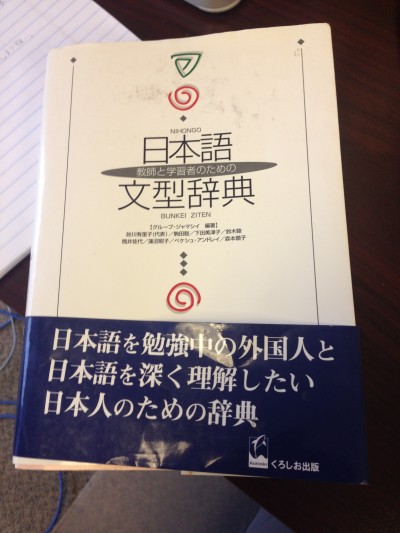
They all have subtly different usages, so it can be helpful to look at Japanese definitions. These are all from the wonderful 日本語文型辞典.

2015-03-03 09.44.21

Do your best to ignore my awful translation.

ようだ

…ようだ 〈推量〉

ものごとについて話し手がもつ印象や推量的な判断を表す。ものごとの外見や自分の感覚について「何となくそんな感じがする/そのように見える」というふうに、その印象や外見をとらえて表現するもので、話し手の身体感覚・視覚・聴覚・味覚などといったものを通してとらえられた印象や様子を述べたり、そのような観察を総合して話し手が推量的判断を述べるような場合に用いる。

すでに述べたことがらを受ける場合は次のように「そのようだ」「そんなようだ」が使われる。(618)

…ようだ

Expresses a speaker’s impression or estimation-like judgment about something. Presents the impression or external appearance (of something) according to the external appearance (of the thing) or the speaker’s senses and suggests “It kind of seems that way/It looks that way.” Used when a speaker gives an impression or condition (of something) taken from the speaker’s sense of touch, sight, hearing, smell, etc. and when making other observations like that to give the speaker’s general, estimation-like judgment.

The following patterns are used when responding to things that have already been mentioned: 「そのようだ」 and 「そんなようだ」

らしい

…らしい

文末に付いて、話し手がその内容をかなり確実度の高いことがらであると思っていることを表す。その判断の根拠は外部からの情報や観察可能なことがらなど客観的なものであり、単なる想像ではない。 (632)

…らしい

Appended to the end of sentences to express that the speaker believes the content has a very high level of certainty. The basis for that judgment is objective, such as outside information or something that is observable, not simply imagination.

そうだ

そうだ

普通体の節に続いて、自分が直接得たことではなくどこかから入った伝聞情報だということを表す。否定や過去の形にはならない。

そうだ

Added on to 普通体 (direct style) clauses to express that (the clause) is not something you received directly but reported information that came from somewhere else. Does not form negative or past tense constructions.

みたいだ

…みたいだ 〈推量〉

話し手の推量を表す。「はっきりと断定はできないが、そのように思う」という意味。話し手が、何かを見たとか、音を聞いた、匂いをかいだなど自分自身の直接経験したことをもとに推量したことを述べる表現。

これに対して、他の人から聞いた話など間接的な情報にもとづいた話し手の推量を表すときには「らしい」が使われ、聞いたことをそのまま報告する場合には「そうだ」が使われる。 (562)

…みたいだ

Expresses a speaker’s estimation. Means “I can’t tell for certain, but that’s what I believe.” An expression used to give an estimation based on something the speaker directly experienced, such as they saw something, heard something, or smelled something.

Conversely, 「らしい」 is used when expressing the speaker’s estimation based on indirect information, such as something heard from another person. 「そうだ」 is used when reporting something exactly as it was heard.

I’ve been wanting to post something like this for a while. I actually drafted it way back in 2009 (typed out the sections from the 文型辞典) but lost the post to a hard-drive crash and have been too lazy to get it together since.

I think it’s helpful to look at things like this explained in Japanese. The book also has a ton of great example sentences. Definitely a must-own for any students of Japanese who make it beyond the intermediate level.

Still, it’s one thing to know the dictionary definition of these patterns and another thing entirely to put them into practice. The occasional reminder from texts like the 文型辞典 can help us be mindful of the usages. Now get out there and get reporting indirectly and judging subjectively!

Japanese Adverb POWER RANKINGS

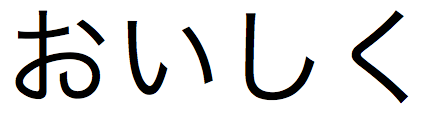
oishiku

I have a new column up on the Japan Times: “Particles create the chemistry of adjectives and adverbs.”

I actually drafted a blog post along these lines (with the whole chemistry analogy) way, way, waaay back in the day (when I was posting thrice weekly) but lost it to a hard drive crash. I remembered it recently because I was thinking about おいしく.

I loved the way that my roommate used the word—I don’t think I’d ever heard it used that way before. A quick Google search shows 4 million plus hits for おいしそうに and only 618,000 for おいしく, so it is somewhat odd/infrequently used. Each of those could technically be translated as “deliciously,” depending on the context.

This all inspired me to put together a quick power rankings of Japanese adverbs. Here you have it:

5. 悔しく
4. 適当に
3. 早く
2. おいしく
1. ちょっと

I assume that 悔しく gets used? It’s one of my favorite adjectives, so I put it on the list. 適当に is another fave, and I’ve written about it in the past. 早く takes third mostly because I was imagining a whiny kid saying 母ーさん、早く〜(HAyaKUUUU). おいしく is wonderful, as I previously mentioned.

I think the reason why おいしく and perhaps 悔しく are so interesting as adverbs is that as adjectives they are more “performative” rather than “descriptive.” 悔しい is what someone says when something sucked. おいしい is what someone says when something is delicious. They are connected equally (if not more so) with the state of the partaker as with that of which is partaken; in other words, how the partaker feels having partaken (in something delicious or a shitty experience).

Other adjectives such as 暑い, 遅い, 静か, etc. are more objective and relate to the object only. Adjectives don’t always work this way in English: Saying “that was delicious,” while equally subjective, feels closer to my bowl of ramen than うまい or おいしい does. …if that makes any sense.

Of course, only ちょっと can be the number one. I love it because of its frequency and variety of use and because it is one exception to the beautiful uniformity of く and に adverbs.

Are there any others that I’m missing?

投げそうだった!

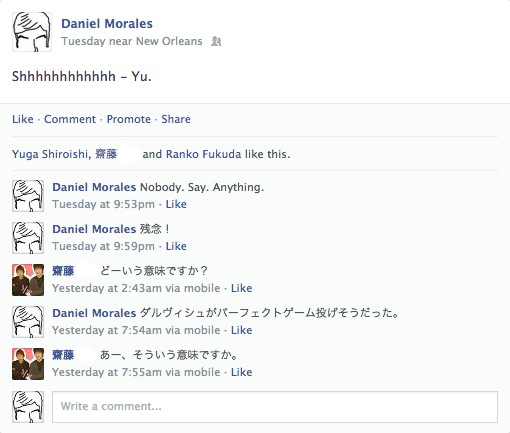
I don’t even like baseball, but I couldn’t help but follow Yu Darvish’s near-perfect game the other night. Thanks to the ESPN app on my phone, I was notified after six perfect innings, and because I live in the south, not far from Houston, FOX Sports Southwest was showing the game. So I was able to watch the eighth and ninth innings live. At some point I posted on Facebook: “Shhhhhhhhhhhhhhhh – Yu.”

As an isolated post this might have looked like I was quoting Yu or something, so immediately underneath it I provided an explanation: “Nobody. Say. Anything.” When the perfect game was destroyed, I added 残念!

Later on, well after that, one of my former students (a kid I taught when he was in second through fifth grades of elementary school!) commented on the post, and I had a chance to use one of my favorite grammar patterns:

nagesou

投げそうだった!

He almost threw a perfect game!

The pattern always reminds me of the time when I nearly finished beating a tanuki to death on the rural roads of Fukushima Prefecture. This is such a fundamental misunderstanding of the word ほとんど that it’s almost embarrassing (my continued misuse of the word “tense” is also embarrassing), and to this day always makes me remember that there is no such thing as perfect translation. Those two phrases above are the best ways to express how close Darvish came to perfection, but they don’t equal each other. They are, however, pretty damn good equivalents.