
We have the title for the new Murakami novel due out on April 13! It’s the same title as a 1980 novella that Murakami disavowed as a “failed work” but later rewrote as Hard-boiled Wonderland and the End of the World. Here’s what we know about that novella, and here are my best guesses about what we could be getting next month.
Category Archives: podcast
SWET Event – Blogging, Podcasts, and Translation
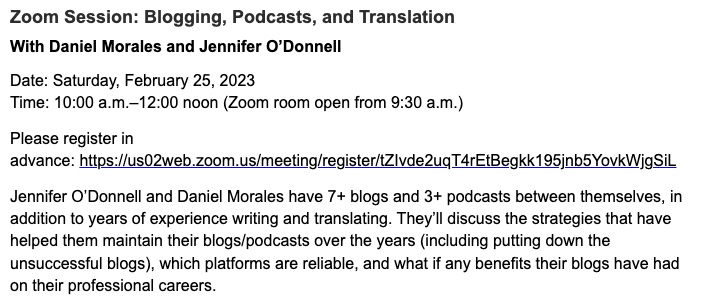
Last minute notice, but I’ll be participating in an event for SWET (Society of Writers, Editors, and Translators) this Saturday Japan time (Friday evening U.S. time). Really excited to talk about this topic, given that starting this website basically changed my life and set me on the path that guided me to my current career. Without it, I’m not sure what I would’ve ended up doing. It’s difficult to believe that I’ve been posting here for 15 years as of this month/next month. Here’s to 15 more.
Check out the link to the event here to register.
Podcast Appearance – Translation Chat on Hard-Boiled Wonderland and the End of the World
I was on Translation Chat, Jenn O’Donnell’s new podcast about translations! Check out the podcast here.
This was so much fun. We talked about Alfred Birnbaum and Elmer Luke’s 1991 translation of Haruki Murakami’s 1985 “Hard-Boiled Wonderland and the End of the World,” so I had a chance to review my six-year Hard-Boiled Wonderland Project—my close blogging of a comparison with the original Japanese and a look at the changes that Murakami made in revision for his Complete Works edition.
Looking back at my close reading, it’s clear that I was working on limited information. Of note, I did not know when the translation was completed in relation to the Complete Works edition.
Well, I have that information now. David Karashima mentions it in his book, and apparently I missed it my first time through. I re-read the chapter about HBW in preparation for the podcast, and it’s very clearly stated that the translation was completed in 1991 and actually took longer than anticipated. At that point, the Complete Works version had already been published. Actually, Murakami mentions in his pamphlet essay included with the Complete Works volume that the book was in the process of being translated but had not yet been published. He also notes that the publisher wanted to title it “Hard-boiled Wonderland,” and of course he said no.
This has pretty cool implications: Birnbaum and Luke were translating based on two versions of the original text. I’m fairly certain that they had access to the 1985 original and Murakami’s revisions. Take a look at Chapter 15, for example. There’s a short stretch in English that includes lines from the 1985 version that were cut from the 1990 version and a sentence from the 1990 version that was not originally in the 1985 version.
This makes me very curious to see what Jay Rubin does with his translation. Yes! He’s working on a new translation. I somehow neglected to mention this during the podcast.
It’s so cool to get all of my HBW knowledge out there in audio format. I did a re-read of the book for the episode, and it was the first time in over ten years that I actually did a relaxed read of (mostly) just the English translation. It really is an incredible piece of art. It’s not perfect, but neither is the original. That’s actually something that really struck me: Murakami’s original is very flawed, but I’d also argue it strikes a better balance between ambition and execution than The Wind-up Bird Chronicle.
Murakami admits the book has flaws. In the Complete Works commentary, he writes about recognizing the 参ったな部分 (literally: “the places where I thought ‘Oh damn’”) as he was re-reading it and about its 完成度 (degree of completion) not being what it could be. So he couldn’t stop himself from making revisions. But by and large they are cosmetic changes.
Thanks so much to Jenn for having me on. She was on the second season of the How to Japanese podcast earlier this year.
And I would be remiss if I didn’t mention that I discussed the Murakami Complete Works on the How to Japanese podcast episode with Molly Des Jardin. We didn’t get into it too deeply, but it’s fascinating to think what a true Murakami Complete Works could look like. There would be so much MORE writing in it!
Fortunately for us, Osakabe Yoshio is (was?) the biggest Murakami fan on the planet and kept a very detailed track of everything that Murakami published early in his career. (I believe he even ran a marathon with Murakami at one point!) His Geocities website is gone but is archived on Archive.org (see here: 村上春樹全作品リスト Part 1 and Part 2). I would recommend saving a PDF copy if you want to make sure it sticks around. I have one that maybe I’ll try to translate and put online sometime. Maybe a good project for a vacation sometime next year. For now, I’m going to give it another close look and cross my fingers that I have a chance to make it to the National Diet Library if and when I make it to Yokohama.
How to Japanese Podcast – S02E20 – Instinctual Nattō and Introversion
On the final episode this season, I talk about the importance of celebrating your little victories as you study a language. And in Japanese, I think about how to balance introversion and extroversion as you’re studying. Listen until the end – I provide a short update on one of the episodes from Season 1.
How to Japanese Podcast – S02E19 – Jens Petersen – Japanese in Sweden, Music and Art, Job Fairs
Jens Petersen has been working in real estate in Tokyo for over 13 years. He initially found interest in Japanese independent music. In recent years his interest has also branched out into the art world. We spoke about learning Japanese, finding an immersive environment, and job hunting at job fairs.
- Cornelius (Keigo Oyamada)
- Swedish university
- Full-time focus on the language
- “Stuffing the sausage full of knowledge”
- Genki Japanese
- Flashcards
- Studying English and foreign languages in Sweden
- Compulsory English
- Optional second foreign language from 6th/7th grade
- Finding Japanese immersion through a shared interest
- Importance of getting out of the exchange student community
- University “circles”
- Shibuya-kei
- Escalator Records
- Kaji Hideki
- Warp Records, Aphex Twin
- Journalism work in Tokyo
- JASRAC (Japanese Society for Rights of Authors, Composers, and Publishers)
- Job hunting in Japan
- Job fairs for bilinguals
- Boston Career Forum
- Job interviews
- Japanese resumes
- Real estate and facilities management/occupancy planning in Japan
- Art in Japan
- Museums
- Galleries
- Roppongi Hills
- Warehouse TERRADA – Tennōzu Isle
- Bakurochō
- Japanese art in Chicago
- Gutai group (this is the art movement Daniel was referring to)
- Karaoke song
How to Japanese Podcast – S02E18 – 都道府県 and 貪る
There is an official order to the 都道府県 (todōfuken, prefectures) in Japan. I share some thoughts about it and in Japanese discuss the importance of learning how to really devour (貪る, musaboru) your Japanese studies.
This is a nice post with a close look at the numbering. Here is the official website for the 全国地方公共団体コード. And I previously wrote about the alphabet in Japanese.
How to Japanese Podcast – S02E17 – Molly Des Jardin – Japanese the Spoken Language, Meiji Era Writing, 全集
Molly Des Jardin is a language and computer nerd who came to study Japanese, and later book and media history of modern Japan. She quickly got sucked into both for the long term and enjoyed the ‘B-kyu’ adventures she got to have while working or studying in Fukuoka, Yokohama, and the least cool wards of Tokyo.
- “Inventing Saikaku: Collectors, Provenance, and the Social Creation of an Author“
- Japanese: The Spoken Language
- University of Pittsburgh Japanese
- No notes allowed
- Middlebury Language Schools – Japanese
- “Learning how to be wrong”
- 「 お聞きしたいんですが」 (I’d like to ask you a question…)
- 「パンになさいますか?」 (Would you like bread?)
- 「左様でございます」 (That is correct.)
- Learning written Japanese/how to read
- Inter-University Center for Japanese Language Studies
- Constant exposure and need to write at Middlebury
- Remembering the Kanji, James Heisig
- Adult learners of Japanese as a second language
- JET Program
- Fukuoka
- ESID (Every Situation is Different)
- Application process
- Reading
- Woman on the Other Shore, Kakuta Mitsuyo
- 夢十夜, Natsume Sōseki
- Meiji-era Writing
- Most-read Meiji writing during the Meiji era: Ozaki Kōyō
- Language in flux
- Morohashi’s 大漢和辞典
- “If you can get 15-20% of any novel, you’re doing great.”
- 変態仮名 (Hentaigana)
- Higuchi Ichiyō
- Mori Ōgai
- 言文一致 (Genbun itchi)
- Molly recommends the book “Language and the Modern State: The Reform of Written Japanese” by Nanette Gottlieb for more on the topic.
- Futabatei Shimei, 浮雲 (Ukigumo)
- Yamada Bimyō
- 全集 (Zenshū “Complete Works”)
- Orthography choices during reprinting
- 一葉全集 (link to the Ichiyō Zenshū at the National Diet Library)
- Osakabe Yoshio’s 村上春樹全作品リスト Part 1 and Part 2
- National Diet Library
- Ihara Saikaku
- Museum of Modern Japanese Literature
- University of Tokyo Library System
- 廃墟 (Haikyo “ruins”)
- Not mentioned in the podcast, but Molly recommend this link for detailed background on the haikyo boom.
- ムック (Mook)
- B級
- 団地 (danchi)
- Gunkanjima
- Junkudo bookstore in Ikebukuro
- ワンダーJAPAN
- 土木フォトグラフィ (Doboku Photography) (Not mentioned in the pod, but recommended Instagram account from Daniel for infrastructure.)
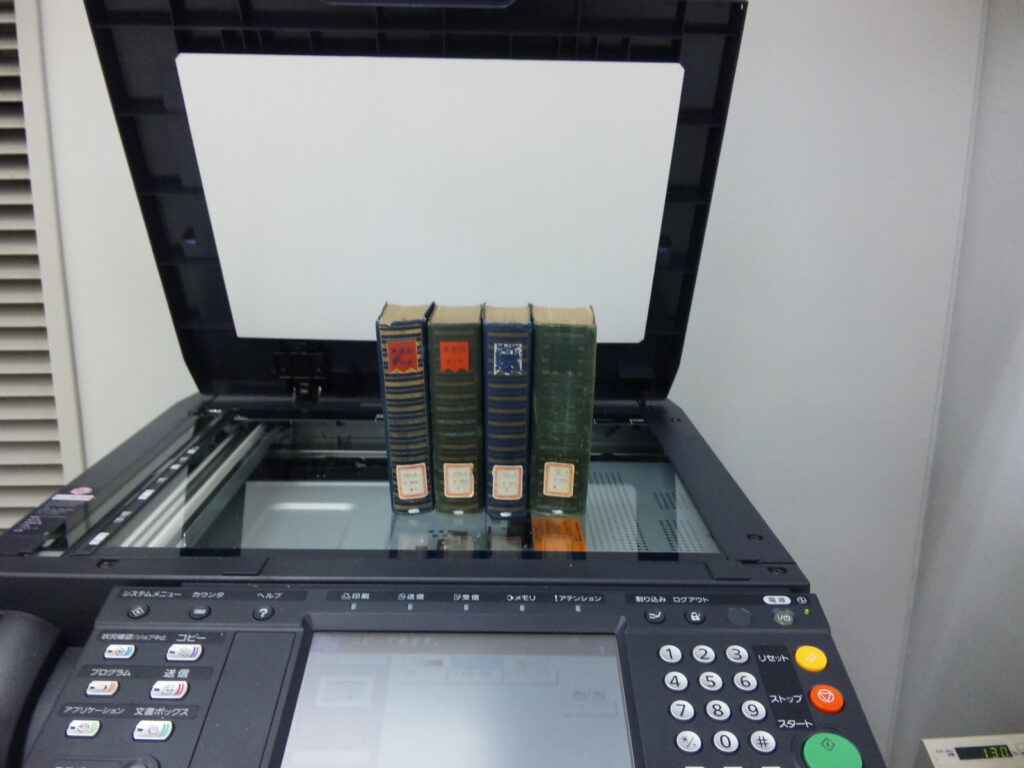 Courtesy of Molly, this is a photo of Ozaki Kōyō’s four-volume 紅葉集 (Kōyōshū), pub. Shun’yōdō (春陽堂) 1909 and how one who access the original text (in its original binding!).
How to Japanese Podcast – 号外 – Pre-JET Japanese Triage
Extra extra, read- er, hear all about it! Special edition of the How to Japanese Podcast! This is an audio version of a presentation I gave to departing JETs at the Consulate-General of Japan in Chicago. Usually I’m able to drill the JETs to get them speaking a little Japanese. Obviously it’s virtual this year, so I recorded a version to use as reference. This material might be useful for others interested in teaching in Japan. Follow along with the slides, which can be accessed here.
How to Japanese Podcast – S02E16 – Pools and 趣味
What’s something that surprised you about Japan that was completely ordinary? For me it was the access to swimming pools. Living in Japan changed my relationship with swimming for the better. And in Japanese, I talk about 趣味 (shumi, hobbies/interests) and their role in Japanese study.
How to Japanese Podcast – S02E15 – Mike Grant – Learning by Ear, Craft Brewing in Japan
Mike Grant is the co-founder of Devil Craft brewing and has been operating in Tokyo for 10 years as of this year. Devil Craft has four locations in the Tokyo area. See Craft Beer Professional’s interview with Mike here.
- “Learning by ear” + Six months of classroom Japanese after an initial stint in Japan
- Practicing and “playing around” by imitating accents in English
- Being able to take criticism of both language skills and brewing skills
- AQ Bevolution – Albert Kuwano
- Learning how to homebrew
- Experimentation
- Online recipes
- Homebrew books
- Developing a familiarity with malt
- Licensing for brewers
- Previous experience or apprenticeship at current brewery
- 6-9 month process for licensure
- Brewing system must be on-site and ready to go; license goes with the physical location
- Recipes must be submitted one day in advance
- All equipment must be registered; limits mobile canning
- Homebrewing in Japan
- No political motivation to change the current laws; no constituency
- Japan = fermentation mecca
- State of the craft beer market in Japan
- Daniel’s 2016 article on Japanese craft beer
- 400+ breweries in Japan
- Lots of breweries that are 50-500 liters in size that are in the industry to brew beer rather than to make omiyage
- Demographics are working against craft beer
- Tanakaya in Mejiro
- Chuhai’s place in the Japanese market
- Barrel-aging and mixed culture brewing
- Yeast in Japan
- Brewing conferences, collaborations, and associations
- Breaking into the craft beer market in Japan