How to Japanese

How to Japonese
How to "Get Used to" Japanese

Archive for the ‘food’ Category

« Older Entries
Newer Entries »

Natto Experiments

Monday, June 22nd, 2009

Three ways to spice up your nattō experience:

Natto Experiments from Daniel Morales on Vimeo.

Garlic Nattō – This is the only original recipe of the three. I came home Tuesday after work feeling sick and decided that I was clearly suffering from garlic insufficiency. I didn’t have much else in the fridge other than a couple of packages of nattō, and thus garlic nattō was born. It actually does a surprisingly good job of covering up the beany funk. You can add red pepper to taste (add after turning the flame off). Not bad. Final answer: ★★

Avocado Wasabi Nattō – This was recommended by a former classmate. I often eat avocado alone with wasabi-jōyu (I love saying that word… wasabi-jōyu) as a side dish for sushi or other Japanese food. One of the English teachers I worked with in Aizu recommended it to me. He said it tastes just like maguro, which it kind of does! It’s not a bad match with nattō, either. Next time I’ll be sure to use a larger portion of wasabi-jōyu, you can see in the video that the portion I use just barely covers the avocado. Final answer: ★★★★

Cheese Nattō – My town used to serve this for school lunches sometimes. The cheese they used was white and much milder. Cheddar has a better bite to it. It doesn’t mask the nattō funk as much as the garlic, but it does give it a cheesy kick. Pretty tasty. I had a small serving of niku-jaga as a side dish, a very nice match. Final answer: ★★★

Tags:beany funk, fermented soybeans, natto
Posted in food | 9 Comments »

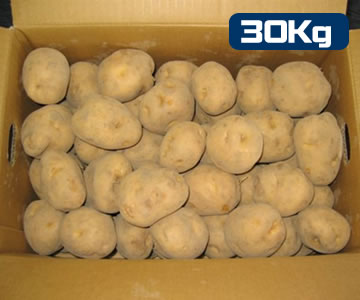
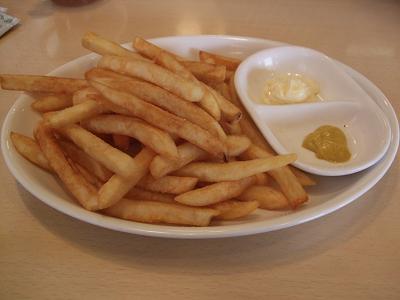
じゃがいも ≠ ポテト (Updated)

Friday, June 19th, 2009

じゃがいも      =   imo

ポテト              =   potato

Google Images provides overwhelming proof: じゃがいも, ポテト. You can add フライド in front of the latter, but it’s unnecessary.

Updated to reflect that いも actually refers more generally to tubers.

Posted in food, get used to it!, vocab | 4 Comments »

Katsuretsu-an Update

Monday, June 15th, 2009

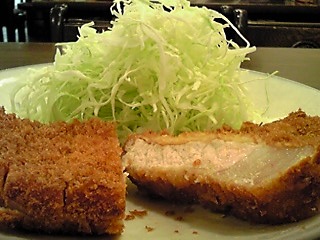
I went back to Katsuretsu-an this weekend, this time at the branch in The Diamond, one of the 50 shopping malls attached to Yokohama Station. The first time I went, I ordered the ヒレ, which is named after the store. This time I went with a ロース cut, and I think it was the best ロース I’ve ever had. The ヒレ was the thinnest of the three katsu I tried back in January. The ロース isn’t much thicker, especially compared with cuts from other stores, but it was the cleanest ロース cut I’ve ever seen, and I think this is evident even from the camera in my phone:

roastkatsuretsuan
Generally with ロース cuts there are bits of fat all through the pork, some of them kind of tough and rubbery. This cut, however, was perfect; all of the fat was on one side, and the rest of the meat was lean and moist. The batter had been fried perfectly, nice and crisp but not too oily. The fat had been almost liquefied within the batter, so it basically melted in my mouth. I hate that sensation of chewing rubbery fat, so I generally order ヒレ, but at Katsuretsu-an, ロース is definitely the way to go.

Less than 100 pages to go in 1Q84!

Tags:tonkatsu, ロース
Posted in food | No Comments »

号外 – Mikan Spotting

Sunday, May 17th, 2009

salmonellamen

I believe I’ve spotted mikan in translation while reading Yasutaka Tsutsui’s collection of short stories Salmonella Men on Planet Porno:

“You know,” said my wife as I made for my sixteenth tangerine. “We could do with a new television.” (80)

16 tangerines sure seems like a lot, but when you realize that it’s mikan, it doesn’t seem so bad. I can and have eaten quite a few in one sitting…I’m not sure about 16, though. I wish mikan were well known enough to translate them as is into English.

I’ve recommended mikan in the past, and now I can also recommend Tsutsui’s collection.

Tags:mikan, Yasutaka Tsutsui
Posted in food, literature | No Comments »

仁亭

Friday, April 24th, 2009

Sometimes there’s a man – I won’t say a hero, ’cause what’s a hero? – but sometimes there’s a man. And I’m talking about the Master here – sometimes there’s a man who, well, he’s the man for his time and place. He fits right in there – and that’s the Master at Jintei in Koriyama:


仁亭 from Daniel Morales on Vimeo.

I debated whether or not to make a video of Jintei for a while. It’s a small yakikatsu restaurant, and I wouldn’t wish even one unpleasant customer on the Master (not that I could cause him to get any more attention than he already has). I finally decided to make the video for a couple reasons. First, in twenty years I’ll want to look back at this video and just go, Damn, we ate some tasty katsu at that place. And second, the Master is well-equipped to deal with the attention of any unruly customers, whether they be Japanese or foreigner. Regular customers are well aware that the restaurant’s queue runs on the honor system. There are benches, groups of chairs, and many people even wait in their cars if the weather is uncomfortably hot or cold. Noobz will peek in the door or even ask the Master what the deal is – wtf is everyone doing just chilling outside? – but he always just replies that he takes customers in the order they arrived. There’s no need to form an actual line, the Master knows.

(This last time I went, a Japanese couple pulled up in a big van and parked blocking several cars in the lot. The guy was clearly starving – he had his wife jump out and figure out what the deal was. There were several groups of people waiting, but after looking inside, this lady camped out right next to the door, probably thinking she’d be the next one in. Her beau finally got out and went in himself, probably convinced that the other half dozen of us were just sitting outside in the nice weather. The Master came out of the restaurant, the first time I’ve ever seen him do that, and personally assured that the next people in line got in ahead of them.)

I kept the video text-free because anything I could write would only detract from the katsu, so I’ll try to keep this post short, too. Just take this one piece of advice – unless you live within walking distance of this place, the only two items on the menu you should even consider ordering are the “Jintei Special Pork” or the “Jintei Special Chicken.” (The actual Japanese names for these are 仁亭凡焼きかつ and 仁亭チキン焼きかつ, and they are on the far right of the menu, which is printed on a fan.) These are the yakikatsu, either chicken or pork, which are stuffed with cheese, a slice of ham, and leaf of basil. They inspired my love of the katsu.

(Oh, and one more thing – the correct salad dressing ratio is two scoops of the creamy dressing for every one of the dark one with peanuts.)


大きな地図で見る

Tags:fukushima, jintei, koriyama, tonkatsu
Posted in food, video | 4 Comments »

Tonkatsu Update Part Deux

Monday, April 6th, 2009

Although tonkatsu is a good hangover cure, I was unsure whether I could actually hold them down yesterday – I was suffering from the wicked aftereffects of Saturday’s excellent hanami. After returning to human form, I remembered Maisen’s 限定 circular sandwiches in the GranSta in the basement of Tokyo Station. These are nice and small, a perfect snack serving size:


There’s also a yolky egg stuffed inside:

Not a bad buy at 470 yen. My only complaint is that they bag them while they’re hot, so the steam condenses on the inside of the bag and makes the bread slightly moist.

Posted in food | No Comments »

Tonkatsu Update

Friday, February 27th, 2009

I had a chance to revisit Maisen (see tonkatsu post) while my folks were in town. I can confirm that there is indeed karashi mustard provided in a jar and that the regular tonkatsu are just as tasty and significantly cheaper than the 黒豚 version (nearly half the price at around 1700 yen).

Also, there is a Maisen in both the Daimaru department store near the Yaesu North Exit of Tokyo Station and in GranSta, both of which I rave about in this post. Actually, at the GranSta store they sell a circular tonkatsu sandwich available only at the GranSta shop. Worth remembering if you’re hungry and happen to be catching a train at Tokyo Station.

Posted in food, random | No Comments »

Underrated Japan Vol. 3 – Tonkatsu

Monday, January 26th, 2009


How to Japanese: Underrated Japan Vol. 3 – Tonkatsu from Daniel Morales on Vimeo.

I can pinpoint the exact moment I fell in love with tonkatsu: tired and probably slightly hungover, early afternoon on a clear, cold Saturday in February 2006, Koriyama, Fukushima Prefecture. My friend said we should go to this restaurant near his apartment, but I was skeptical. I’m not sure if I’d ever had tonkatsu before that. I must’ve had katsu curry (rice and tonkatsu ladled with curry) at some point, but it didn’t leave much of an impression on me. We went, stood in line for an hour, and then sat around a table listening to oldies, eating the best food I’ve ever had.

From that day on, tonkatsu were a landmark on my Japanese culinary map. Growing up vegetarian (until I was 12 or so) and in a city with little other than sushi, there’s no reason I would’ve known about tonkatsu before coming to Japan. The yoshoku phenomenon (must read Norimitsu Onishi article on yosohoku) on the whole doesn’t really make it out of Japan. And I guess that’s not really a strange thing: why would an imported food concept be exported back to the area of origin? (I’m sure this happens all the time, to be honest, but…) It’d be like translating English into Japanese on Babelfish and then taking that translation and plugging it into the Japanese to English Babelfish translator. The result would only confuse the natives.

But what if it was an incredibly tasty confusion?

That’s exactly what tonkatsu is. To be more accurate, tonkatsu is pork cutlet battered in egg, covered with panko, and then deep fried. It’s served with white rice, red miso soup, cabbage salad, and some pickled vegetables. The cutlets are covered in sauce and dipped in karashi, a spicy horseradish mustard. The result is almost sinfully delicious. For anyone who thinks Japan is a tofu nation perfect for vegetarians, tonkatsu are one of many dishes that will prove that you are seriously misinformed – the Japanese are, in fact, carnivorous, deep-frying motherfuckers.

Rather than have you all risk clogging your veins with less than the absolute highest quality tonkatsu, I have sought it out for you:


とんき (Tonki)  目黒区下目黒1-1-2

大きな地図で見る
Tonki is supposedly the most famous tonkatsu-ya in Tokyo. The main store is just a quick walk from Meguro Station. They open at 4pm everyday, and generally the seats are full by 4:15. I went on Sunday, January 4th for 初カツ, the first tonkatsu of the New Year, and was the second person in line. There was only one guy behind me, but somehow the place still filled up by 4:15.

The store is lit by an array of clean, white lights that hang from the ceiling. The staff all wear crisp white uniforms and keep a careful watch on all of the customers seated at the smooth, wooden counter – the only seating in the store. Tonki easily had the best service of these three restaurants; I was offered refills on rice and salad almost immediately after I finished eating them.

As in most tonkatsu-ya, there are really only two things to order – ロース or ヒレ. ロース comes from the word “roast,” and ヒレ from “fillet.” The former is a fatty cut, the latter a lean cut. Teishoku of either cut at Tonki cost 1800 yen.

Tonki batter their katsu pretty good and fry it up nice and crispy – the fried edge was falling off of the pork. Interestingly, they also serve their teishoku with 豚汁, a miso-based pork soup, rather than the standard red (dark) miso soup with clams.

Tonki is legendary for a good reason: the place is an experience. The katsu themselves might not have been my favorite, but this will probably be the first of these three that I revisit. The decor and service are amazing, presentation is exquisite, and all the little things are taken care of; the toothpicks are covered with a small, glass beer cup and they serve you a small dish of peanuts with beer – details like that.


まい泉 (Maisen) 渋谷区神宮前4-8-5

大きな地図で見る
Maisen is the second most famous tonkatsu-ya, according to bento.com. The main restaurant is in Aoyama, not far from Omotesando Station. The building is huge; there’s a counter on the first floor and tables on the second floor.

The service is not quite as top notch as Tonki, but Maisen has a menu with more options, including a gluttonous cut of 黒豚 – black pork. For whatever reason, black pork is popular in Japan at the moment. It will run you nearly 3000 yen for a teishoku, but it’s a thick, juicy cut, and probably the one that impressed me the most. (Their normal teishoku are more fairly priced but don’t include the mikan-flavored ice cream you get at the end.) They also bring out a special sauce jar just for the black pork, which has, I think, grated daikon in it.

They didn’t provide any karashi on the plate, although it might have been in a jar on the counter – I was so hungry that I didn’t notice. It was so delicious that it was almost unnecessary, but I love karashi, so I imagine it could have been even better. Oh well, I guess I’ll have to go back some time and find out.


勝烈庵 (Katsuretsu-an) 横浜市中区常盤町5-58-2

大きな地図で見る
Katsuretsu-an (it almost looks Chinese if you write it Katsuretsuan) is, according to Japanese Wikipedia (which cites an interesting-sounding book on tonkatsu), one of the restaurants that is often associated with the invention of the term “tonkatsu.” There are two other restaurants that also seem to claim the term as their own, but Katsuretsu-an is the oldest – the Bashamichi location opened in 1924.

Compared to Maisen and Tonki, Kasturetsu-an was relatively quiet when I went on a Saturday for lunch. The place is very nice on both the outside and the inside; it is equipped with a similar wooden counter as in Tonki.

It also shares a relatively limited menu with Tonki. The special named after the restaurant is really a ヒレ cut, but ロース is also an option. The katsu were thinner than the ones at Tonki and Maisen. Karashi was serve yourself, which made me very happy. Overall, they were nice and light and didn’t sit heavy afterwards at all. Perhaps not katsu with much impact, but definitely worthy of a pilgrimage at some point.

Posted in food, underrated japan, video | 6 Comments »

Underrated Japan Vol. 2 – Mikan

Wednesday, January 21st, 2009

The idea of doing a homestay during a study abroad program is appealing to me now that I’m past my college years. Back when I actually studied here, I was far more interested in running around Tokyo than sitting around talking with old people who probably would have lived really far from campus. I’m happy with the experience I had, but I was forced to discover a lot of things on my own. Host parents would have been the most effective way to improve my Japanese while also learning a lot about Japanese customs.

I lived in a dorm out in Edogawa-ku on the Tozai Line. The dorm provided breakfast and dinner, but I would occasionally get tired of Japanese style food every morning, so every now and then I’d buy yogurt, granola, and some fruit at the supermarket and eat in my tiny room. I remember eating bananas a lot and maybe some other fruit. I also have my first memories of mikan. I was hesitant to buy them at first, not really knowing what they were, and while I remember enjoying them, I never really understood their place in Japanese culture.

Mikan are often translated as “mandarin orange” or “tangerine,” but they’re actually the fruit called satsuma. They get that name because they were first exported to the US from Satsuma Province, which is the old name for part of Kagoshima Prefecture. Ehime, Wakayama, Nagasaki, and Shizuoka are all famous for mikan, which thrive in cold weather like other citrus fruit, but most areas in southern Japan are rife with the fruit between November and February. Along the southwestern coast of Kyushu there’s a private train line called the Hisatsu Orange Line, in part because you can see groves from the windows of the train.

They are sold in sizes ranging from SS, S, and M up through LL. I am of the opinion that mikan, when eaten, should be consumed in tremendous quantities, so I invariably buy S. The smaller ones also seem to be sweeter and tangier. For a bag of eight to ten, you should expect to pay between 200 to 600 yen depending on the quality. I err on the cheap side for the same reason I buy small. Recently I discovered that an anonymous, home-run convenience store near my apartment sells eight for 180 yen. If you’re really lucky, you can buy a 5kg box for 1000-1500 yen.

In terms of a cultural symbol, mikan are a winter comfort food and strongly associated with kotatsu, the short Japanese table equipped with a heater and a heavy quilt to keep the heat trapped underneath. In the winter, people sit on the floor with the lower half of their body tucked into the warm space under the kotatsu and snack on mikan and other winter foods like nabe, Japanese hotpot. I eat about four to five a day on average, sometimes more. I’m naturally nice and brown, but Japanese who eat too many take on a orange tint.

Mikan are Japan, but unfortunately they don’t penetrate the filter to foreign countries. (Not cute or cool enough?) They are highly underrated abroad and are therefore Volume 2 in the Underrated Japan video series. (You can see Vol. 1 here.) Enjoy:


How to Japanese: Underrated Japan Vol. 2 – Mikan from Daniel Morales on Vimeo.

Posted in food, underrated japan, video | 4 Comments »

号外 – Rich Pistachio

Tuesday, January 20th, 2009
 The best one yet.

Posted in food, random | No Comments »

Newer Entries »
  • Follow @howtojapanese How to Japonese

    Promote Your Page Too
  • You are currently browsing the archives for the food category.

  • Pages

    • About
    • Contact
    • Portfolio
  • Archives

    • February 2012
    • January 2012
    • December 2011
    • November 2011
    • October 2011
    • September 2011
    • August 2011
    • July 2011
    • June 2011
    • May 2011
    • April 2011
    • March 2011
    • February 2011
    • January 2011
    • November 2010
    • October 2010
    • September 2010
    • August 2010
    • July 2010
    • June 2010
    • May 2010
    • April 2010
    • March 2010
    • February 2010
    • January 2010
    • December 2009
    • November 2009
    • October 2009
    • September 2009
    • August 2009
    • July 2009
    • June 2009
    • May 2009
    • April 2009
    • March 2009
    • February 2009
    • January 2009
    • December 2008
    • November 2008
    • October 2008
    • September 2008
    • August 2008
    • July 2008
    • June 2008
    • May 2008
    • April 2008
    • March 2008
    • February 2008
  • Categories

    • airbag expressions (5)
    • appear (2)
    • beer (28)
    • body parts (7)
    • casual (31)
    • causality (3)
    • causative (10)
    • class notes (3)
    • comedy (26)
    • conjunctions (2)
    • custom (2)
    • dictionaries (5)
    • food (53)
    • gerund-related (6)
    • get used to it! (66)
    • giving (3)
    • kanji (88)
    • literature (45)
    • Murakami (56)
    • onomatopoeia (4)
    • particles (2)
    • passive (11)
    • phone (1)
    • podcast (1)
    • polite (27)
    • politics (3)
    • probability / possibility (3)
    • project management (5)
    • puzzle (38)
    • random (95)
    • reading (15)
    • receiving (3)
    • refusal (10)
    • reporting (1)
    • requesting (6)
    • research (2)
    • Resources (16)
    • theory (8)
    • travel (14)
    • TV (17)
    • Uncategorized (8)
    • underrated japan (5)
    • video (39)
    • video games (19)
    • vocab (110)
    • wordplay (31)
    • 変換 (2)

How to Japanese powered by WordPress | minimalism by www.genaehr.com
Entries (RSS) and Comments (RSS).