How to Japanese

How to Japonese
How to "Get Used to" Japanese

Archive for the ‘get used to it!’ Category

« Older Entries
Newer Entries »

“Veggie” Dog

Wednesday, February 3rd, 2010

Subway in Japan is true to the spirit of the original American store. While they don’t have the “melt” sandwiches or the “Five-dollar Footlong” (footlongs range from 600 yen to 810 yen), the core group of offerings (Smoked Turkey, Ham, Roast Beef, Veggie, Subway Club, Egg, Tuna) is the same, and they have a few regular sandwiches special to Japan (Tandoori Chicken, Shrimp Avocado). Besides these two, there are the seasonal sandwiches that get changed every couple months or so. Since I moved to Tokyo in 2008 (and began to eat semi-regularly at Subway again) these have included Chili Beans, Avocado Turkey, and the heavenly Double Pastrami.

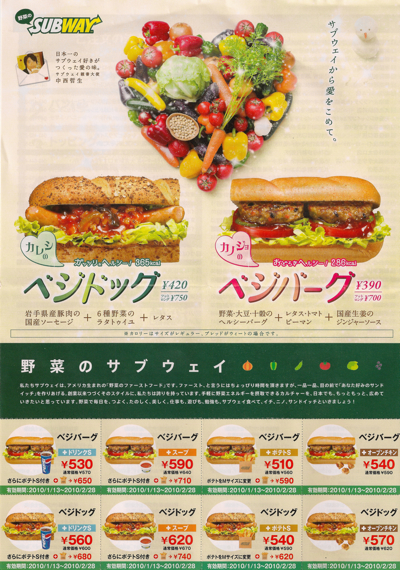
The current seasonal sub offerings are the ベジバーグ (bejibaagu, an approximation of “veggie burger”) and the ベジドッグ (bejidoggu, “veggie dog”). I was pleasantly surprised to see these available: Japan is not a very vegetarian-friendly country, but it is slowly starting to change and this is one of the signs. Clearly these are being advertised to healthy eaters:

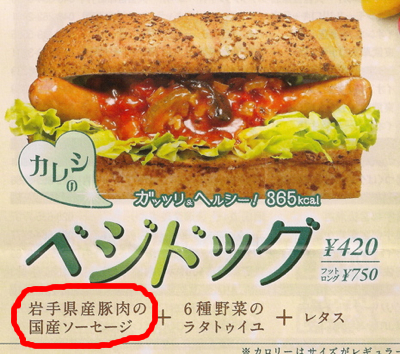
I tried the ベジバーグ a few times and was moderately satisfied. For whatever reason, they won’t add all the veggies – just tomato, lettuce and bell peppers in addition to the patty. But then they douse it with special ginger sauce. It’s decent (and makes me feel less guilty for eating so much tonkatsu). They give out a flier with coupons too, and as I was perusing it I noticed something funny about the ベジドッグ:

ベジドッグ is Iwate Prefecture pork! I was stunned. If you read their equation carefully, the “ベジ” must refer to the six-vegetable ratatouille (ラタトゥイユ) that they use as a topping. A scoop of ratatouille does not a veggie dog make. Japan clearly has 肉 issues to work out before it fully embraces vegetarianism.

Posted in food, get used to it! | 9 Comments »

履歴書 – Japanese Résumés

Friday, November 20th, 2009

rupanresume2

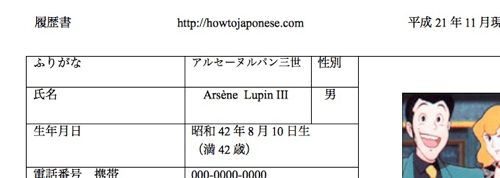
Japanese résumés, unlike American résumés (and I assume other Western résumés), follow a rigid format. They sell special résumé paper here that is gridded into different categories. Applicants fill them out by hand in their prettiest handwriting and stick on a photograph of themselves.

If you have confidence in your kanji skills and a ton of free time, you might consider filling yours out by hand – that would have to be really impressive to anyone looking to hire. I myself couldn’t be asked, so I created a résumé in Word using tables. It covers all of the basic categories and was relatively easy to edit. I’ve edited it into a mock résumé for Lupin III and uploaded it here. Feel free to download it and adapt it for your own uses. I originally created the file in Word but have been editing it in Open Office, so I apologize if the formatting is a little finicky. If it comes in handy for you, send me your success story.

A couple of interesting differences with an American résumé:

- Japanese use photos on their résumés. You will go far if you are tall, dark, and handsome with striking sideburns.

- Japanese put their date of birth, age and sex on résumés. Too many X chromosomes, and you may be serving tea.

- A lot of people list their hometown and parents. I was encouraged to do this by a teacher I was working with. This could be especially effective for foreigners because katakana may help with the pronunciation of difficult city names.

- There is a lot of what they call 自己PR (literally “self public relations”) that goes on with résumés and also job hunting in general. It reminds me of the pep rallies at the junior high school where I taught. The teams lined up individually and the kids had to give a self-introduction. They go down the line one by one and say a little sentence about themselves: “Hello, I’m Taisuke in the second year. I will do my best at the tournament and run as fast as possible.” The kids all vary their statements slightly (“I will give my best effort.” “I won’t ever give up.” etc.), and I always felt bad for the last guy because all the good words had been taken! 自己PR is kind of like this, but you have to say what your strong points are. I always felt like it was a load of crap. To give you an idea, here’s what I use on my actual résumé: ひとつのことにこだわらずに、いろいろな角度で物事を考え、見て、行動できることです。そのときの状況を踏まえて行動できるからこそうまくいきます。Basically I have a short attention span and am good at extemporaneous bullshitting. And remember, those words are mine – you’re next in line, so get your own!

- While the document is two pages, Japanese résumés are double-sided, so this is actually a one-page résumé. Always print them on one page.

Enjoy!

Tags:Japanese job hunting, Japanese resumes, 履歴書, 自己PR
Posted in get used to it!, Resources | 11 Comments »

Cool Compound – 適当に

Wednesday, November 18th, 2009

tekitouni

Blue Shoe over at Just Another Day in Japan has a nice little post about his experience with the word 適当に. It’s cool to read as he gets closer and closer to the meaning and then nails the definition almost without realizing it. It’s not his fault, though, since this word gets defined obscurely in just about every dictionary ever created.

He gives the standard dictionary definition of “appropriately” or “properly” when a yakitori chef says, 適当にしましょうか. At first Blue Shoe thinks it might refer to a set meal, but there is none on the menu. His second guess is right on the money:

Either that or he was offering to just let us buy whatever he felt like making. Sometimes the problem in these cases is that you really have no idea what “properly” or “appropriately” means.

There it is in bold – the chef was exercising his subjective choice when performing the action of choosing and cooking delicious chicken bits. Less eloquently, 適当に means “do something however the fuck you/I want to.” It’s not exactly that rough in every case – especially this one which is probably closer to “So should I just rustle up some stuff for y’all to grub on?” – but it’s definitely that arbitrary. A good comparison might be an お任せ course at a sushi place, although if お任せ is A level, then 適当に is like B- level.

One of the best examples is when someone delegates work but can’t be bothered to specify how that work should be done. They usually tell the person to 適当にやって or 適当にしてもいい. Something along those lines. Plug in my profane example and you get the extreme end of the spectrum (imagine an angry boss yelling this): “Do it however the fuck you want!” The other end of the spectrum is “Do it however you see fit” or “However you see suitable.” This is where the “appropriate” and “proper” come in to play.

In a Japanese dictionary, the first listing is “Done well so that the action meets certain conditions, goals or requirements. Something that fulfills something. Something appropriate. Something with those characteristics.” Because the decision-making is subjective, however, the word can also take on negative meanings if the doer happens to choose standards that are inappropriately low.

No matter how you look at it, it’s tough to gather the meaning from the words “appropriate” and “properly” alone. I definitely remember wrestling with the meaning of 適当に. This one takes some getting used to.

Posted in get used to it!, kanji, vocab | 7 Comments »

Encounter Two – No Way Jose

Friday, November 13th, 2009

I live with two Japanese girls and three Japanese guys. We were sitting around our kitchen at some point in the last couple of months, and I told everyone about a beer event – I think the IPA event at Towers back in August. I’m always trying to get them to come along, but they’re usually uninterested, often busy. One of the girls has been trying to be more social and outgoing. She still hasn’t come to any beer events, but she at leasts feigns interest initially. She also a thing for Korean guys, so she asked me if any Korean guys would be at the beer event. I said 来ないかもしれません.

One of my other roommates almost choked on his beer and was like, What the hell are you talking about? 来ないだろう! (Yes, those kana are italicized. No, I was not able to put 傍点. Boo.) There aren’t going to be any Korean guys at an IPA event!

This is the standard usage of だろう・でしょう. The intonation was emphatic, but mostly because the guy was straightening out my ambiguous answer – Korean guys will not be going to an IPA event in Tokyo. Generally the intonation is flat like most Japanese words.

This is what I like to call the “Weatherman でしょう.” Whenever the forecaster gives the weather on Japanese news, he/she uses the set form 明日_でしょう, where you can insert 雨, 晴れ, 曇り, or a number of other possibilities into the blank. Tomorrow it will rain. Tomorrow it will be sunny. Tomorrow Korean guys will not go to cozy but awesome beer bars near Tokyo Station and drink super hoppy beer.

I think it’s relatively safe to equate this with the future tense and a high level of certainty. It’s not 100% certainty (as my 日本語文型辞典 tells me – no Japanese weatherman would make the mistake of giving a guaranteed weather report), but it’s more certain than かもしれない.

The main reason this pattern was so confusing to me early on is the wide range of meaning でしょう・だろう can have based on intonation alone. As a beginner, it was hard to differentiate the ですね, ですよ and ですか aspects of the phrase – no matter how many times I read the textbook explanation, 雨でしょう sounded like, “Will it rain?” until I got used to it by watching enough Japanese TV and hearing my roommate laugh at my かもしれない.

(I tried desperately to put Japanese emphasis dots on the だろう up there but failed epicly. Readers of Japanese are probably familiar with these. They go by the name of 圏点 (けんてん), 傍点 (ぼうてん), or 脇点 (わきてん), and they are the little dots above/beside (depending on the direction of the text) characters that emphasize certain words. They are roughly equivalent to italics in English, and they are definitely necessary to express the emphasis my roommate put on だろう. Beer to anyone who can tell me how to get the dots in WordPress.)

Posted in beer, casual, get used to it!, probability / possibility | 5 Comments »

That’s What All the Ladies Say

Wednesday, November 11th, 2009

My understanding of だろう and でしょう are tenuous at best. I remember being puzzled by these when I took my first Japanese class – an intensive summer class, which I would not recommend (slow down, everyone, you’re moving too fast).

Two encounters have shaped my understanding of these phrases. Today, encounter one.

I was up in Fukushima, I think during my first year as a JET, watching TV. There was a small variety show where a host was interviewing different celebrities who came out one by one. After the host asked a few questions about the kind of work they did, the audience had to guess the celebrity’s annual income. One of the people on the show was パックン – Patrick Harlan, a Harvard grad who parlayed English teaching into Japanese study into fame as a manzai comedian. I don’t remember exactly what the host said to Pakkun, but he responded with a highly suggestive でしょう, which got a lot of laughs. I immediately noted the tone of his phrasing and added it to my mental catalog of funny phrases to use.

It felt like he was confirming something, just as you would with ですね, but this something was overly obvious and a little silly. A phrase you could substitute it with is the equally laugh-inducing よく言われます – literally, and extremely awkwardly, “That is often said about me.” I guess the English equivalent would be, “That’s what they all say.”

The tone on でしょう here is important – it’s slightly inquisitive with the hint of a smile. Amirite? でしょう?

Posted in comedy, get used to it!, passive, TV | 11 Comments »

Cool Kanji – 肉

Friday, November 6th, 2009

niku

肉 (にく) – the character for meat. It always reminds me of a ribcage or a little rack of lamb or something. Maybe a bizarro chicken tulip.

The concept of meat in Japan is slightly different from that in the U.S. Here, to the great collective unhappiness of all vegetarian expats, it refers to mammal meat – beef and pork, mostly – and not the flesh of living things in general (at least when talking about food). So, saying you don’t eat meat (肉は、食べません) won’t always earn you a meal that meets (har har) your dietary restrictions, especially if you take into account broths and pastes and flakes (many of which are fish-based).

(On a side note, I once knew a “vegetarian” who ate ramen and just gave away the チャーシュー on top – what a joke! Ramen broth is, more or less, pig rendered into a delicious liquid form.)

When I was a CIR on JET, I was forced to explain strict vegetarianism to Japanese people for expats on a number of occasions. (Including one Lithuanian artist who wouldn’t eat mushrooms for some reason. His English was really bad, but from what I could gather, spores are little people.) I found the best way to explain it is to say that you don’t eat 動物 (どうぶつ, doubutsu) – animals in general. But even that was not general enough sometimes, so I would always bastardize the pronunciation to 動き物 (うごきもの, ugokimono) – things that move – and then add the sentence, 動くのなら、食べません. If it moves on its own (and not in search of photons to photosynthesize), they don’t eat it. This always gets the point across and makes people laugh as an added bonus.

Posted in food, get used to it!, kanji | 7 Comments »

~ている – Stative Gerunds

Wednesday, November 4th, 2009

現在進行形 is the name of the tense (present progressive in English). You’re probably well familiar with this pattern. 食べています (tabete imasu). 飲んでいます (nonde imasu). Eating stuff. Drinking stuff. Doing stuff in general.

But I was reminded last week by 落ち着いている that you have to be careful with this pattern in Japanese because the same construction can be used as stative description depending on the verb. One of the best examples of this is the phrase 変わっている. This should not be translated as “is changing.” If something is 変わっている it means it is “in a changed state,” i.e. it is strange or weird. This is often used to describe quirky, unusual people.

You have to be vigilant not to fall into this traps. I recently had to pull myself out of one. In the Murakami story “The Town and Its Uncertain Wall,” there is a short introduction where the narrator meditates on the uncertainty and ineffectiveness of words:

語るべきものはあまりに多く、語り得るものはあまりに少ない。

おまけにことばは死ぬ。

一秒ごとにことばは死んでいく。路地で、屋根裏で、荒野で、そしで駅の待合室で、コートの襟を立てたまま、ことばは死んでいく。

お客さん、列車が来ましたよ!

そして次の瞬間、ことばは死んでいる。

I initially translated that last line as “And the next moment words are dying.” But it actually should be “And the next moment words are in the state of being dead”; in other words, “words are dead.” This passage is interesting because you have three different conjugations of the verb die: 死ぬ (shinu), 死んでいく (shinde iku), and 死んでいる (shinde iru). Here is the translation I ended up with:

There are too many things I want to say and too few things that I am able to say.

And to make matters worse, words die.

Every second words are dying. Words die in alleyways, in attics, in the wilderness, and in waiting rooms at stations with the collar on their coat turned up.

Excuse me, sir! The train is here!

And the next moment, words are dead.

I guess if you wanted to be more dramatic and read into it a little you could go with “Every second words are uttered and then go off to their death” for 死んでいく. Anyone have other ideas?

If you are trying to say “is changing” you should probably say 変化している (or possibly 変身している), or you could bust out some ところ action and say 変わっているところ.

Other frequently used examples are:
開いている。 It’s open.
閉まっている。 It’s closed.
冷えている。 It’s chilled (and ready to drink).

Maintain gerund vigilance.

Posted in gerund-related, get used to it!, Murakami | 9 Comments »

~てくる – Changes

Wednesday, October 28th, 2009

The pattern ~てくる is also really useful way to express a change in state. I remember it being a confusing pattern when I first started studying Japanese, but I solved that problem by using it constantly (regardless of whether or not it was appropriate) because, let’s face it, shit be changing, yo. (Cue Tupac track.) Gradually I’ve narrowed down the appropriate usage conditions.

Here’s a quick example sentence: この2ヶ月間仕事が忙しくて大変だったけど、やっと落ち着いてきた。

The first clause sets the scene – work was busy and it sucked. But (there’s the fulcrum for the change) things have settled down (or so he thinks). The second clause shows how things have changed from the first clause. They have gone from an 落ち着いていない condition to an 落ち着いている condition. The きた, I feel, helps emphasize this transformation and the やっと impresses exactly how long the subject was waiting for the きた to くる so he could キター!

So the next question is what’s the difference between ~た and ~てきた? It’s pretty subtle. Another example. I got a birthday package from a friend in the US the other day. If my friend spoke Japanese I could say that it got here with a simple 荷物が届きましたよ. Just the basic way to say that the package was delivered. I could also say 届いてきたよ, which feels more urgent – as if my friend or I were awaiting the arrival of the package slightly more desperately. Maybe the package was delayed? Maybe there was a kitten inside?! Or maybe we were just waiting to compare the USPS with Japan Post. (Japan Post wins.) As in the example yesterday, the きた・くる seems to address a sort of mutual understanding that exists whereas the plain form of the verb is best for communicating brand new information.

〜なってきた・くる is another pattern that you can use to express how something changes. An example: 寒くなってきた. Like Monday, the timeframe feels more specific, as in 最近 or 今日 or 今週. And once it’s cold enough, (you can use Monday’s pattern to say…) 雪が降ってくる.

Posted in gerund-related, get used to it! | 4 Comments »

~てくる – Going to Do Stuff

Monday, October 26th, 2009

This week I’ll explore the glories of the pattern ~てくる。The eternal caveat: trying to get back to the core of How to Japonese, this week will be especially unfounded in textbook “learnin’.” I’m looking back through the fog of time, thousands of hours of study, and countless repetitions in an attempt to narrow down the “sense” that I’ve developed for this pattern and how I came to that sense. How I’ve gotten used to it, I guess. Hope it’s helpful.

For me, this pattern represents the earliest stages of getting used to it. Jay Rubin’s book Making Sense of Japanese is the Bible of “getting used to it.” I first read through it my sophomore year of college. Not all of it sank in immediately, but this pattern did. He has one short section titled “Go Jump in The Lake, But Be Sure to Come Back” where he calls 〜てくる an idiomatic expression; in English we say “go do,” and in Japanese they just happen to say “do and then come.” Get used to it.

The most basic ~てくる pattern is 行ってきます, which is what people say when leaving the house in Japan. When translating, it’s probably best to go with something like “I’ll be back” or “I’m stepping out” or even “See you later.” The expression literally breaks down to “I will go and then come (back)” but really only means “I’m going.”

That’s easy enough. You can extend this to any activity:
弁当(を)買ってきます。 I’m going to buy a bento. (Because I can’t be asked to make anything.)
一服してくるよ。 I’m taking a cigarette break/rest. (Because this office is hot as hell!)
まい泉でトンカツを食べてきた。 I went and had tonkatsu at Maisen. (Which is why I can’t get up from the couch.)
年末ジャンボを二枚買ってきた! I bought two New Year’s Jumbo tickets! (And when I win I will retire at 28.)

The big question is what is the difference between plain, old 買いました and 買ってきました. The former conveys only the basic information – you bought something. The second one feels more like an event, one that the person being addressed was previously aware of – you went out and bought something that you had been talking about earlier. (You can see this implied information in parenthesis for the examples above.) And 買います and 買ってきます? The former to me feels undefined in terms of timeframe, whereas the latter is going to happen sooner or at least in a more specified timeframe such as これから or 明日 or お金がたまったら.

I’m going to go ahead and say that you should be using this pattern 40% more often than you currently do. So go on. Get out there and go do some stuff. And come back when you’re done.

Posted in gerund-related, get used to it! | 3 Comments »

Chillin’ Out

Monday, September 28th, 2009

After two straight weekends of awesome globetrotting madness, I finally had a weekend to myself and could make use of a couple of terms my host mom in Nishiaizu taught me:

骨を休め – literally “rest one’s bones,” take a physical rest

羽を伸ばす – literally “spread one’s wings,” a similar pattern but also includes a mental rest aspect, and another alternative is…

鬼の居ぬ間に洗濯をする – literally “do laundry while the oni is away,” where oni = unpleasant boss-like person/situation that oppresses you

Get the scoop on these and other idioms at this awesome ことわざ dictionary.

Posted in casual, dictionaries, get used to it!, vocab | 1 Comment »

Newer Entries »
  • Follow @howtojapanese How to Japonese

    Promote Your Page Too
  • You are currently browsing the archives for the get used to it! category.

  • Pages

    • About
    • Contact
    • Portfolio
  • Archives

    • February 2012
    • January 2012
    • December 2011
    • November 2011
    • October 2011
    • September 2011
    • August 2011
    • July 2011
    • June 2011
    • May 2011
    • April 2011
    • March 2011
    • February 2011
    • January 2011
    • November 2010
    • October 2010
    • September 2010
    • August 2010
    • July 2010
    • June 2010
    • May 2010
    • April 2010
    • March 2010
    • February 2010
    • January 2010
    • December 2009
    • November 2009
    • October 2009
    • September 2009
    • August 2009
    • July 2009
    • June 2009
    • May 2009
    • April 2009
    • March 2009
    • February 2009
    • January 2009
    • December 2008
    • November 2008
    • October 2008
    • September 2008
    • August 2008
    • July 2008
    • June 2008
    • May 2008
    • April 2008
    • March 2008
    • February 2008
  • Categories

    • airbag expressions (5)
    • appear (2)
    • beer (28)
    • body parts (7)
    • casual (31)
    • causality (3)
    • causative (10)
    • class notes (3)
    • comedy (26)
    • conjunctions (2)
    • custom (2)
    • dictionaries (5)
    • food (53)
    • gerund-related (6)
    • get used to it! (66)
    • giving (3)
    • kanji (88)
    • literature (45)
    • Murakami (56)
    • onomatopoeia (4)
    • particles (2)
    • passive (11)
    • phone (1)
    • podcast (1)
    • polite (27)
    • politics (3)
    • probability / possibility (3)
    • project management (5)
    • puzzle (38)
    • random (95)
    • reading (15)
    • receiving (3)
    • refusal (10)
    • reporting (1)
    • requesting (6)
    • research (2)
    • Resources (16)
    • theory (8)
    • travel (14)
    • TV (17)
    • Uncategorized (8)
    • underrated japan (5)
    • video (39)
    • video games (19)
    • vocab (110)
    • wordplay (31)
    • 変換 (2)

How to Japanese powered by WordPress | minimalism by www.genaehr.com
Entries (RSS) and Comments (RSS).