Last Line

With the goal of stirring up even more interest in Murakami between now and mid-October tomorrow, when the Nobel Prizes are announced, I will post a small piece of Murakami translation once a week from now until the announcement. You can see the other entries in this year’s series here: More DrawersPhone CallsMetaphorsEight-year-olds, dude, Ushikawa.

Tomorrow is the announcement! Murakami started at 16/1 moved to 8/1 and now is in second place at 6/1 behind Bob Dylan. (If Bob wins, I hope Sgt. Tanuki writes something epic about it.) This year Murakami’s chances are as good as they’ve ever been.

For this year’s final entry, I figured I’d go simple. I began my liveblog of 1Q84 with the very first sentence of the novel, so this week I’ll translate the very last sentence of Book 3. Translating any more than that will spoiler.

Here it is:

Until, in the light of a new sun that had just risen, [the moon] quickly lost the intense shine it had at night and turned into just a gray cutout hanging in the sky.

As you can see, he ends with the same metaphor that begins Book 1 in an epigraph – “It’s Only a Paper Moon.” I don’t really have much to say about this other than that it again mirrors the ending of “The Twins and the Sunken Continent.” There, too, he uses a new foreign environment (a sea bed) as a metaphor for how life will proceed. In 1Q84, the new world will be different; its moon may lack the shine from the night, but the passage still feels hopeful. Not completely negative at least. And that’s about all I can add without saying too much about the plot.

In terms of the translation, the definite/indefinite article before “new sun” forces a translator to make interesting decisions. The Japanese is: それが昇ったばかりの新しい太陽に照らされて、夜の深い輝きを急速に失い、空にかかったただの灰色の切り抜きに変わってすまうまで。 I went with “a” to imply that it’s a brand new day. Using “the” would feel more like rebirth of an old sun, which is also a nice image. I’ll be very curious to see how Phillip Gabriel renders this line. I wonder if he’ll leave it as a fragment or connect it with the previous sentence. If I have the energy/effort/time, I’ll try to go back through these posts and compare my versions with the official translation. Should be fun.

Hooray for Murakami Fest! I’m running out of ideas for Murakami translation themes, so you’ll have to give me your thoughts about what I should do next year. I have a couple of things I’ve been working on, but nothing set in stone yet. I’m pretty happy with the way this year turned out, even though it was all off the cuff.

Ushikawa

With the goal of stirring up even more interest in Murakami between now and mid-October, when the Nobel Prizes are announced, I will post a small piece of Murakami translation once a week from now until the announcement. You can see the other entries in this year’s series here: More DrawersPhone CallsMetaphors, Eight-year-olds, dude.

As promised, this week I want to take a look at Book 3. One of the interesting/strange things that Murakami does with Book 3 is to add an additional narrative perspective – the book suddenly starts with a chapter from the point of view of Ushikawa, a creepy messenger/errand boy for the cult in the novel.

The name Ushikawa might be familiar. I can’t believe I didn’t realize it sooner (as in, when I was writing one of my two reviews of the novel), but Ushikawa was also a character in The Wind-up Bird Chronicle. He sneaks into Toru Okada’s house in Chapter 13 of Book 3, he makes another house call in 16, and in 19 they talk on the phone.

And that’s the last we see of him for the entire novel.

He’s nothing more than a device that Murakami uses to advance the plot: he delivers a threatening message from Noboru Wataya – cut ties with “the Hanging House,” the residence where Cinnamon and Nutmeg are set up – which gradually becomes less and less threatening until eventually he just helps Toru get in touch with Kumiko via computer and disappears. We get long blocks of dialog that show what a poor bastard he is, but as best I can tell, he doesn’t really serve any other purpose in the novel.

He’s described similarly in both novels – disheveled, bald, an uncanny ability to track down information, clearly a lackey for someone powerful – but he doesn’t appear to be the exact same character. Just the same trope.

In 1Q84, too, Ushikawa is one sad bastard. In Book 2, he’s again used mostly as a plot device, but because he’s the narrative point of view in Book 3, we get extended information about how sad his life is in Book 3, so much so that I even started to feel bad for him – of all Murakami’s characters, he seems to get a raw deal.

And Murakami seems to revel in making him more and more miserable. I noted one passage in particular on 202. Ushikawa is riding around Tokyo on trains, hunting down information about Tengo and Aomame, and as he does, he’s thinking through the different possible connections in his head (connections that we as readers have known for hundreds of pages). Here’s the part just before a space break:

Ushikawa thought about this the entire time he was on the train from Ichikawa to Tsudanuma. He grimaced and sighed and stared off into space, probably without even realizing it. The primary school student sitting across from him was watching him with a strange look on her face. Out of embarrassment he smiled and rubbed the top of his lopsided bald head with his palm. However, that just seemed to scare the girl. She stood up all of the sudden right before Nishifunabashi Station and quickly ran off somewhere.

I felt like this was a bit overkill. We know he’s ugly. We know he’s a sad bastard. Does he really have to frighten primary school kids? Oh well. I guess that’s Ushikawa for ya.

One little language nugget of note: “lopsided” is いびつ in Japanese, and it appears over and over again in the novel. It’s one of those words that Murakami fixates on and uses a lot like 胡散臭い, 具わっている, and 惹かれる. He uses it a lot to describe the new moon that appears in the 1Q84 alternate reality: the new moon is smaller and more lopsided. I probably would have used a word like warped or irregular, but a teaser from Knopf shows that Rubin went with lopsided, which is a far superior choice. So I borrowed that for this week’s translation.

Eight-year-olds, dude

With the goal of stirring up even more interest in Murakami between now and mid-October, when the Nobel Prizes are announced, I will post a small piece of Murakami translation once a week from now until the announcement. You can see the other entries in this year’s series here: More Drawers, Phone Calls, Metaphors.

More of 1Q84 Book 2 this week. I’m not quite sure why I’m stuck in Book 2. I promise to check out Book 3 next week.

The big Murakami news of late was that a school in New Jersey decided to ban Norwegian Wood because it has naughty bits. The naughty bits were distorted by parents playing the telephone game: lesbian sex became lesbian statutory rape. This is ironic because it’s exactly what happens in the book – a thirteen-year-old girl tricks the neighbors into believing that Reiko abused her when it was actually the girl who took advantage of thirty-one-year-old Reiko. Reiko snaps from the pressure, divorces her husband, and ends up in the mental hospital with Naoko.

So this week, rather than picking a random section based on the notes I took above the pages, I sought out the naughty bits of 1Q84. The bits I found aren’t the naughtiest, I don’t think, but they do a nice job of obfuscating other important plot details, so there will be no spoiler. Book 2, page 242:

Aomame said, “You’ve raped countless young girls. Girls who were barely ten years old.”

“You’re right,” the man said. “By conventional wisdom, that’s how it would be taken. Judging by the laws of the world, I am a sinner. I had physical relations with girls who hadn’t yet reached maturity. Even though it wasn’t what I wanted.”

Aomame just sighed deeply. She didn’t know how to suppress the intense convection of emotions running through her body. Her face distorted, and her right and left hand seemed to be demanding something different entirely.

Yes, dude. Baby raping. Rereading this section reminded me exactly how weird and tedious this book can get at times. This section is getting toward the final quarter of the book. We’re seeing the encounter we’ve been waiting 750 pages to see. And now there’s a long-ass discussion of morality to draw the whole thing out and ruin any sense of movement. If you were wondering why baby raping comes into discussion at all, it seems to be an example of how there is no absolute good or evil in the world – it’s constantly shifting, and things that were good can soon become evil and vice versa. This happens to be exactly what Dostoevsky was trying to portray in The Brothers Karamazov, apparently. Conveniently, both of the characters in this scene have read the book, so they can discuss it at length.

Not that any of this will matter to some people. They’ll just hear the baby raping part and put on their lynching shoes. I’m not sure I have the interpretive abilities to stop them. I’m very curious to read the translation and see the reaction to this part of the novel.

On a side note, Aomame is constantly scrunching up her face. In this case, the Japanese is 彼女の顔が歪められ, the first clause in that last sentence. Her face is described pretty horrifically in the beginning of the book. I’m interested to see how Rubin handles this in English. I can’t say anything about her hands because that would spoiler, but I promise the last clause makes sense in the original.

Metaphors

With the goal of stirring up even more interest in Murakami between now and mid-October, when the Nobel Prizes are announced, I will post a small piece of Murakami translation once a week from now until the announcement. You can see the other entries in this year’s series here: More Drawers, Phone Calls.

We’re looking at Book 2 again on page 336, and this time the note to myself is “world is a big model room – nice.” Let’s check it out:

Aomame slowly looked around the inside of the room again. This is like a model room, she thought. It was clean, had a sense of uniformity, and all the necessary items had been arranged. However, it was cold and lacked any individuality – it was just an imitation. Dying in a place like this probably wouldn’t be a very pleasant way to die. But even with a nicer backdrop, was there really such thing as a pleasant way to die? As she considered this, Aomame realized that the world in which we live is itself something like a giant model room in the end. We come in, take a seat, have some tea, watch the scenery outside the window, and when the time comes we say our thanks and leave. All of the furniture inside is nothing more than makeshift knock-offs. Even the moon shining through the window could be an imitation made of paper.

I can’t remember who I had this conversation with – possibly a translator friend – but I remember talking with someone about Murakami, and that person remarked that the strongest part of Murakami’s writing is his metaphors. He can write damn good metaphors. This one appealed to me when I first read it, and I still think it’s pretty good. It has that ever-present Murakami theme that reality isn’t much more than a place where we eat, live, shit, and fuck before we die. やれやれ.

The passage also refers to the “It’s Only a Paper Moon” epigraph. I can’t remember if he refers to it this specifically anywhere earlier in the novel, but the moon is important throughout the book.

One interesting language note: Murakami mentions that he wrote the book entirely in third person – his first one – but he still has lines like this: もし私がこんなところで死ぬことになるとしたら、それはあまり心愉しい死に方とは言えないだろう. (Which I rendered above as “Dying in a place like this probably wouldn’t be a very pleasant way to die.”) I’m not certain, but I feel like Murakami uses the 私 to show that this is being filtered through Aomame’s consciousness, so I guess it equates to something like free indirect speech in English? It’s first person kind of, but it’s actually third person. The goal is to make it feel like that initial “she thought” (彼女は思った) covers the entire paragraph, which is why I translated it as Aomame might think it to herself in English rather than using the “If I” that you might normally use. Anyone have thoughts on this?

I was also curious about tense. It jumps to present in the “As she considered this” sentence. Does that seem to work?

One last note – papier-mâché is はりぼて in Japanese. The Google Images search makes this pretty clear. The word gets used twice in the passage above. The first usage is just はりぼて, but the second is 紙で作られたはりぼて, which would seem redundant unless there’s another meaning for the word, and Yahoo Dictionary notes the other meaning is metaphorical, so I went with “imitation.”

Phone Calls

With the goal of stirring up even more interest in Murakami between now and mid-October, when the Nobel Prizes are announced, I will post a small piece of Murakami translation once a week from now until the announcement. You can see the other entries in this year’s series here: More Drawers.

Okay, let me set the scene: I’m listening to Zoot Sims, I’ve had a beer (and hell I’ll have another – it’s Murakami Fest and I don’t have class tomorrow), the cats have been fed, and now it’s time to translate a nugget of 1Q84.

Today’s nugget comes courtesy of Book 2 page 125, above which I wrote the note “random phone calls → WUBC & Yoru no kumozaru.” Let’s see what the page has to say – we’re in Chapter 6, so we’re following Tengo, whom you should be familiar with from “Town of Cats”:

The telephone rang just after nine on Tuesday night. Tengo was reading a book while listening to music – his favorite time of the day. He read as much as he wanted before he went to sleep, and when he got tired, he fell asleep right where he was.

It was the first telephone ring he had heard in a while, and it seemed to have a sort of ominous echo. It wasn’t a call from Komatsu. Phone calls from Komatsu had a different sort of ring. For a moment, Tengo wasn’t sure whether he should pick up the phone or not. He let it ring five times. Then he lifted the needle on the record player and picked up the phone. It might have been his girlfriend calling.

“Is this the residence of Tengo Kawana?” a man said. The voice was that of a middle-aged man, deep and soft. It was an unfamiliar voice.

“This is he,” Tengo said cautiously.

“I’m sorry for calling so late at night. My name is Yasuda,” the man said. His voice was very neutral. Neither friendly nor hostile. Neither businesslike nor intimate.

Yasuda? Tengo couldn’t remember anyone by the name of Yasuda.

“I’ve called because there’s something I need to tell you,” the person said. And then he paused for a brief moment, like he was inserting a bookmark into the pages of a book.

And that’s all you get. Otherwise I would spoiler, and spoiler is no fun.

This passage illustrates Murakami’s near obsession with phone calls as well as 1Q84’s unfortunate reliance on phone calls to drive the plot. As noted in my note above, Murakami began his magnum opus Wind-up Bird Chronicle (WUBC) with a random phone call (which also happened on a Tuesday!), and he used it in a number of stories in Yoru no kumozaru, a collection of short-shorts, notably “Eel,” which features May Kasahara, another character from Wind-up Bird Chronicle.

Something about that ability of the telephone to connect people in two completely different places seems to fascinate Murakami, and he uses it often to show how individuals often occupy two entirely different “worlds,” whether they realize it or not. Magically, the telephone can connect these worlds and bring people together, enabling them to communicate in ways they could not before.

Now that I think about it, Norwegian Wood ends with a telephone call between Toru and Midori. I’ve always thought that Rubin’s translation of that final line was interesting. He creatively invokes death:

Again and again, I called out for Midori from the dead center of this place that was no place.

Whereas Birnbaum does not:

I held onto the line to Midori from there in the middle of nowhere.

The Japanese is:

僕はどこでもない場所のまん中から緑を呼びつづけていた。

Birnbaum’s translation feels a little awkward. I still haven’t read his translation all the way through, but there were a number of places that made me wonder if the final text had been edited by a non-native speaker.

Okay, I’m rambling now, but you get the idea – phones are powerful symbols in Murakami’s fiction, and 1Q84 continues this trend.

More Drawers

Now begins the Fourth Annual How to Japonese Murakami Fest!

With the goal of stirring up even more interest in Murakami between now and mid-October, when the Nobel Prizes are announced, I will post a small piece of Murakami translation once a week from now until the announcement.

For those of you who don’t know how this works, check out the past three years:
Year One: Boobs, The Wind, Baseball, Lederhosen, Eels, Monkeys, and Doves
Year Two: Hotel Lobby Oysters, Condoms, Spinning Around and Around, 街・町, The Town and Its Uncertain Wall, A Short Piece on the Elephant that Crushes Heineken Cans
Year Three: “The Town and Its Uncertain Wall” – Words and Weirs, The Library, Old Dreams, Saying Goodbye, Lastly

I thought I’d start with something recent. Murakami serialized another set of essays in AnAn over the past year, and the collected edition, Murakami Radio 2, came out in July. In the introduction to the collection, Murakami continues his recent obsession with the drawer metaphor for writing:

Novelists need lots of drawers inside their heads when they write novels. Little episodes, specific knowledge, vague memories, a personal worldview (or something along those lines) – all these come in handy quite often when writing novels. But if I go and dump all of that material into essays, I’m not able to use it in novels very well. So I’m stingy (as it were) and secret it away into drawers. However, when I finish a novel, there are always a couple drawers I didn’t end up using, and some of those can sometimes make good material for essays.

Drawer is 抽斗, which Murakami mentioned in his interview with Monkey Business before the publication of 1Q84. I noticed it a couple of times in 1Q84, and Matt over at No-Sword examined the origins of the character.

He goes on to compare the collection of essays to “oolong tea made by beer companies” – it’s not his main business, so he’s able to relax a bit (肩の力を抜いて) and write off the cuff.

This is quickly apparent, as the essays are all really short, have no connecting theme, and often start quite lightly with questions for the first sentence: Do you like to drive? Hello, runners – how are you doing? Are you the kind of person that angers quickly? Did you know there are some socks where the left and right are shaped differently? Do you read Dazai Osamu? Have you been to Ireland? Do you know about seal oil?

It’s really a shame that he doesn’t publish this material online – they feel much more like blog posts than essays (as he calls them), and he does have a history of publishing material online. Also, then it would have been free and not 1700 yen.

Speaking of writing off the cuff, for free, and on the Internet – that’s what I do! I’ve been busy with the start of classes and unable to prep my translations this year, so starting next week, I’ll be posting short translations that I pick randomly from 1Q84, an excerpt of which was just published in The New Yorker as the short story “Town of Cats” (arguably the best section of the book). I took notes, so hopefully I’ll be able to find some interesting passages. And if they suck, just remember it was all free.

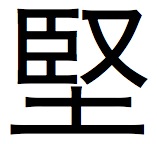
Cool Kanji – 堅

堅い (かたい) is a word I had a basic feel for long before I knew the actual English equivalent. I took an intensive summer class after my first year in university, and I have memories of the sensei using it all the time and me not exactly understanding what it meant when they used it to describe different words and phrases. I probably looked it up once and then just let it sink in. Unfortunately I can’t think up any specific examples of what was and wasn’t 堅い. It might have just been keigo variants.

Needless to say, having an understanding of 堅い is immensely important in Japan. The rigidity of your speech, your body language, your overall interactions with other people – these are all very important in Japan. Arguably more important than elsewhere. This isn’t to say that you should tense up like a plank when you talk with your 社長 (all 社長 should be lovingly referred to, behind their backs, as “the Shach” – let’s make it happen, y’all!). The most respected ability in Japan is being comfortable with your situation and knowing when and when not to dial up the intensity/formality/rigidity/堅さ.

Because this is such an important idea, it can be abused for humorous reasons, as I’ve mentioned a number of different times – most recently in my article in the Japan Times today about universal humor. Check it out!

My New Manga Reading Technique is Unstoppable

That YOINK sound you may have heard earlier this week was the sound of Junji Itō’s “Voices in the Dark” and Naoyuki Ochiai’s “Crime and Punishment: A Falsified Romance” being licensed, ending Daniel Lau’s scanlation series. This is too bad because Daniel gave me the first three volumes of the latter before I left Japan. I’ve started reading the first volume and was looking forward to checking out his translations when I finished.

Everytime I go to Japan, I end up flying back with a lot of books and manga, but I find it hard to dig up the necessary willpower to actually read them. I’ve got reading for classes (that I’m both taking and teaching), writing for classes, too many blogs that I’m trying to run, and it’s hard to find that energy when I’m finished with all of that and taking care of my semi-feral cats.

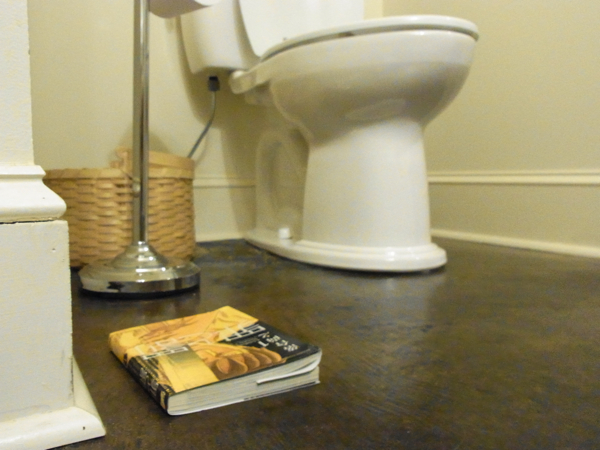
No longer! This time I felt a little obligated to read the manga (anything a friend presses on me, I try to actually get through), so I needed to find a way to motivate myself. I’ve combined two strategies into an unstoppable manga reading technique – AJATT’s do something easy + Penelope Trunk’s if…then thinking = toilet manga:

If I am sitting on the toilet, I am reading “Crime and Punishment: A Falsified Romance.” Usually I can get through a couple pages in any given sitting, which is progress! And it’s easy. I don’t have to commit a half hour or an hour, but all the sittings do add up: I’m about halfway through the first volume. I’m not sure if this will work for novels or short stories (this strategy seems especially suited for manga with pictures that enable quick review of the storyline), but I’ll give it a shot when I finish this.

The only problem is that I’m out of the house so often these days, and it’s weird to carry reading into a public restroom – too weird.

How to Fly First Class for Free

I have what my mother has described as “follow through issues.” No, this has nothing to do with my golf swing or the form of my jumpshot. I always find it easy to start big projects, but sometimes completing them can be an issue, and when something is a tedious task, I have trouble even getting started.

Schoolwork was never an issue, and real work hasn’t been either, but favors for friends and the little unimportant things like laundry, cleaning house, etc. always take me several tries. I’m almost never able to complete them in one go. I also find it hard to keep a budget and deal with number-based stuff. This includes joining an airline mileage program and racking up miles.

But I have seen the promised land, friends, and its name is first class on a transpacific flight. Yes, I was upgraded to first class on a LAX-NRT Delta flight when I flew in two months ago.

I’m not sure what your impression of the upgrade process is like, but I always imagined people in suits schmoozing their way from economy to business class or business to first. Well, this is a lie. The best way to get free upgrades to first class is to pick an airline, commit to it over the long term, and build up miles in the mileage plan. I wasted three years on JET by flirting with several different airlines (always the cheapest and most convenient), but not long after I moved to Tokyo, I committed to a long term relationship with Delta, and that’s been the secret. Delta has been a love-hate relationship, but she’s made up for her wrongs.

If you work long term in Japan, chances are you were like me and went home about once a year for a week or two. Tokyo to New Orleans is about 5000-6000 miles for each leg. That’s 10-12,000 miles per trip, and if you happen to take two trips in the same year, you can get close to the 25,000 miles required for Silver Medallion status.

I don’t care what Delta says, that Silver Medallion status is GOLD. Once you’re in to the medallion club, you get unlimited free upgrade requests. I’m not exactly sure if this is true for international flights, but when you purchase a domestic ticket, it will show you that your upgrade has been requested. I imagine that this enables the airline to sell more economy fares in the event that the first class fares don’t sell out; they simply bump a medallion member to first class and sell another (probably more expensive) ticket to Joe Schmoe (because he had to buy last minute).

Since last December, I’ve been upgraded to first class on four out of five domestic flights. For mathematically disadvantaged individuals, that’s 80%.

Most of these were short, one-hour flights, so the only real advantage was being first on and first off the plane. The MSY(New Orleans)-LAX flight was longer, so I got breakfast, which was great. The flight attendant came up to me and asked, “Will you be joining us for breakfast?” which absolutely killed me. Worth the price of admission to get Japanese-style attention in the U.S.

I don’t know how many of you have flown through LAX recently, but it’s a crap airport. Because of the construction and lack of speakers, I didn’t know I’d been upgraded to first class to Tokyo until shortly before I boarded. I got an email a few days before the MSY-LAX flight telling me I’d been upgraded, but the lady at the gate in LAX handed me my upgraded boarding pass a few minutes before I boarded. I didn’t have to ask for anything. It was automatic. Again, my guess is that this is because folks were flying standby and there were open seats in first class, and they start going down the list of people in the following order – medallion status, number of miles flown, price paid for ticket.

First class was great. I was used to economy where food isn’t served until an hour or two into the flight, so I had a meal at LAX before I left. Appropriately, my last American meal looked like a big, fat zit – clam chowder in a bread bowl:

In first class, they feed you immediately, and they take your order before take off. I only took pictures of the food, and this is what it looked like:

After we finished the meal, they brought out a dessert tray and started with the seats across from me. The desserts slowly started to disappear, so I resolved to go without the ice cream I wanted until another dessert tray appeared in my peripheral vision.

Cue tryptophan dream sequence. Wake up, breakfast like a boss:

The secret is, as mentioned before, committing to an airline, building up miles, and being a little lucky. I had a little luck myself. On my way home to Japan from the U.S. last year, my flight got canceled because the toilet was broken, so they put us all in a hotel for the night and gave us 25,000 miles on vouchers. Later they gave us an additional 10,000 miles just to apologize. I think these are what really helped bump me to medallion status, but flying a bunch of times didn’t hurt either.

A couple other notes:

– Book your ticket directly through Delta.com. Tickets booked via miles or a travel agent probably won’t be upgraded because they are special fares. Booking online probably won’t cost much more.

– Ask for the upgrade over the phone before the flight. I feel like this would probably improve your chances more than asking someone at the gate. Those gate people always seem to be incredibly stressed out. I’m not sure the people on the phone are any less stressed, so this might be the best idea.

– Enjoy the hell out of your first class experience! At first I was all self-concious, telling myself “Be cool, bitch!” but then I relaxed and said fuck it, I’m going to enjoy the hell out of this. I pressed all the buttons on the seat (there are a ton) until I figured them all out, despite the fact that it made me look like an idiot. I took pictures of all the food. I watched movies. I cracked some beers.

– Don’t get drunk and be obnoxious like the lady in front of me. She had something like five or six glasses of wine and then went on a toilet rampage. I waited for one to open and went in to brush my teeth and relieve myself. I had taken a little time, so when I heard a knock on the door, I assumed it was the flight attendant. I quickly finished and apologized when I got out. The flight attendant said, “Don’t be sorry” and rolled his eyes at the lady who was wasted and pounding on the bathroom doors.

– Always wear a jacket or something you can check just in case you get upgraded. They hang it up in a closet for you!

– I’m flying home in a week. I’m not expecting to get upgraded (because the service in Japan is horrible, according to some terrible documentary film asshole), but it would be a nice surprise. I’ll keep everyone posted.