Karaoke Kotoba – 別れ

wakare1

My column is in the Japan Times Bilingual page this week: “Submitting yourself to the 50 shades of arigatō gozaimasu.”

I take a look at ways to diversify your phrases of appreciation: ありがとう is great, but there are other ways you can thank people. Why not add a few to your repertoire?

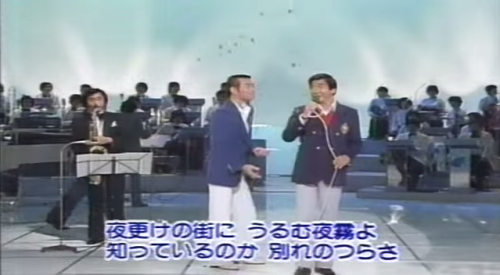
There’s nothing really wrong with ありがとう, of course, and I mention a couple karaoke songs there at the end that use ありがとう, notably 夜霧よ今夜も有り難う, one of Yūjiro Ishihara’s legendary songs:

https://youtu.be/5xvCmxP5iB8

I love this song for several reasons: 1) There are few songs that fit within my vocal range (deep), but this is one of them, 2) Yūjiro is boss — as my college graduate advisor put it, he’s basically the Japanese Elvis — and 3) in the video above (if the link isn’t broken) he doesn’t bat much of an eye even though some jackass comes on stage in the middle of the song to pelt him with confetti:

wakare3

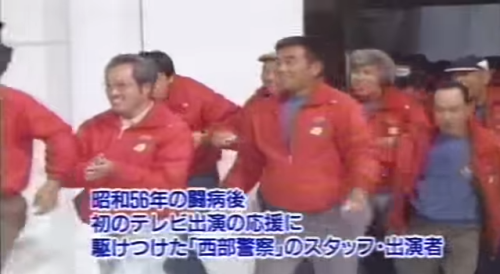
I was going to write something snarky about how the real つらさ is having to share the stage with the confetti pelters, but apparently they are celebrating Ishihara’s first television performance after recovering from an aortic aneurysm:

wakare4

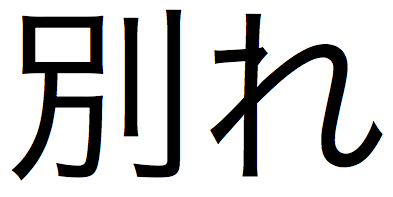
The real pain, though, is 別れのつらさ – the pain of parting/breaking up. Because of the nature of music (especially pop music), 別れ (わかれ) is a word you can expect to encounter frequently in the karaoke box. It’s just a noun from the verb 別れる.

I went hunting for other examples of 別れ and I found a great example: 別れても好きな人.

https://youtu.be/kIoqFi2KUgM

It’s a duet, one that was originally released in 1969 but got covered in 1979 and became a million-seller for “Los Indios and Sylvia” (ロス・インディオス&シルヴィア). The song gives you a great tour of famous parts of Tokyo, and duets are fun as hell. It’s always good to have a well-known duet up your karaoke sleeve, in your karaoke quiver, etc.

The grammar pattern the song highlights is one of the most basic: Gerund X + も = Despite X/even though X. In this case, “people you love/like/crush on even though you broke up.”

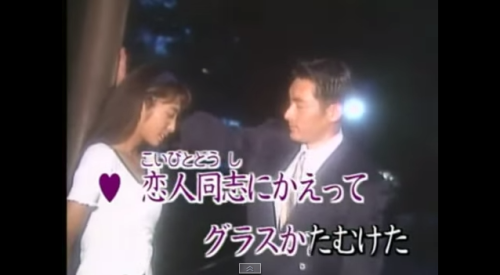
On a side note, the video I found above has a solid example of 壁ドン, a word which drew attention in 2014 when it was a runner up for word of the year. As you can see from this video, it has a pretty long history as a visual trope (although I have no idea what year the karaoke video was produced, could be later than 1979 I assume, but judging from the way the Scramble Crossing looks, it’s a while back):

wakare2

文末 Nuggets

My March Japan Times Bilingual piece is up: “Avoiding the subject isn’t such a bad idea in Japanese.”

Inspired by a question on Twitter, I take a look at how to avoid using subjects in Japanese. (Hint: Just ignore them mostly.) Besides just leaving them out, there are a ton of phrases in the language that promote concision, notably a few handy 文末 phrases. I address そうだ and ようだ in the piece, but らしい and みたい are also very effective in similar roles.

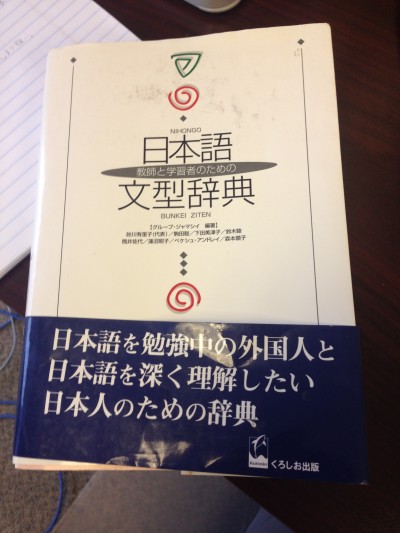
They all have subtly different usages, so it can be helpful to look at Japanese definitions. These are all from the wonderful 日本語文型辞典.

2015-03-03 09.44.21

Do your best to ignore my awful translation.

ようだ

…ようだ 〈推量〉

ものごとについて話し手がもつ印象や推量的な判断を表す。ものごとの外見や自分の感覚について「何となくそんな感じがする/そのように見える」というふうに、その印象や外見をとらえて表現するもので、話し手の身体感覚・視覚・聴覚・味覚などといったものを通してとらえられた印象や様子を述べたり、そのような観察を総合して話し手が推量的判断を述べるような場合に用いる。

すでに述べたことがらを受ける場合は次のように「そのようだ」「そんなようだ」が使われる。(618)

…ようだ

Expresses a speaker’s impression or estimation-like judgment about something. Presents the impression or external appearance (of something) according to the external appearance (of the thing) or the speaker’s senses and suggests “It kind of seems that way/It looks that way.” Used when a speaker gives an impression or condition (of something) taken from the speaker’s sense of touch, sight, hearing, smell, etc. and when making other observations like that to give the speaker’s general, estimation-like judgment.

The following patterns are used when responding to things that have already been mentioned: 「そのようだ」 and 「そんなようだ」

らしい

…らしい

文末に付いて、話し手がその内容をかなり確実度の高いことがらであると思っていることを表す。その判断の根拠は外部からの情報や観察可能なことがらなど客観的なものであり、単なる想像ではない。 (632)

…らしい

Appended to the end of sentences to express that the speaker believes the content has a very high level of certainty. The basis for that judgment is objective, such as outside information or something that is observable, not simply imagination.

そうだ

そうだ

普通体の節に続いて、自分が直接得たことではなくどこかから入った伝聞情報だということを表す。否定や過去の形にはならない。

そうだ

Added on to 普通体 (direct style) clauses to express that (the clause) is not something you received directly but reported information that came from somewhere else. Does not form negative or past tense constructions.

みたいだ

…みたいだ 〈推量〉

話し手の推量を表す。「はっきりと断定はできないが、そのように思う」という意味。話し手が、何かを見たとか、音を聞いた、匂いをかいだなど自分自身の直接経験したことをもとに推量したことを述べる表現。

これに対して、他の人から聞いた話など間接的な情報にもとづいた話し手の推量を表すときには「らしい」が使われ、聞いたことをそのまま報告する場合には「そうだ」が使われる。 (562)

…みたいだ

Expresses a speaker’s estimation. Means “I can’t tell for certain, but that’s what I believe.” An expression used to give an estimation based on something the speaker directly experienced, such as they saw something, heard something, or smelled something.

Conversely, 「らしい」 is used when expressing the speaker’s estimation based on indirect information, such as something heard from another person. 「そうだ」 is used when reporting something exactly as it was heard.

I’ve been wanting to post something like this for a while. I actually drafted it way back in 2009 (typed out the sections from the 文型辞典) but lost the post to a hard-drive crash and have been too lazy to get it together since.

I think it’s helpful to look at things like this explained in Japanese. The book also has a ton of great example sentences. Definitely a must-own for any students of Japanese who make it beyond the intermediate level.

Still, it’s one thing to know the dictionary definition of these patterns and another thing entirely to put them into practice. The occasional reminder from texts like the 文型辞典 can help us be mindful of the usages. Now get out there and get reporting indirectly and judging subjectively!

Karaoke Kotoba – いとし

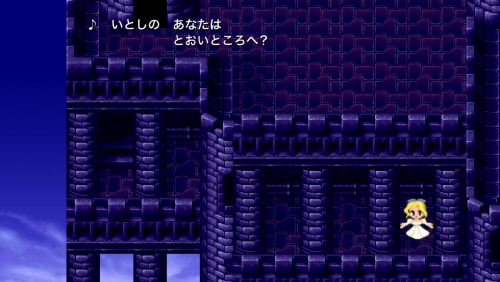
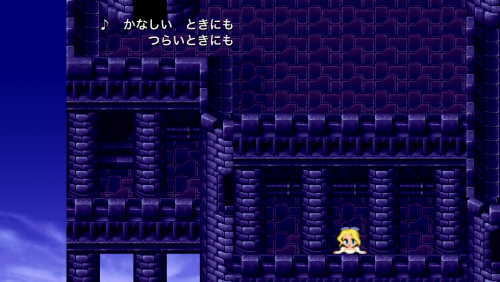
Back in the ‘90s and the early ‘00s when I first played through (parts of) FFVI, I had no idea how much the opera scene owed to karaoke culture, but now it’s totally clear. I mean, there’s a syllable for syllable midi voice of the Japanese lyrics.

karaoke1

karaoke2

Now I’m seriously surprised that I didn’t hear someone sing this at a karaoke box. Maybe I just didn’t karaoke with the right people.

At any rate, the first word of the song, いとし, is one of those classic karaoke words that you hear in countless songs. I’m never sure sure how reliable Chiebukuro is, but this post seems to suggest an evolution of the word.

Currently it means “beloved,” or something of that ilk, and it often gets attached to people’s names or pronouns. The Southern All-Stars have the best translation in their song いとしのエリー, which doesn’t even use the word いとし in the lyrics: Instead, the chorus is “Eri, my love, so sweet.” “X, my love” is a pretty nice rendering.

On a side note, after watching this video of サザン lead singer Keisuke Kuwata belt out the song, I can’t help but think he’s had a huge influence on Japanese rock vocals (even though I know next to nothing about Japanese rock).

http://youtu.be/S8ysnOJIKTw

His weird growl sounds similar to some imitations of “foreigner Japanese.” It also seems extremely ripe for parody…which I may have to attempt at karaoke soon.

A Questionable Cut

When I first read Hard-boiled Wonderland and the End of the World, I preferred the odd-numbered chapters with the data agent. I visited a few colleges that summer as I was reading it, and because of the book I was convinced I wanted to study cognitive neuroscience. Obviously I was a moron. What I really wanted was to live in the world of the data agent. Back then the End of the World chapters were speed bumps. I’m a slow reader, but I tore through those chapters to get on with the longer, more convoluted parts about memory, INKlings, and the chubby girl in pink.

Now it feels like the opposite, most likely because I’m reading in Japanese. It takes me forever to read through the odd-numbered chapters only to reveal another short episode in the End of the World, which I really savor. Also I’ve realized the End of the World chapters are much stronger. They’re lean compared to Murakami’s normal style, but just as tense and suspenseful and even more mysterious. It’s almost like a totally different author wrote them.

Chapter 23 “Holes, Leeches, Tower” is another massive speed bump chapter in the data agent Watashi’s world, and Birnbaum really pares down the Japanese throughout, rendering only the absolute necessities to get Murakami’s point across. It feels like he’s only writing three sentences for every five in Japanese. It’s a generous translation, though, and very funny.

Watashi and the Girl in Pink spend the chapter running through the underground area more, this time away from a tidal wave of water, and then climbing a massive altar. As in previous chapters, Watashi wants nothing to do with his circumstances, so he ends up daydreaming quite a bit. Birnbaum does a fantastic job of bringing out this element.

Most of these changes are not worth looking at closely, but Murakami does make one cut between the original and the Collected Works edition. Birnbaum, however, includes the cut section in the English translation. So this should show us something about Murakami’s work as an editor. Here’s the passage in Birnbaum’s version:

The next thing I realized was that my body was missing from the waist down. I reassessed the situation. My lower half was there, just unable to feel anything. I shut my eyes and concentrated. Trying to resurrect sensations below the belt reminded me of trying to get an erection. The effort of forcing energy into a vacuum.

So here I was, thinking about my friendly librarian with the gastric dilation and the whole bedroom fiasco. That’s where everything began going wrong, it now struck me. Still, getting a penis to erect itself is not the sole purpose of life. That much I understood when I read Stendhal’s Charterhouse of Parma years ago.

My lower half seemed to be stuck in some halfway strait. Or cantilevered out over empty space or…dangling off the edge of the rock slab. It was only my upper half that prevented me from falling. That’s why my hands were clinging to the rope so desperately. (232)

It’s clear that Birnbaum’s translation is clearly pretty slim without even looking at the original, but here it is with my re-translation:

私の下半身はもうなくなっているのかもしれない、と思った。地面に投げ出されたショックでちょうど傷口のあたりから私の体はふたつにちぎれ、下半身がどこかに吹きとんでしまったのだ。私の脚―と私は思った―私の爪先、私の腹、私のペニス、私の睾丸、私の……、しかしどう考えてもそれは不自然だった。下半身を全部失くしていたとしたら、私の感じる痛みはこの程度で済むわけがないのだ。

私はもっと冷静に状況を確認するべく試みることにした。私の下半身はちゃんと存在するのだ。それはただ何かを感じることのできない状況下にあるだけなのだ。私はしっかりと目を閉じて波のようにあとからあとから押し寄せてくる頭の痛みをやりすごし、神経を下半身に集中した。存在しないかのように感じられる下半身に神経を集中しようとする努力は、なんだか勃起しないペニスを勃起させようとする努力に似ているような気がした。それは何もない空間に力を押しこめているようなものなのだ。

私はそうしながら図書館で働いている髪の長い胃拡張の女の子のことを考えていた。やれやれ、なんだって私は彼女とベッドに入ったときにうまく勃起することができなかったのだろう、と私はまた思った。あのあたりからすべての調子が狂いはじめたのだ。しかしいつまでもそんなことを考えているわかにもいかなかった。ペニスを有効に勃起させることだけが人生の目的ではないのだ。それはずっと昔にスタンダールの『パルムの僧院』を読んだときに私が感じたことでもあった。私は勃起のことを頭の中から追い払った。

何はともあれ私の下半身は何かしら中途半端な状況に置かれているのだ、と私は確認した。たとえば宙ぶらりになっているような……そう、私の下半身は岩盤の向う側の空間にぶらさがり、私の上半身がそれが落下するのをかろうじて阻止しているのだ。そして私の両手はそのためにしっかりとロープを握りしめているのだ。31-32

Maybe my lower body is gone, I thought. The shock from being thrown to the ground must’ve torn my body in two right around my wound, and my lower half was blown off. My legs, I thought, my toes, my stomach, my penis, my testicles, my… but the more I thought about it, it just didn’t seem right. If I’d lost all of my lower body, I would be in a lot more pain than I was right now.

I tried to reassess the situation with a level head. My lower half still existed. It was just in a state of not being able to feel anything. I sealed my eyes shut, fought off the never-ending waves of pain that surged in my head, and focused on my lower body. I realized that trying to focus on a lower body that felt like it didn’t exist was somewhat similar to trying to force a penis that wouldn’t get hard into an erection. It was like trying to put force into a space with nothing in it.

In the process, I remembered the girl with long hair and gastric dilation who worked at the library. That went spectacularly, I thought. For whatever reason I’d been unable to get an erection the moment I got into bed with her. That was right around when everything started to go off the rails. But I couldn’t keep thinking about it. Being able to successfully produce erections isn’t the only reason for living. That’s something I’d realized when I read Stendhal’s The Charterhouse of Parma ages ago. I cleared my mind of hard-ons.

At any rate, I managed to confirm that my lower body had been placed in some sort of halfway state. For example, maybe it was dangling in air or… That was it. My lower body was dangling in the air over the side of a cliff, and my upper body was only just barely preventing me from falling. And that’s why my hands had a firm grip on a rope.

Ugh. My translation feels ugly and bloated and 直訳 compared with Birnbaum’s.

For the Complete Works edition (pages 333-334), Murakami chose to cut the entire third paragraph (highlighted in red) for some reason. It’s the only cut he chose to make for 25 pages (30 in the paperback)! What gives? There’s dozens of other lines that could have gone, and—trust me—Birnbaum finds them. There are entire passages that get dismissed in favor of moving the narrative along.

Was it the Stendhal reference? Or the Librarian? It can’t be the erections—he kept a few of those. I’m baffled by this one.

What say ye, reader?

Video Game Lingo – 始末

Fucking Ultros. I just got beat down in the opera house, and I’ve realized I probably either need to A) head back to Narshe and pick up another party member, B) hope that I can still add Shadow, or C) grind until I level enough to take the bastard down.

Which is basically to say that I haven’t made much progress in FFVI. I also haven’t found a seat on my commutes all that often. The El is unforgiving, especially between Sheridan and Fullerton, and I need at least one hand free when standing.

But I did come across this:

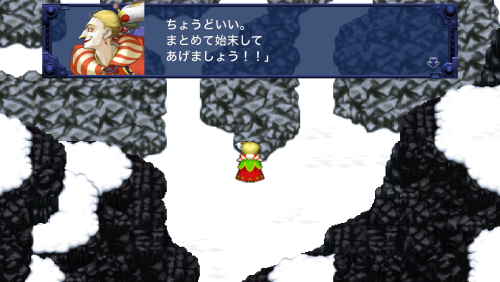
shimatsu

It pays to have a large vocabulary of words that mean “kill” or “destroy” when making video games, and 始末 is, effectively, one of those. In this case, the compound has the more general meaning “manage” or “deal with” (with an implied finality, thus death).

It’s also a cool kanji in its own right, combining two opposite characters for “beginning” (始) and “end” (末).

It has other meanings as well and confuses some with 仕末. This is a nice little blog post that concisely summarizes some of the frequently encountered forms:

「後始末」「跡始末」「始末書」「始末に負えない」などのように使います。

Fortunately for our heroes, Kefka isn’t that adept at dealing with them.

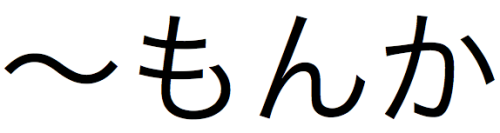
Cool Phrase – 〜もんか

monka I’ve got an article in the Japan Times Bilingual page today about the very interesting little particle か: “‘Ka’ can help you sound less like Mr. Roboto.”

For the most part か is harsh and striking (いいか?); it demands attention. This is especially true when compared with が, its softer more demure cousin (ちょっと聞きたいんですが). But I think the article points out a couple of places where maybe か can take the edge off and sounds very natural.

One of my favorite usages of the harsh and sharp か is 〜もんか. The quintessential example of this usage is 知るもんか. The English translation is “Like I know!” with an implied element of “(So why would you ask me/expect me to know?)” This is a great phrase but useful only in circumstances where you’re trying to express disbelief in the person you’re talking with; thus, it’s a fairly rude phrase.

You can attach it to a lot of different verbs to express your disbelief that you would ever do those verbs or that something would ever happen. そういうことやるもんか。そんなことあるもんか。

A Google search turns up a movie titled なくもんか which, judging from its poster, means something along the lines of “I’m not crying *sob*.”

A fun phrase, useful to deploy in certain circumstances.

On a side note, I can share a bit of good news: Barring grievous bodily injury or total mental collapse, I should be in the Japan Times Bilingual page every month this year, the first week of the month. Look for me there, and thanks for reading.

Booty Call, As It Were

Chapter 22 “Gray Smoke” is back in the End of the World. The Gatekeeper continues to burn the beasts, and Boku is blinded by the reflection of the sun off fresh snowfall. His eyes are in such pain that he is almost unable to work that night, so he and the Librarian talk and then look in the Collection Room for a musical instrument after Boku realizes that her mother used to sing.

This is a nice quick chapter after the beast that was Chapter 21.

One minor side note before I look at the translation: This chapter does give the singing in the previous chapter more context. As I was reading Chapter 21, it all felt unnecessary and kind of random, but I think that’s the point. In this chapter, when Boku tries to remember a song, he says, “I take a deep breath but find no music in my memory.”

It’s almost like he is straining to hear Watashi in the previous chapter. Both he and the Girl in Pink have no trouble just making up lyrics as they go, but Boku doesn’t have it that easy.

There aren’t many big cuts to the translation or in the Complete Works version, but Birnbaum (or his editor) does make the usual changes: Cuts to the narrator’s reactions to make them simpler and starker. As with the previous chapter, there’s a surprising moment of romance/sexuality. Here is the official translation:

“Is there nothing else I can do for you?” she says, looking up unexpectedly.

“You do so much for me already,” I say.

She stays her hand and sits facing me. “I mean something else. Perhaps you wish to sleep with me.”

I shake my head.

“I do not understand,” she implores. “You said you needed me.”

“I do. But now it is not right.” (225)

And here is the Japanese followed by my translation:

「私が何かあなたにしてあげられることはあるかしら?」と彼女はふと顔を上げて言った。

「君はとてもよくしてくれているよ」と僕は言った。

彼女は頭骨を拭いていた手を休めて椅子に座り、正面から僕の顔を見た。「私が言っているのはそういうことじゃないの。もっととくべつなこと。たとえばあなたのベッドに入るとか、そんなことね」

僕は首を振った。「いや、君と寝たいわけじゃないんだ。そう言ってくれるのは嬉しいけどね」

「どうして?あなたは私を求めているんでしょう?」

「求めているさ。でも少なくとも今は君と寝るわけにはいかないんだ。それは求めるとか求めないというのとはまたべつの問題なんだ」 (322-323)

She lifts her head suddenly and says, “Is there something I can do for you?”

“You already do so much for me,” I say.

She withdraws the hand she was using to wipe the skull, sits down, and looks me square in the face. “I’m not talking about those kinds of things. I mean something more special. For example, I could join you in bed, something like that.”

I shake my head. “No, it isn’t that I want to sleep with you. I’m glad that you would say that, but…”

“Why? You do want me, right?”

“I do. It’s just, I mustn’t sleep with you right now. It’s unrelated to wanting you or not wanting you.”

Yeah, I ripped off that one Birnbaum line “You already do so much for me” but I don’t think it can be improved. More importantly, you can see that BOHE cuts two sentences of dialogue from Boku and opts to have him remain silent when she offers to sleep with him. The cuts have a very interesting effect, not necessarily a bad one.

BOHE also add a dialogue tag for the Librarian. She “implores” Boku.

And perhaps the most curious translation from Birnbaum is his version of あなたのベッドに入るとか. “Perhaps you wish to sleep with me” puts the action back on Boku rather than keeping the Librarian as the subject. It also smoothes over the somewhat unusual (?) Japanese ベッドに入る with the regularly encountered English phrase “sleep with X.” I dunno…maybe BOHE has the right idea, maybe it’s better to not draw attention to it. At any rate, I think “For example, I could sleep with you” would be a more accurate rendering that maintains the Librarian as the subject.

Murakami-san no tokoro

Murakami’s new advice column/blog is online: http://www.welluneednt.com/

The site is titled 村上さんのところ (Murakami-san’s place)—pretty standard—but the domain name is curious. I was disappointed that I didn’t recognize it from the jazz standard “Well, You Needn’t,” a 1944 Thelonious Monk composition.

In my defense, I haven’t been listening to as much Monk lately (mostly “Thelonious Monk Plays Duke Ellington,” which may be the greatest album of all time), but I think the real culprit is the iPod-ification of all music. When I only carried 5-10 CDs in my car in rural Japan in 2005, I could’ve told you all the track names for “Thelonious Alone in San Francisco,” “Thelonious Himself” and “Solo Monk,” but alas, no longer. First I had an iPod classic with hundreds of albums, dozens from Monk, and now I have an iPhone that can stream just about anything (as long as I have wifi).

But back to the main point of this post: Murakami’s new column/blog. It’s nice. The design is simple and straightforward. The illustrations are well done. It’s easy to see the questions that Murakami has answered and to ask your own question. So far it’s very similar to some of the Murakami Asahido material and other public projects Murakami did (way before blogs were even a thing).

One of the most interesting things about the page is the “Categories” for the types of questions you can ask. Here is the list with my translation following:

1. 村上さんにおりいって質問したいこと・相談したいこと
2. 村上さんにちょっと話したいこと
3. 私の好きな場所・嫌いな場所
4. 「猫」あるいは「ヤクルト・スワローズ」関連

1. Things I want to ask Murkami/consult with him about
2. Things I’d like to tell Murakami about
3. Places I love/hate
4. (Things) related to cats or the Yakult Swallows

Very interesting. It seems like Murakami is looking for a pretty wide range of material. Questions and consultations, sure, but also just some randomness from his readers, things he can kind of bounce his thoughts off of and produce funny/quirky/interesting/readable material.

Obviously you sign away all rights when you ask a question. This stuff is going into a book in the not too distant future. You can ask questions until the end of January, and the site will be online until the end of March.

He’s going through questions at a pretty intense pace: He responded to six different inquiries on a Sunday (1/18)! I read through all of the entries through 1/17 and did some quicky translations on Twitter of interesting posts. Here are the results:

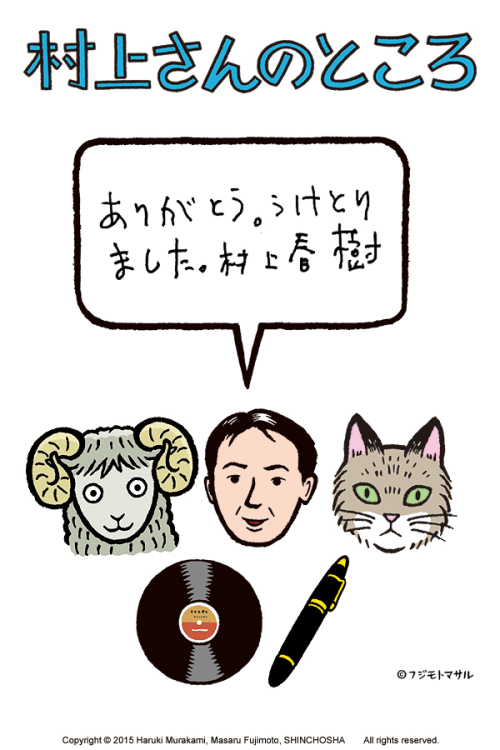
And when you ask a question, you get a very cool confirmation email with this graphic from the website:

murakamiCheck my Twitters for more translations in the coming weeks. I’ll plan to read through the posts as he answers…I want to see if he answers my question.


Final Fantasy VI on iOS in Japanese

I have another Bilingual page column in the Japan Times today: “The myths and misery of translating Japanese video games.”

It’s sort of a redux of my post “On Translation and Me” (which was later syndicated at Kotaku) with a few of my Video Game Lingo posts thrown in for good measure.

I haven’t done much video game translation recently, unfortunately. I did a bit in the summer of 2013, and it was a reminder of how difficult and complicated translating dialogue for a major game can be. I only did about 10,000 characters or so, but I got a small peak inside the workings of a larger translation company. It was impressive. I will always be in awe of folks who are able to build living, breathing characters from context-less dialogue text alone. Translators rarely get to see the game they are working on.

I have, however, been doing more Japanese video games. Square has put out a lot of their old catalogue on mobile platforms in recent years, and they were on sale for 50% off until January 5th. So I picked up Final Fantasy VI for iOS.

I somehow scraped together the $60 for Chrono Trigger on the SNES back in the 1990s and spent a week one summer devoted to it, but I never managed to play through Final Fantasy III (née VI). I have at various times played emulated versions partway through (once during college, I believe, and once while I was teaching on JET), but I’ve never beaten it.

I’m a couple hours in and here are some thoughts in game-chronological order:

ffvi01

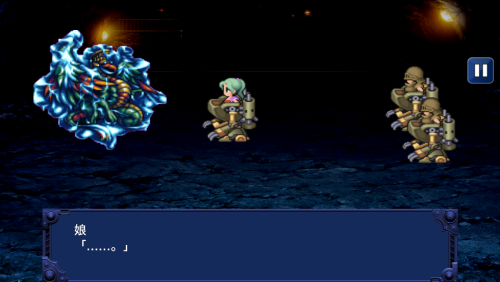
Japanese dialogue has a tendency to use a ton of ellipsis. I’m not quite sure if there is a standard way to deal with these. Occasionally you can translate around them, but it’s sometimes easiest to just leave them.

ffvi02

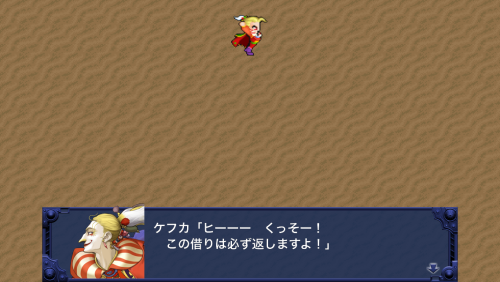
Kefka is even more ridiculous and evil in Japanese. (Partly due to the illustration. An inspiration for the Joker in the Dark Knight movies, perhaps?) As you can see, the language is more colorful in the Japanese original. くそ gets thrown around pretty lightly. Kefka’s infamous laugh, however, is merely ヒッヒッヒ or some variation, which is a bit of a disappointment because the English laugh is so legendary.

This screen grab also has a great word that pops up frequently in games: 借り (かり). 借りができたぞ is a way to say “I owe you one.” I distinctly remember a translator delivering a project with that line, and I was blown away by how succinct and spot on he was. There is a great Chiebukuro post about this phrase and 貸しができる.

Here, Kefka ironically shows that he will 返す the 借り(generally a good thing) without fail (必ず).

ffvi03

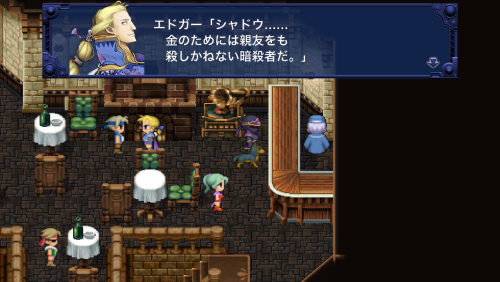
Here’s a great example of the double particle をも and ~かねない, one of my favorite phrases.

ffvi04

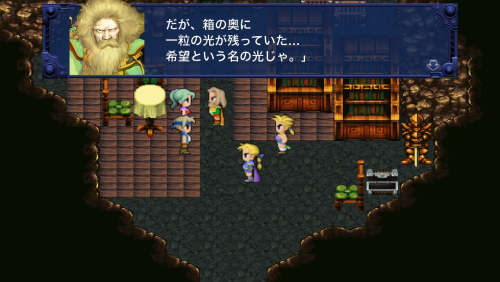
The (new?) character illustrations are great, and Banon looks awesome. You can tell he’s old because he’s got the old-man じゃ in place of the standard copula.

ffvi05

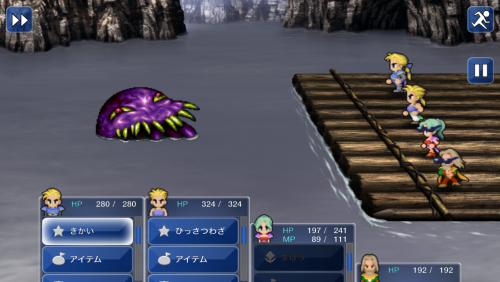
Go home, Ultros, you’re drunk.

ffvi06

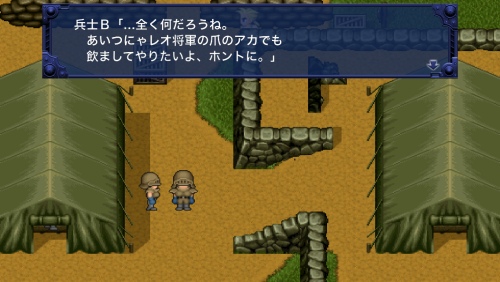
Here’s a lovely-sounding Japanese idiom: 爪(つめ)のアカでも飲ましてやる. Literally: Make someone “drink” the crap under their nails. The kicker is that it’s not even their own nails: It’s someone else’s nail crud. アカ is also given as the kanji 垢, but I assume it’s kana-ized to allow younger players to understand in this case. I wrote a post about this idiom and got a couple of really great comments. Basically, these troops want Kefka to be a little more like Leo…which would happen if Kefka drank some of Leo’s toenail crud. Here’s what one of the commenters noted about the phrase:

In a scenario (profession, trade or any organization) where a rookie without a clue tends to blunder from one breach of etiquette after another, and where a sage advice clearly would be wasted, the only economic advice is to suggest such a concoction be consumed. But, this is said with one’s tongue in cheek only to underline the hopelessness of the endeavor.

So perhaps “take a page out of [somebody’s] book (which happens to be written in a language they probably won’t understand)” would be an appropriate translation.

ffvi07

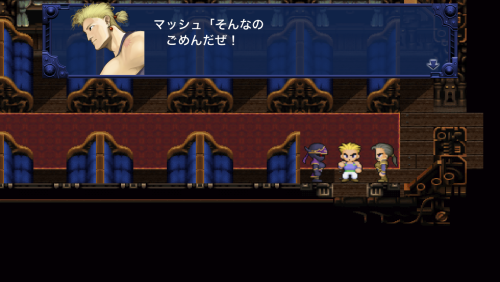
Here’s a nice example of a use of ごめん that isn’t ごめんなさい. I can’t remember what exactly was happening (this is on the ghost train), but whatever it is マッシュ (Sabin) doesn’t want to do it, and expresses that with ごめん. It’s sometimes used with だけ in the expression 〜だけごめんだ to express “the one thing” that someone doesn’t want to do.

ffvi08

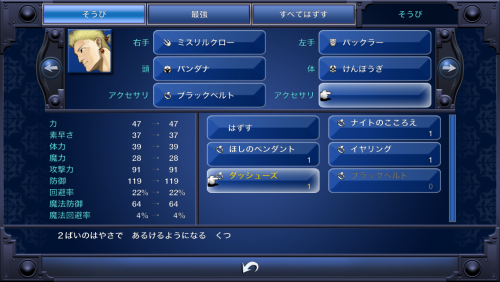
And one thing I noticed in the menu: The explanations for the the different items are given only in kana. This isn’t unusual, I don’t think, but it is a little strange given that all of the story is given in both kanji and kana. Just another reminder that kanji are awesome and reading kana-only writing takes a different set of muscles that you lose quickly once you move past the most basic stages of Japanese study.

Everything about this reboot is great. The graphics are slick and the sound is fantastic. I’m confident that I’ll be able to finish the game this time around, thanks in part to my commute, and because it’s in Japanese I won’t feel guilty about doing so.

The Birds and the Trees

camphor

Final post for Chapter 21 “Bracelets, Ben Johnson, Devil,” the final chapter of the first half of the novel.

As we’ve seen in Posts 1, 2, 3, and 4, this chapter is long and isolates Watashi and the Girl in Pink. Birnbaum’s (or his editor’s) cuts in translation simplify her as a character. They eliminate her interests in sex and eliminate some of Watashi’s reaction to her as a sexual being. These might seem like excusable cuts—and many of them are, especially her “Bicycle Song”—but a scene cut near the end of the chapter helps put these seemingly light sections in context.

After the two of them sing to distract themselves, they make it to a plateau and continue onward. Watashi falls asleep, lured by the INKling trap, so they tie themselves together with rope. Watashi briefly goes back into his thoughts, but the Girl in Pink suggests they sing again and then, when Watashi rejects more songs (thankfully), that they have a conversation.

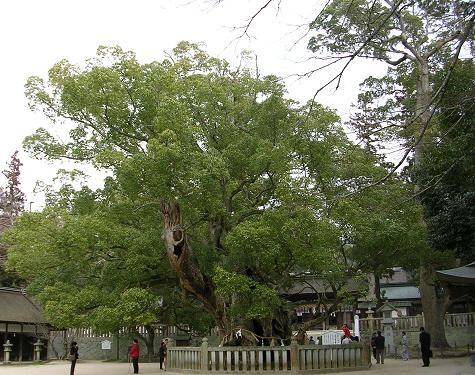
They decide to talk about rain, which leads to her character background: Her family all died in a car accident while she was in the hospital recovering from a heart operation. While she was in the hospital, she watched the birds on a camphor tree outside the window. Watching the birds made her sad.

Birnbaum’s translation of her back story makes some cuts but captures almost everything. Here’s how Birnbaum treats the subsequent passage, which has more cuts:

“It made you sad?”

“Because, like I said, there’s go to be millions of trees in the world and millions of birds and millions of rainfalls. But I couldn’t even figure one out, and I’d probably die that way. I just cried and cried, I felt so lonely. And that was the night my whole family got killed. Though they didn’t tell me until much later.”

“That must have been horrible.”

“Well, it was the end of the world for me. Everything got so dark and lonely and miserable. Do you know what that feels like?”

“I can imagine,” I said.

Her thoughts on rain occupied my thoughts. So much so I didn’t notice that she’d stopped and I bumped into her, again. (220)

And here’s how it looks in the Japanese:

「どうして?」

「たぶん世界が数えきれないほどの木と数えきれないほどの鳥と数えきれないほどの雨ふりに充ちているからよ。それなのに私にはたった一本のくすの木とたったひとつの雨ふりさえ理解することができないような気がしたの。永遠にね。たった一本のくすの木とたったひとつの雨ふりさえ理解できないまま、年をとって死んでいくんじゃないかってね。そう思うと、私はどうしようもなく淋しくなって、一人で泣いたの。泣きながら、誰かにしっかりと抱きしめてほしいと思ったの。でも抱きしめてくれる人なんて誰もいなかった。

それで私はひとりぼっちで、ベッドの上でずっと泣いていたの。

そのうちに日が暮れて、あたりが暗くなり、鳥たちの姿も見えなくなてしまったわ。だから私には雨が降っているのかどうか、たしかめることもできなくなってしまったの。その夕方に私の家族はみんな死んでしまったわ。私がそれを知らされたのはずっとあとのことだったけれどね」

「知らされたときは辛かっただろうね」

「よく覚えてないわ。そのときは何も感じなかったんじゃないかっていう気がするの。覚えているのは、私がその秋の雨ふりの夕暮に誰にも抱きしめてもらえなかったということだけ。それはまるで—私にとっての世界の終わりのようなものだったのよ。暗くてつらくてさびしくてたまらなく誰かに抱きしめてほしいときに、まわりに誰も自分を抱きしめてくれる人がいないというのがどういうことなのか、あなたにはわかる?」

「わかると思う」と私は言った。

「あなたは愛する人をなくしたことがある?」

「何度かね」

「それで今はひとりぼっちなのね?」

「そうでもないさ」とベルトに結んだナイロンのロープを指でしごきながら私は言った。「この世界では誰もひとりぼっちになることなんてできない。みんなどこかで少しずつつながってるんだ。雨も降るし、鳥も鳴く。腹も切られるし、暗闇の中で女の子とキスすることもある」

「でも愛というものがなければ、世界は存在しないのと同じよ」と太った娘は言った。「愛がなければ、そんな世界は窓の外をとおりすぎていく風と同じよ。手を触れることもできなければ、匂いをかぐこともできないのよ。どれだけ沢山の女の子をお金で買っても、どれだけ沢山のゆきずりの女の子と寝ても、そんなのは本当のことじゃないわ。誰もしっかりとあなたの体を抱きしめてはくれないわ」

「そんなにしょっちゅう女の子を買ったり、ゆきずりで寝てるわけじゃないさ」と私は抗議した。

「同じことよ」と彼女は言った。

まあそうかもしれない、と私は思った。誰かが私の体をしっかりと抱きしめてくれるわけではないのだ。私も誰かの体をしっかりと抱きしめるわけではない。そんな風に私は年をとりつづけているのだ。海底の岩にはりついたなまこのように、私はひとりぼっちで年をとりつづけるのだ。

私はぼんやりと考えごとをしながら歩いていたせいで、前を行く彼女が立ち止まったのにきがつかず、そのやわらかい背中にぶつかってしまった。(314-316)

“Why (did it make you sad)?”

“Probably because the world is full of countless trees and countless birds and countless rainy days, but I felt like I couldn’t even understand a single tree and a single rainy day. And I never would. Like I’d die without being able to understand a single camphor tree and a single rainy day. When I thought about that, I couldn’t help feeling incredibly sad, so I cried by myself. And while I cried, the whole time I kept wanting someone to hold me. But there was no one to hold me.

“So I just cried there on the (hospital) bed, all by myself.

“Eventually the sun set, everything got dark, and I couldn’t see the birds anymore. So I wasn’t able to tell whether it was still raining or not anymore. That night my whole family died. I wasn’t told until much later, though.”

“It must’ve been tough when they told you.”

“I don’t really remember. I probably didn’t feel anything when they told me. The only thing I remember is not having anyone to hold me on that rainy Autumn evening. It was like—the end of the world for me. Do you know what that’s like? To be incredibly sad, in pain, in the dark and to want someone to hold you but not to have anyone around to hold you?”

“I think I understand,” I said.

“Have you ever lost someone you loved?”

“Several times.”

“And now you’re lonely?”

“Not really,” I said as I drew the nylon rope connected to my belt through my fingers. “No one in this world can ever be lonely. Everything is connected somewhere in some slight way. Rain will fall and birds will sing. You might get your stomach cut, but sometimes you get to kiss girls in the dark.”

“But if there’s no love, that’s the same as the world not existing,” the plump girl said. “If you don’t have love, the world is just wind passing outside of a window: You can’t touch it or smell it. No matter how many girls you buy and how many girls you sleep with casually, it’s not real. None of them are going to hold you tightly.”

“I don’t buy girls or have casual sex all that often,” I protested.

“It’s still the same,” she said.

I guess so, I thought. No one was going to hold me tightly. Nor was I going to hold anyone tightly. I would keep getting older just like that. I would keep getting older alone, like a sea cucumber stuck to the ocean floor.

I drifted off into my thoughts as I walked and didn’t realize that the girl had stopped, so I ran right into her soft back.

Birnbaum (or his editor) has to cut part of this because BOHE already cut the makeout scene earlier in the chapter, which informs all the talk of “being held tightly.”

The Girl in Pink’s back story is pretty made-for-TV, but it makes her more compelling than she is without it, and this cut part in particular makes her seem much more human in all the scenes that were cut previously. I wouldn’t be surprised if some of these ideas return in the second half of the novel (and get cut/trimmed there as well). Only one way to find out.