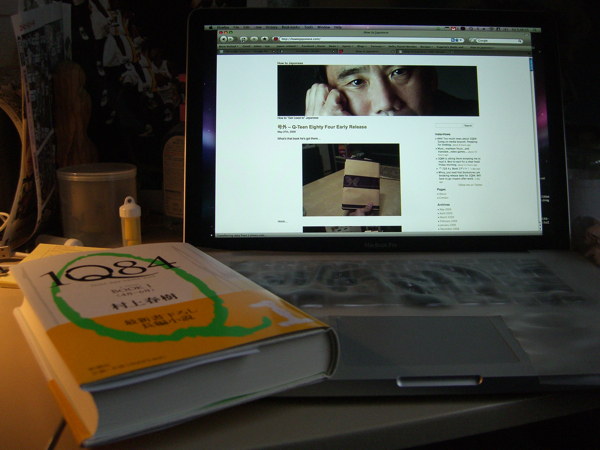
With the goal of stirring up even more interest in Murakami between now and October, when the Nobel Prizes are announced, I will post a small piece of Murakami translation/analysis/revelation once a week from now until the announcement. You can see past entries in the series here.
Chapter 9 “Appetite, Disappointment, Leningrad” is one of the most fascinating chapters in the book so far because of the work that Birnbaum does in translation and the changes that Murakami makes for the Complete Works.
In this chapter, the librarian comes in, Watashi cooks a nice dinner spread for her, and she eats everything he puts in front of her (thanks to her gastric dilation). Then they drink, listen to records, and, eventually, are unable to have sex when Watashi can’t get an erection. He blames it on thinking about all the food she just ate but doesn’t say that to her. So instead, they have a few more drinks and she reads to him from the books on unicorns she brought over for him.
Before we look closely at the text, it’s important to note that Birnbaum does some serious adaptation in this chapter. In Japanese, the second half of the chapter is a dialogue between Watashi and the Librarian: all the information about unicorns is given within quotation marks, and Watashi mostly listens but occasionally butts in with a question or comment.
In English, Birnbaum combines their dialogue together and renders it all in exposition provided by the narrator Watashi. This requires a lot of cuts of small lines, but he does do an impressive job of maintaining the tone, and he exits from the exposition on occasion to keep the best of the interactions between the two. Such as this one:
The skull next saw the light of day in 1935. Petrograd had since become Leningrad. Lenin was dead, Trotsky was in exile, and Stalin was in power. No one rode horses in Leningrad. The old stablemaster had sold half his premises, and in the remaining half he opened a small hockey goods shop.
*
“Hockey?” I dropped my jaw. In the Soviet thirties?”
“Don’t ask me. That’s just what I read. But who knows? Post-Revolution Leningrad was quite your modern grad. Maybe hockey was all the rage.” (101)
He cuts out of the unicorn information and back into reality in his bedroom with a space break and switches back into dialogue: a very creative technique to help make all this conveyance of information seem less laborious. Because let’s face it – Murakami is known for devoting huge chunks of his novels to the latest classical musician he’s been listening to or Russian novel he’s been reading. This is something he did even in his early books. In this book and in A Wild Sheep Chase, however, he manages to contain himself a little and tie in the all the excess information with the plot and theme. Still, Birnbaum improves on the original.
[Here is Rubin’s version of this passage:
“It was 1935 before the skull saw the light of day again. By then, Petrograd had become Leningrad, Lenin himself was dead, Trotsky had been exiled, and Stalin had a firm grip on power. Nobody in Leningrad rod on horses anymore, so the harness maker sold half his business and converted the rest to a little shop selling hockey gear.”
“Hockey gear?” I asked. “Was hockey popular in the 1930s Soviet Union?”
“I have no idea,” she said. “I’m just telling you what it says here. But Leningrad was a rather modern city even after the revolution, so I wouldn’t be surprised if everybody played hockey.” (102)
]
And now let’s take a look at some of the cuts. Here’s how the official translation looks with them in bed:
After dessert, we’d had another round of bourbon and beer, listened to a few records, then snuggled into bed. And like I said, I didn’t get an erection.
Her naked body fit perfectly next to mine. She lay there stroking my chest. “It happens to everyone. You shouldn’t get so worked up over it.” (92)
There is, however, a section cut from between these two paragraphs. I’ll use Birnbaum’s translations where applicable. The translation follows immediately in the blockquote. Here’s the version from the original 1985 text:
我々はデザートのあとでウィスキーとビールを飲みながらレコードを二枚か三枚聴き、それからベッドにもぐりこんだのだ。これまでにけっこういろんな女の子と寝てきたが、図書館員と寝るのははじめてだった。そしてまたそれほど簡単に女の子と性的関係に入ることができたのもはじめてだった。たぶんそれは私が夕食をごちそうしたせいだと思う。でも結局、さっきも言ったように、私のペニスはまったく勃起しなかった。胃がイルカのおなかみたいに膨らんでいるような気がして、どうしても下腹部に力が入らないのだ。
彼女は裸の体をぴったりと私のわきにつけ、中指で私の胸のまん中を十センチくらい何度も上下させた。「こういうのって、誰にでもたまにはあることなんだから、必要以上に悩んじゃ駄目よ」(156)
After dessert, we’d had another round of bourbon and beer, listened to a few records, then snuggled into bed. I’ve slept with my fair share of girls, but it was my first time sleeping with a librarian. It was also the first time I’d gotten into a sexual relationship with a girl so easily. I thought it was probably because I’d made her dinner. But in the end, as I said, I couldn’t get an erection. I just couldn’t get my loins going with the image of her belly swollen like dolphin in my head.
Her naked body fit perfectly next to mine. She lay there stroking my chest. “It happens to everyone. You shouldn’t get so worked up over it.”
And now here’s the 1990 Complete Works adjustments:
我々はデザートのあとでウィスキーとビールを飲みながらレコードを二枚か三枚聴き、それからベッドにもぐりこんだのだ。これまでにけっこういろんな女の子と寝てきたが、図書館員と寝るのははじめてだった。たぶんそれは私が夕食をごちそうしたせいだと思う。でも結局、さっきも言ったように、私のペニスはまったく勃起しなかった。胃袋に呑みこまれ消化されつつある食品のことを思うと、どうしても下腹部に力が入らないのだ。
彼女は裸の体をぴったりと私のわきにつけ、中指で私の胸のまん中を十センチくらい何度も上下させた。「こういうのって、誰にでもたまにはあることなんだから、必要以上に悩んじゃ駄目よ」(129)
After dessert, we’d had another round of bourbon and beer, listened to a few records, then snuggled into bed. I’ve slept with my fair share of girls, but it was my first time sleeping with a librarian. I thought it was probably because I’d made her dinner. But in the end, as I said, I couldn’t get an erection. I just couldn’t get my loins going when I thought about all the food that was being digested in her stomach.
Her naked body fit perfectly next to mine. She lay there stroking my chest. “It happens to everyone. You shouldn’t get so worked up over it.”
Birnbaum chose not to include the passage entirely, but it’s also clear that Murakami made minor adjustments in his own version. Really minor. He cuts the dolphin line, which is slightly more grotesque and mean than the image of food digesting, and he cuts the line about the librarian being the easiest girl he ever had – in both cases it makes her look better and the narrator seem nicer. Perhaps Murakami was feeling a little self conscious about the line and made the cuts for that reason.
[Rubin’s version:
After dessert, we had drunk more whiskey adn beer while listening to two or three records, and then had crawled into bed. I had slept with plenty of girls over the years, but she was my first librarian. That was probably why I had treated her to dinner. Finally, though, as I just said, I couldn’t get an erection. The thought of all the food that had been taken into—and was now in the process of being digested in—taht stomach of hers was enough to prevent the energy from doing down to where I needed it.
Pressing her naked body against me, she ran her middle finger a few inches up and down the center of my chest. “This happens to everybody once in a while, so don’t let it bother you too much.” (92)
]
Murakami further adjusts the characterization of Watashi later in the chapter, unfortunately by cutting some very funny sections. Take, for example, this passage from the 1985 version:
彼女が全裸でベッドを出て、キッチンでウォッカ・トニックを作っているあいだに、私は『ティーチ・ミー・トゥナイト』の入ったジョニー・マティスのレコードをプレイヤーに載せ、ベッドに戻って小さな声で合唱した。私と私のやわらかなペニスとジョニー・マティスと。 (161)
Very funny and typical Murakami. Here is Birnbaum’s acurrate rendering:
She got out of bed and walked naked to the kitchen to mix two vodka tonics. While she did that, I put on my favorite Johnny Mathis album. The one with Teach Me Tonight. Then I hummed my way back to bed. Me and my limp penis and Johnny Mathis. (94)
For some reason, Murakami decides to do away with most of this section! Here’s the 1990 version:
彼女が全裸でベッドを出て、キッチンで二人分のウォッカ・トニックを作り、それを持ってベッドに戻ってきた。 (132)
She got out of bed totally naked, made two vodka tonics in the kitchen, and brought them back to bed.
[Rubin’s version:
She got up naked, made two vodka and tonics in the kitchen, and brought them back to bed. (94)
]
I don’t get it. We lose the interiority and all of Watashi’s personality. Maybe Murakami didn’t want him to seem so easy-going.
There’s one other spot where he makes edits to adjust Watashi’s character slightly. Here’s the passage from Birnbaum:
“When was the last time you slept with someone?” she asked.
“Maybe two weeks ago,” I said.
“And that time, everything went okay?”
“Of course,” I said. Was my sex life to be questioned by everyone these days?
“Your girlfriend?”
“A call girl.”
“A call girl? Don’t you feel, how shall I put it, guilt?”
“Well…no.”
“And nothing…since then?”
What was this cross-examination? “No,” I said. “I’ve been so busy with work, I haven’t had time to pick up my dry-cleaning, much less wank.” (92)
You can see from the 1985 edition that Birnbaum has made a few adjustments here:
「この前女の子と寝たのはいつ?」と彼女が訊いた。
私は記憶の箱のふたを開けて、その中をしばらくもそもそとまさぐってみた。「二週間前だな、たしか」と私は言った。
「そのときはうまくいったのね?」
「もちろん」と私は言った。ここのところ毎日のように誰かに性生活についての質問をされているような気がする。あるいはそういうのが世間で今はやっているのかもしれない。
「誰のやったの?」
「コールガール。電話して呼ぶんだ」
「そういう種類の女の人と寝ることについてそのとき何か、そうねえ、罪悪感のようなものは感じなかった?」
「女の人じゃない」と私は訂正した。「女の子、二十か二十一だよ。罪悪感なんてべつにないよ。さっぱりしててあとくされもないしさ。それにはじめてコールガールと寝たわけでもない」
「そのあとマスターベーションした?」
「しない」と私は言った。そのあと私はとても仕事が忙しくて、今日までクリーニングに出したままの大事な上着をとりに行く暇もなかったのだ。マスターベーションなんてするわけがない。 (157-158)
“When was the last time you slept with a girl?” she asked.
I pried open my brain and, for a moment, rummaged around the memories inside. “Two weeks ago, roundabouts,” I said.
“And it went okay that time?”
“Of course,” I said. It felt like someone was asking me about my sex life every damn day these days. Or maybe that’s what the world’s come to.
“Who did you sleep with?”
“A call girl. I called one up.”
“Don’t you ever feel, how should I put it, guilty when you sleep with women like that?”
“They aren’t women,” I corrected her. “They’re girls – twenty or twenty-one. I don’t feel guilty at all. It feels great, and there’s nothing to worry about after. And it wasn’t like it was my first time sleeping with a call girl.”
“Did you masturbate after that at all?”
“Nope,” I said. After that I’d been so busy with work that I hadn’t even had time to pick up one of my best jackets at the cleaners until today. So no, I hadn’t jerked off.
Birnbaum cuts Watashi’s “correction,” which seems perhaps a bit mysognistic. This eases up a little on the harshness of the character. As you can see, Murakami makes similar alterations to the 1990 version:
「この前女の子と寝たのはいつ?」と彼女が訊いた。
私は記憶の箱のふたを開けて、その中をしばらくもそもそとまさぐってみた。「二週間前だな、たしか」と私は言った。
「そのときはうまくいったのね?」
「もちろん」と私は言った。ここのところ毎日のように誰かに性生活についての質問をされているような気がする。あるいはそういうのが世間で今はやっているのかもしれない。
「誰のやったの?」
「コールガール。電話して呼ぶんだ」
「そういう種類の女の人と寝ることについてそのとき何か、そうねえ、罪悪感のようなものは感じなかった?」
「とくに感じなかったと思うけれど」と私は言った。
「そのあとマスターベーションした?」
「しない」と私は言った。そのあと私はとても仕事が忙しくて、今日までクリーニングに出したままの大事な上着をとりに行く暇もなかったのだ。マスターベーションなんてするわけがない。 (129-130)
“When was the last time you slept with a girl?” she asked.
I pried open my brain and, for a moment, rummaged around the memories inside. “Two weeks ago, roundabouts,” I said.
“And it went okay that time?”
“Of course,” I said. It felt like someone was asking me about my sex life every damn day these days. Or maybe that’s what the world’s come to.
“Who did you sleep with?”
“A call girl. I called one up.”
“Don’t you ever feel, how should I put it, guilty when you sleep with women like that?”
“No, not really,” I said.
“Did you masturbate after that at all?”
“Nope,” I said. After that I’d been so busy with work that I hadn’t even had time to pick up one of my best jackets at the cleaners until today. So no, I hadn’t jerked off.
[Rubin’s version:
“When’s the last time you slept with a girl?” she asked.
I opened my memory box and fumbled around inside there for a while. “Two weeks ago,” I said. “I’m pretty sure.”
“And it worked okay?”
“Of course,” I said. Someone seemed to be asking me about my sex life every day lately. Or maybe it was just the latest fashion.
“Who was it with?”
“A call girl. I called her.”
“And didn’t you feel a little…guilty at the time, sleeping with a woman like that?”
“No, not especially, I don’t think I did.”
“And have you masturbated since then?”
“No, I have not,” I said. I had been so busy with work since then that I hadn’t found the time to pick up an important jacket I had left at the cleaners, let alone the time to masturbate. (93)
]
This version of Watashi isn’t quite as defensive about the whole call girl thing. When we take all of these passages together, it feels like Murakami is making this narrator a little bit more sympathetic than in the first edition.
However, the biggest change comes to Murakami’s characterization of the librarian in the section immediately before she begins to read to him. She begins to ask him all sorts of questions about who he is and what he does because she’s noticed the switchblade he had in his shorts for protection when opening the door. When she points this out to him, he explains his line of work. Here’s the official translation:
“Oh,” I said, “in my line of work, you can’t be too careful. I process data. Biotechnology, that sort of thing. Corporate interests involved. Lately there’s been a lot of data piracy.”
She didn’t swallow a word of it. “Why don’t we deal with our unicorn friends. That was your original purpose in calling me over here, wasn’t it?” (94)
There isn’t too much different in the 1990 Complete Works version:
「生物学関係のデータ処理をしているんだ。一種のバイオテクノロジーで、企業利益がからんでいるものだからね。それで用心をしてるんだ。最近はデータの奪いあいも物騒になってきたもんでね」
「ふうん」と彼女は今ひとつ納得しかねるような顔つきで言った。「まあいいわ。とにかく一角獣の話をしましょう。そもそもはそれが私を呼んだ本来の目的だったんでしょう?」 (133)
“I process biological data. It involves biotechnology and corporate profits, so I’ve gotta look after myself. Lately everyone is up in arms about data theft.”
“Hmm,” she said, looking unconvinced. “Whatevs. Let’s talk about unicorns. That’s why you called me over here in the first place, right?”
So basically, Birnbaum provides an accurate translation. All the pieces are accounted for, if you compare it with the 1990 Complete Works edition.
[Here’s Rubin’s version:
“I do biological data processing. It’s a kind of biotechnology, and since it involves corporate profits, I have to be careful. Data piracy between corporations has become a dangerous game lately.”
“Hmm,” she said and gave me a look that signaled she didn’t quite believe me. “Oh, well, never mind. Let’s talk about unicorns. That’s what you called me for to begin with, wasn’t it?” (95)
]
However, the 1985 version is drastically different, which you’ll notice from sheer length alone:
「生物学関係のデータ処理をしているんだ。一種のバイオテクノロジーで、企業利益がからんでいるものだからね。それで用心をしてるんだ。最近はデータの奪いあいも物騒になってきたもんでね」
「ふうん」と彼女は今ひとつ納得しかねるような顔つきで言った。
「君だってコンピューターを操作しているけれど、とてもコンピューター関係者には見えないぜ」と私は言った。
彼女は指の先でしばらくこつこつと前歯を叩いていた。「だって私の場合は、ほら、完全な実務レベルだもの。末端を処理しているだけ。蔵書のタイトルを項目べつにインプットして、リファレンスのために呼びだしたり、利用状況を調べたり、その程度のことね。もちろん計算も出来るけど……。大学を出てから二年間コンピューター操作専門の学校にかよったの」
「君が図書館で使ってるのはどんなコンピューター?」
彼女はコンピューターの型番を教えてくれた。最近型の中級オフィス・コンピューターだが、性能は見かけよりずっと優れていて、使い方次第ではかなり高度な計算をすることもできる。私も一度だけ使ったことがある。
私が目を閉じてコンピューターのことを考えているあいだに、彼女が新しいウォッカ・トニックをふたつ作って持ってきた。それで我々はまた二人並んで枕にもたれ、二杯めのウォッカ・トニックをすすった。レコードが終わるとフル・オートマティックのプレイヤーの針が戻り、ジョニー・マティスのLPをもう一度頭から演奏しなおした。それで私はまた「空は大きな黒板で―(ザ・スカイ・ザ・ブラックボード)」と口ずさむことになった。
「ねえ、私たち似合いだと思わない?」と彼女が私に言った。彼女のウォッカ・トニックのグラスの底がときどき私の腹に触れてひやりとした。
「似合い?」と私はききかえした。
「だってあなたは三十五だし、私は二十九だし、ちょうどいい歳だと思わない?」
「ちょうどいい歳?」と私は繰りかえした。彼女のオウム型反復がすっかり私の方に移ってしまったようだった。
「これくらいの歳になれば、お互いちゃんといろんなことも心得てるし、どちらもひとり身だし、私たち二人でけっこううまくやれるんじゃないかしら。私はあなたの生活に干渉しないし、私は私なりにやるし……私のこと嫌い?」
「そんなことないさ、もちろん」と私は言った。「君は胃拡張だし、こちらはインポテントだし、似合いかもしれない」
彼女は笑って手をのばし、私のやわらかいペニスをそっとつかんだ。ウォッカ・トニックのグラスを持っていた方の手だったので、とびあがりそうなくらい冷たかった。
「あなたのはすぐになおるわ」と彼女は私の耳もとで囁いた。「ちゃんとなおしてあげる。でもべつに急いでなおさなくてもいいのよ。私の生活は性欲よりはむしろ食欲を中心にまわっているようなものだから、それはそれでかまわないの。セックスというのは、私にとってはよくできたデザート程度のものなの。あればあるにこしたことないけれど、なくてもそれはそれでべつにかまわないの。それ以外のことがある程度満足できればね」
「デザート」と私はまた反復した。
「デザート」と彼女も繰りかえした。「でもそのことについてはまた今度キチンと教えてあげる。その前に一角獣の話をしましょう。そもそもそれが私を呼んだ本来の目的だったんでしょう?」 (162-165)
“I process biological data. It involves biotechnology and corporate profits, so I’ve gotta look after myself. Lately everyone is up in arms about data theft.”
“Hmm,” she said, looking unconvinced.
“I mean, you use computers,” I said, “but you don’t look like a computer whiz.”
She tapped on her front teeth with the tips of her fingers for a moment. “But in my case, come on, I only use it for purely practical reasons. I just control the interface. I input the titles in the stacks based on subject and then look things up for reference or to see if it’s checked out, that sort of thing. Of course I can do calculations with it…after college I went to a computer technical school for two years.”
“What kind of computer do you use at the library?”
She told me the model number of the computer. It was a recent mid-level office computer, but it had more horsepower than its appearances suggested, and given the right user, it could complete pretty high-level calculations. Even I’d only ever used one once.
I closed my eyes and thought about computers, and while I did, she refreshed our vodka tonics and came back. So we rested against the pillows, side by side, and sipped our second vodka tonics. When the record finished, the needle on the full automatic player returned to the beginning and played the Johnny Mathis record again from the start. Again I ended up singing along quietly: “The sky’s a blackboard high above you.”
“Say,” she said to me, “we match up pretty well, don’t you think?” The ice-cold bottom of her glass brushed against my stomach every now and then.
“Match-up?” I asked back.
“You’re 35, I’m 29 – our ages are just right, aren’t they?”
“A-ges are just right?” I repeated. Apparently I’d been infected with her om-like meditative repetitions repetitive parroting.
“Once you get to our age, both people have an understanding of different things. We’re also both single. We might work out well together. I won’t meddle in your life, and I have my own stuff going on… What? Do you not like me?”
“No, of course I do,” I said. “You’ve got gastric dilation, and I’m impotent. Maybe we do match up.”
She laughed and reached out to take my soft penis gently in her hand. It was the hand she’d been holding her vodka tonic with, so it was cold enough to make you jump out of bed.
“You’ll get better soon,” she whispered into my ear. “I’ll fix you. But there’s no rush. My life is centered around my appetite more so than my libido, so I don’t mind. Sex, to me, is like a really well made dessert. There’s nothing better when it’s good, but I’m fine without it as well. As long as everything else is more or less satisfying.”
“De-ssert,” I said, again in a chant.
“De-ssert,” she repeated. “I’ll tell you all about it next time. But first let’s talk about unicorns. That’s why you called me over here in the first place, right?”
This section is great! It’s hilarious and sweet in a very strange Murakami way. The two moments of cold connection between the two – strong sensory details – really stand out. And the way Watashi takes on some of her characteristics (her sing-song way of repeating short phrases that confuse her) kind of forecasts their connection. This section gives her more explicit agency in the relationship and makes her independent: she is interested in a relationship/connection but has her own things going on. Perhaps Murakami makes the cuts because she comes on a little too strong, and seems less independent because of that? Maybe without this section she’s the same independent character, reflected more in the aggressive way she comes in the apartment and inspects the food in the previous chapter and in the way she leaves in the next and is comfortable enough in her own skin to wait for the next time he cooks?
But there’s something very nice about Watashi being flipped upside down one more time. So far Watashi has emphasized how strange everything is going for him (soundlessness, being asked to shuffle, the crazy scientist and his granddaughter, a unicorn skull), and now on top of that he can’t get an erection. The one last element of surprise is the librarian’s attempts to start some sort of casual (but significant and long term?) relationship, which renders him incapable of doing anything other than repeating what’s already been said.
Great stuff.
This does bring a small chicken-egg question: Who made the cuts first – Birnbaum or Murakami? The Complete Works edition was published in November 1990, and the Kodansha International translation was published in 1991, which is remarkably close. You have to imagine that the manuscript for the translation was done well in advance, probably at some point in 1990, but when did Murakami turn in his final edits for the Complete Works? Was it after he’d seen suggested cuts by Birnbaum and his editor? Or did Birnbaum have access to both the original manuscript and the edited one that Murakami was preparing for the Complete Works?
Very interesting stuff. I don’t think I have the answers yet.
Update – 2013.9.28
A small translation update courtesy of Matt from No-Sword. Sez Matt:
It may be that I’m too eager to discount the possibility of wordplay, but I don’t think “オウム型反復” really means “om-like meditative repetitions”. It’s definitely a reference to “オウム返し”, also spelled “鸚鵡返し”, i.e. parroting. (Interestingly, not a calque from English but parallel evolution — it’s been in use as a technical term in poetics since late Heian times.)
I knew about オウム. And about オウム. But not about オウム. Just goes to show that you should always search a bit deeper when you’re uncertain about a term while translating. I’ve adjusted the translation above accordingly.
[Rubin quotes added on 2025.09.08.]