How to Japanese

How to Japonese
How to "Get Used to" Japanese

Archive for the ‘literature’ Category

Newer Entries »

Baseball

Friday, September 26th, 2008

With the goal of stirring up even more interest in Murakami between now and mid-October, when the Nobel Prizes are announced, I will post a small large piece pieces of unpublished Murakami translation once a week from now until the announcement. You can see the other entries in this series here: 1, 2.

On April 1, 1978, Murakami went to a baseball game. When he got home, he had a brand new fountain pen and fresh paper. He started writing.

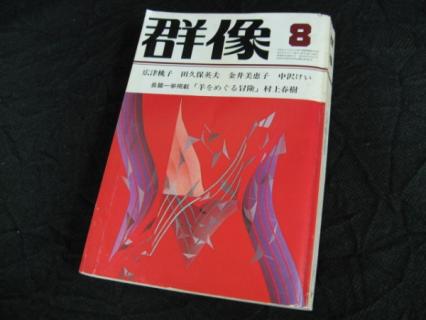
For Murakami freaks the story is well known. At the game he saw Dave Hilton hit a double and had a sudden thought, I can write a novel. He wrote out Hear the Wind Sing over the next few months, submitted it to Gunzō, and the rest is history.

Murakami has recounted the tale himself several times, so I thought this week I’d show you three different versions, two of which I’ve translated.

The first comes from Walk, Don’t Run – Ryū versus Haruki (ウォーク・ドント・ラン 村上龍VS村上春樹), a lengthy transcript of two conversations between Haruki and Ryū Murakami.

The first conversation took place on July 29, 1980.

It had been over a year since Hear the Wind Sing. In that time he wrote Pinball 1973 and a “medium-length” novel called Machi to sono futashika na kabe (街とその不確かな壁, The Town and Its Uncertain Wall), which he later incorporated in Hard-boiled Wonderland and the End of the World. Here’s the part where Haruki describes the moment:

Haruki: Back then all sorts of people were agitated, right? Even the novelists were pretty agitated. If you asked them at that time, they were all really comfortable with that. But when it [the era] ended, there was nothing left. Right around 1970. I had an intense feeling that words had no meaning. I really did want to write something when I was in my twenties. Just scripts for movies, you know. But I just felt that a bunch of words, they’ve got no meaning. And so I couldn’t write anything for ten years. Ten years passed. I thought, Alright now, I should be able to write something, and I wrote it. I hardly wrote anything at all until I was 29, and this might be an exaggeration, but I felt like the reason I was able to write it was something like God’s grace. I feel like it would be terrible to waste that. I felt like I seriously couldn’t do anything, and then I turned 29 and all of a sudden…it was right when I was watching a Yakult [Swallows] game at Jingū Stadium. It was Opening Day of the season they won the championship, and Hilton hit a double to left-center his first at bat. Yasuda threw a complete game, giving up one homerun to Garrett. I saw that and thought, “Okay.” Dunno why, but I thought I’d write a novel. (laughs) I went straight to Shinjuku, bought a 5000-yen fountain pen at Kinokuniya, and when I started writing, I was able to write.
Ryū: And that was Hear the Wind Sing?
Haruki: Exactly. Matsuoka shut out [the] Chunichi [Dragons], and I finished writing right around when they won the championship. I brought it to the post office right in front of Jingū Stadium and submitted it [for the Gunzō Prize]. So before that, there was absolutely no necessity to write. Even if you don’t put that along the lines of receiving something from above, I do feel like the act of writing is itself something like that. (14-15)

I knew that he felt a sense of fate in that moment, but it surprised me to see him use the word God (神). I also hadn’t realized that he basically wrote through the baseball season.

Murakami described the moment again ten years later in supplementary commentary to the Complete Works 1979~1989.

Each of the eight volumes to the complete works contained a small pamphlet with the series title 自作を語る (じさくをかたる) – telling the stories of my works.

In the pamphlet included with the first volume he told the story again:

    The reason I started to write this novel is actually pretty easy to explain. All of a sudden I wanted to write something. That’s it. Honestly, I wanted to write on a whim. And so I went to the Kinokuniya in Shinjuku and bought a fountain pen and paper. Then I sat down at my desk. All of my time had gone into my work ever since I graduated from university, so other than taxes and the occasional letter, I had barely written even a single word. I’m not just saying that to sound cool. It’s actually true.
    For a long time I had always felt like I wanted to make writing, although not necessarily being an author, my job. However, in university I tried writing scripts (I was in the Cinema and Theater department) but could never write them very well, so I thought, “I guess I don’t have that kind of ability.” Not that it was ever serious enough to make me lay down the pen forever; I just thought, If that’s the way things are, that’s okay, and gave up. After that I just kind of went on with the way life took me. Work was going relatively well, and I was too busy to do much else. So much so that I didn’t even realize that I didn’t own a fountain pen.
    But one early afternoon when I was 29, I was laying out in the grassy outfield embankment section of Jingū Stadium (they still didn’t have seats back then), and I had a thought: whether or not I have talent or ability, I just want to write something for myself. There wasn’t any of the eagerness that I felt whenever I wanted to write something long ago. I was relieved even just to set the cheap pen and pad I’d just bought on my desk.
    1978 was the year the Yakult Swallows won the championship. I started writing in the spring and finished right around the time they finally won. I was living nearby Jingū Stadium, so I went to see a lot of games. Yakult won its first championship in its 29th year in the league, and I, too, was 29. Of course Matsuoka and Wakamatsu were great. But that season guys like Funada, Ise and Hilton, guys past their prime, or maybe you could call them athletes who weren’t quite all-stars in the first place, were solid role players. I remember sitting at my desk and thinking, Everyone is trying hard, I’ve gotta try hard, too. Every day I worked late, and then all through the night I’d drink beer and write at the kitchen table. Every day I wrote a little more, cutting off enough to make me think, “That’s enough for today.” I think that’s the reason the chapters are so fragmentary. (II – III)

Pretty much the same story except he had the time to stylize it as it wasn’t part of an impromptu conversation. Note for now that he called the pen (and pad of paper) “cheap” but in 1980 mentioned that he spent 5000 yen on it, which even at the time was $20. He also left out Dave Hilton’s hit.

The final story comes from Philip Gabriel’s translation of Murakami’s 2007 What I Talk About When I Talk About Running.

This comes 17 years since the Complete Works supplement and 27 years since Murakami’s conversation with Ryū Murakami:

    I can pinpoint the exact moment when I first thought I could write a novel. It was around one thirty in the afternoon of April 1, 1978. I was at Jingū Stadium that day, alone in the outfield drinking beer and watching the game. Jingū Stadium was within walking distance of my apartment at the time, and I was a fairly big Yakult Swallows fan. It was a perfectly beautiful spring day, not a cloud in the sky, with a warm breeze blowing. There weren’t any benches in the outfield seating back then, just a grassy slope. I was lying on the grass, sipping cold beer, gazing up occasionally at the sky, and leisurely enjoying the game. As usual for the Swallows, the stadium wasn’t very crowded. It was the season opener, and they were taking on the Hiroshima Carp. I remember that Yasuda was pitching for the Swallows. He was a short, stocky sort of pitcher with a wicked curve. He easily retired the side in the top of the first inning, and in the bottom of the inning the leadoff batter for the Swallows was Dave Hilton, a young American player new to the team. Hilton got a hit down the left field line. The crack of the bat meeting ball right on the sweet spot echoed through the stadium. Hilton easily rounded first and pulled up to second. And it was at that exact moment that a thought struck me: You know what? I could try writing a novel. I still can remember the wide open sky, the feel of the new grass, the satisfying crack of the bat. Something flew down from the sky at that instant, and whatever it was, I accepted it.
    I never had any ambitions to be a novelist. I just had this strong desire to write a novel. No concrete image of what I wanted to write about, just the conviction that if I wrote it now I could come up with something that I’d find convincing. When I thought about sitting down at my desk at home and setting out to write I realized I didn’t even own a decent fountain pen. So I went to the Kinokuniya store in Shinjuku and bought a sheaf of manuscript paper and a five-dollar Sailor fountain pen. A small investment on my part.
    This was the spring of 1978, and by fall I’d finished a two-hundred-page work handwritten on Japanese manuscript paper. (27-28)

Again, the same story for the most part. The pen is even cheaper now. The location of Hilton’s hit is also different – left center vs. left field line. Besides small changes in the details, Murakami decided not to include his disenchantment with literature left over from the late-60s in the later two. My guess is that came up because he was talking with Ryū Murakami, kind of reminiscing about the era.

His main emphasis, clearly, is that external will he felt. He wasn’t even eager or excited to write. He was just relieved. Something in Dave Hilton’s hit, maybe the sound of it, knocked on Murakami’s subconscious and woke him up, called him to write a novel. Or so he says.

This page has a picture of Jingū Stadium as well as Murakami’s jazz bar, Peter Cat, his apartment, and a ramen shop he went to in Sendagaya, the area around the stadium.

So I guess this requires some Japanese study material, too, eh? Here are the baseball terms Murakami used:

優勝する (ゆうしょうする) – win a championship
野球 (やきゅう) – baseball
試合 (しあい) – game
開幕試合 (かいまくしあい) – Opening Day game
第一打席 (だいいちだせき) –  first at bat
左中間 (さちゅうかん) – left-center field
二塁打 (にるいだ) – a double
完投する (かんとうする) – throw a complete game
ホームラン – homerun
完封する (かんぷうする) – throw a shutout / shutout a team
外野席 (がいやせき) – outfield seats
球場 (きゅうじょう) – baseball stadium
 

Posted in literature, Murakami, vocab | 2 Comments »

The Wind

Friday, September 19th, 2008

With the goal of stirring up even more interest in Murakami between now and mid-October, when the Nobel Prizes are announced, I will post a small piece of unpublished Murakami translation once a week from now until the announcement. You can see the other entries in this series here: 1.

Well, if we’re going to be looking at Murakami, we might as well start at the beginning – the first page of his first novel. Technically it’s been published, but not in the States, so it still counts. I’ve read Birnbaum’s version, and the first line has always been kind of seared into my brain, so you’ll have to forgive me if mine is similar. Something just doesn’t sound right with “Perfect writing doesn’t exist.” I’ve taken this first page from Murakami’s Complete Works 1979~1989.

Listen to the Wind Sing

1

    “There’s no such thing as perfect writing. Just like there’s no such thing as perfect despair.”
    When I was in university, a writer I met kind of randomly said that to me. It wasn’t until long afterwards that I finally understood the true meaning of those words, but it was still possible for me to take some small bit of comfort in them. In the fact that there’s no such thing as perfect writing.
    Nevertheless, whenever I got to the point where I was about to write something, I was always attacked by a sense of despair. That’s because the scope of things that I am able to write about is too limited. For example, even if I could write something about an elephant, I might not be able to write anything at all about an elephant keeper. Something like that.
    For eight years I’ve wrestled with that dilemma – eight years. That’s a long period of time.
    Of course, as long as you keep trying to learn from everything around you, getting older isn’t too hard. That’s the commonly held belief.
    I’ve tried my best to live that way ever since around the time I entered my twenties. And thanks to that, I’ve been deeply hurt, deceived, and misunderstood countless times by other people, and at the same time I’ve had many strange experiences. Lots of different people have run in to me and told me their stories, passing over me almost as though they were making noise crossing a bridge, and they’ve never come back. That whole time I kept my mouth tightly closed and didn’t tell them anything. That’s how I welcomed in the final year of my twenties.   

It’s impressive how representative this one page is of Murakami’s writing. There’s an elephant in there, a sense of sadness but also curiosity in the strangeness of life, and a hint at the importance of being a listener or a storyteller.

Elephant is, of course, 像 (ぞう), and elephant keeper is 像使い (ぞうつかい). Interesting when you think of 魔法使い (まほうつかい) – magician.


Posted in literature, Murakami, vocab | No Comments »

Boobs

Wednesday, September 10th, 2008

With the goal of stirring up even more interest in Murakami between now and mid-October, when the Nobel Prizes are announced, I will post a small piece of unpublished Murakami translation once a week from now until the announcement.


Murakami (Do I even need to tell you which one?) lived in Europe for three years between 1986 and 1989. In addition to novels and short stories, he also wrote a lengthy set of travel writings called Tōi taiko (遠い太鼓, A Distant Drum).

During his travels he spent some time on a small Greek island, and the tourists there often sunbathed nude. Apparently only the local Greek men (he calls them "Zorba Greeks") went to the trouble of checking out the boobs. This resulted in a three-page discussion of nude sunbathing and the following moment of complete linguistic genius:

おっぱいを出すのも勝手なら、出されたおっぱいを見るのも勝手である。

(I was going to write the page number at the end of that line, but when I realized it was page 69, I thought I’d better explain what I was doing.)

The Japanese is so economical that translating it won’t be as great, but here it goes:

If it’s a person’s prerogative to reveal her boobs, then it’s also a person’s prerogative to look at revealed boobs

That kind of expresses what’s going on with the verb. 出す literally means “take out,” but I translated it as “reveal” in order to maintain the verb tenses and still have the sentence sound okay, although, now that I think about it, “taken-out boobs” is a pretty funny phrase.

The major difference between the English and the Japanese is that no people are explicitly involved in the Japanese sentence; all of the subjects are implied, and he uses the loaded word 勝手 (かって). "Prerogative" feels a little complicated, but I guess it does the job. 勝手 is often used as an adverb (勝手に〜) to mean "do ~ however I want" or "do ~ even though I’m thinking only of myself and not the Japanese collective spirit." One word that pops up in the dictionary is "arbitrary." So does "one’s own way" and "selfishness."

So yes, long story short, if you reveal your boobs, do not be surprised when people look at them.


Posted in body parts, casual, comedy, literature, Murakami, passive | 4 Comments »

号外 – Murakami Ryu

Friday, August 15th, 2008

Apparently he’s pimping Seoul.

Posted in literature, random | No Comments »

A まち is a 町 is a 街

Wednesday, May 14th, 2008

I did a rewrite of my senior thesis and it has been published on Neojaponisme, a Japanese culture web journal. I wrote about the Haruki Murakami short story collection Dead Heat on a Merry-go-round (『回転木馬のデッド・ヒート』). Before it was a collection, it was serialized under the title Views of the City (『街の眺め』).

While I used the word “city” in the translation of that set of stories, the actual word is 街, which is pronounced まち and is loosely related to the other まち, 町.

町 can either be either a town (e.g. 西会津町) or a neighborhood within a city or ward (e.g. 門前仲町). It’s a geographic and bureaucratic term.

街 is used in 商店街 (しょうてんがい, shopping arcade), 繁華街 (はんかがい, downtown/entertainment district/center of town), and 住宅街 (じゅうたくがい, residential area). It refers to a less well-defined portion of geographical space but definitely a piece of the city. (China Bonus!: In Chinese it means street.) It can also be used to talk about a town in the broad sense, but unlike 町, it is never named.

Murakami uses 街 in nearly all of his novels between 1979 and 1983, always referring to the unnamed (*cough* Kobe *cough*) hometown of his unnamed boku narrator. Murakami contrasts this hometown with Tokyo, where the narrator has gone off to college; Tokyo is where he lives now, but all his memories and emotions are tied to the 街. Murakami takes this comparison to its most extreme limit in his book Hard-boiled Wonderland and the End of the World, in which he contrasts an ultra-modern Tokyo with a pre-modern, industrial town, the 街, in alternating chapters.

In Views of the City, however, Tokyo is the only 街 to be found. It feels like a casual reference to a familiar place. For example, you could say, “This is my part of town,” even in reference to a big city. It also shows how 街 is the "town" from the phrase "town and country."

While 街 is often used to refer to big cities, this is the first time Murakami uses the term in reference to Tokyo. It is also his first collection of realistic stories. The change in usage of this term mirrors the way Murakami turns his vision from the interior thoughts of his anonymous first-person narrator to the lives of people around him in Tokyo.

Posted in kanji, literature, Murakami, reading | No Comments »

Newer Entries »
  • Follow @howtojapanese How to Japonese

    Promote Your Page Too
  • You are currently browsing the archives for the literature category.

  • Pages

    • About
    • Contact
    • Portfolio
  • Archives

    • February 2012
    • January 2012
    • December 2011
    • November 2011
    • October 2011
    • September 2011
    • August 2011
    • July 2011
    • June 2011
    • May 2011
    • April 2011
    • March 2011
    • February 2011
    • January 2011
    • November 2010
    • October 2010
    • September 2010
    • August 2010
    • July 2010
    • June 2010
    • May 2010
    • April 2010
    • March 2010
    • February 2010
    • January 2010
    • December 2009
    • November 2009
    • October 2009
    • September 2009
    • August 2009
    • July 2009
    • June 2009
    • May 2009
    • April 2009
    • March 2009
    • February 2009
    • January 2009
    • December 2008
    • November 2008
    • October 2008
    • September 2008
    • August 2008
    • July 2008
    • June 2008
    • May 2008
    • April 2008
    • March 2008
    • February 2008
  • Categories

    • airbag expressions (5)
    • appear (2)
    • beer (28)
    • body parts (7)
    • casual (31)
    • causality (3)
    • causative (10)
    • class notes (3)
    • comedy (26)
    • conjunctions (2)
    • custom (2)
    • dictionaries (5)
    • food (53)
    • gerund-related (6)
    • get used to it! (66)
    • giving (3)
    • kanji (88)
    • literature (45)
    • Murakami (56)
    • onomatopoeia (4)
    • particles (2)
    • passive (11)
    • phone (1)
    • podcast (1)
    • polite (27)
    • politics (3)
    • probability / possibility (3)
    • project management (5)
    • puzzle (38)
    • random (95)
    • reading (15)
    • receiving (3)
    • refusal (10)
    • reporting (1)
    • requesting (6)
    • research (2)
    • Resources (16)
    • theory (8)
    • travel (14)
    • TV (17)
    • Uncategorized (8)
    • underrated japan (5)
    • video (39)
    • video games (19)
    • vocab (110)
    • wordplay (31)
    • 変換 (2)

How to Japanese powered by WordPress | minimalism by www.genaehr.com
Entries (RSS) and Comments (RSS).