How to Japanese Podcast – S03E02 – The Murakami Season

Well, I’ve had a week to mull over the title announcement for the new Murakami novel, and I’m still just as stunned as I was last week. Here’s the intro episode for this season of the podcast. Stay tuned for more!

And here’s the blog post I mention in the episode that includes the passage from Murakami’s supplementary commentary included with the Complete Works.

How to Japanese Podcast – S03E01 – Emergency Murakami Podcast

We have the title for the new Murakami novel due out on April 13! It’s the same title as a 1980 novella that Murakami disavowed as a “failed work” but later rewrote as Hard-boiled Wonderland and the End of the World. Here’s what we know about that novella, and here are my best guesses about what we could be getting next month.

Winning and Losing

Year 1: BoobsThe WindBaseballLederhosenEels, Monkeys, and Doves
Year 2: Hotel Lobby OystersCondomsSpinning Around and Around街・町The Town and Its Uncertain WallA Short Piece on the Elephant that Crushes Heineken Cans
Year 3: “The Town and Its Uncertain Wall” – Words and WeirsThe LibraryOld DreamsSaying GoodbyeLastly
Year 4: More DrawersPhone CallsMetaphorsEight-year-olds, dudeUshikawaLast Line
Year 5: Jurassic SapporoGerry MulliganAll Growns UpDanceMountain Climbing
Year 6: Sex With Fat WomenCoffee With the ColonelThe LibrarianOld ManWatermelons
Year 7: WarmthRebirthWastelandHard-onsSeventeenEmbrace
Year 8: PigeonEditsMagazinesAwkwardnessBack Issues
Year 9: WaterSnæfellsnesCannonballDistant Drumming
Year 10: VermontersWandering and BelongingPeter Cat, Sushi Counter, Murakami Fucks First
Year 11: Embers, Escape, Window Seats, The End of the World
Year 12: Distant Drums, Exhaustion, Kiss, Lack of Pretense, Rotemburo
Year 13: Murakami Preparedness, Pacing Norwegian Wood, Character Studies and Murakami’s Financial Situation, Mental Retreat, Writing is Hard
Year 14: Prostitutes and Novelists, Villa Tre Colli and Norwegian Wood, Surge of Death, On the Road to Meta, Unbelievable
Year 15: Baseball on TV, Kindness, Murakami in the Asahi Shimbun – 日記から – 1982, The Mythology of 1981

I’ll finish up Murakami Fest this year by returning to where I started: Murakami’s 1978 baseball revelation. I’ve looked at a number of his early accounts but only his 2007 What I Talk About When I Talk About Running when it comes to more recent accounts.

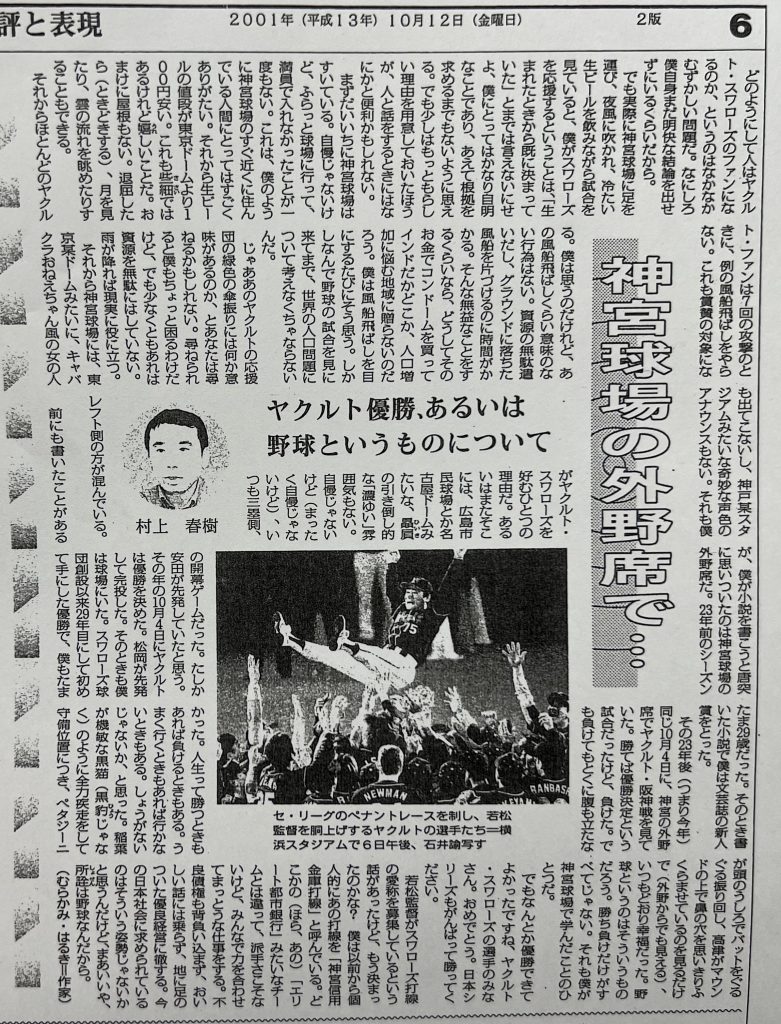
At the Diet Library, I tracked down a 2001 Mainichi Shimbun article Murakami wrote on October 12 ahead of the Japan Series that year. The Swallows played the Kintetsu Buffaloes starting a week later, and Murakami wrote an article on the Culture page about how he became a Swallows fan. He says he doesn’t really know, that he basically realized he was a Swallows fan the day he first walked into Jingu Stadium, but that whenever people ask him about it, he always mentions the few benefits of being a Swallows fan: Jingu is never full, so it’s easy to get a ticket. Beer is 100 yen cheaper than at the Tokyo Dome. And they don’t do the traditional 7th inning balloon release at Jingu, of which Murakami notes “I can’t think of a more meaningless thing to do.”

Here’s what he has to say about the day of his revelation:

I’ve written about this before, but the outfield seats at Jingu Stadium are where I suddenly realized I wanted to write a novel. It was opening day 23 years ago. I think Yasuda [Takeshi] was starting. On October 4 that year, the Swallows won the championship. Matsuoka [Hiromu] was starting and pitched a complete game. I was in the stadium that day as well. It was the first championship for the Swallows, 29 years after being founded, and I happened to be 29 years old. I won the new author’s prize for the novel I wrote that year.

23 years later (so this year), I was in the outfield seats at Jingu on October 4 again, watching Yakult against Hanshin. If they won the game, they would’ve won the series, but they lost. Even though they lost, I wasn’t all that mad. In life, sometimes you win, and sometimes you lose. Somethings things go well, and sometimes they don’t. There wasn’t anything I could do, I realized. It made me happy to see Inaba [Atsunori] sprint at full speed out to his spot like a shrewd black cat (not a black panther), [Roberto] Petagine spin the bat behind his head, and Takatsu [Shingo] flare his nostrils widely on the mound (which you could even see from the outfield). That’s what baseball is all about. It’s not just about winning and losing. That’s something else I learned at Jingu Stadium.

前にも書いたことがあるが、僕が小説を書こうと唐突に思いついたのは神宮球場の外野席だ。23年前のシーズンの開幕ゲームだった。たしか安田が先発していたと思う。その年の10月4日にヤクルトは優勝を決めた。松岡が先発して完投した。そのときも僕は球場にいた。スワローズ球団創設以来29年目にして初めて手にした優勝で、僕もたまたま29歳だった。そのとき書いた小説で僕は文芸誌の新人賞をとった。

その23年後(つまり今年)同じ10月4日に、神宮の外野席でヤクルト・阪神戦を見ていた。勝てば優勝決定という試合だったけど、負けた。でも負けてもとくに腹も立たなかった。人生ってい勝つときもあれば負けるときもある。うまく行くときもあれば行かないときもある。しょうがないじゃないか、と思った。稲葉が機敏な黒猫(黒豹じゃなく)のように全力疾走をして守備位置につき、ペタジーニが頭のうしろでバットをぐるぐる振り回し、高津がマウンドの上で鼻の穴を思いきりふくらませているのを見るだけで(外野からでも見える)、いつもどおり幸福だった。野球というのはそういうものだろう。勝ち負けだけがすべてじゃない。それも僕が神宮球場で学んだことのひとつだ。

Not noted here is that the Swallows did end up clinching, advancing to the Japan Series, and then going on to win after the publication of this article.

So we have all these accounts, and in only one of them does Murakami claim he was watching on TV. I’m willing to attribute it to the journalist doing the interview, especially given that it wasn’t formatted as a clean transcript. And given that a year earlier in the 対談 with Murakami Ryu, he’d given a very detailed account of the basic story that he’s stuck to over the years. It would have to have been a fairly significant slip up for Murakami to relax enough to deviate from a constructed story, if indeed it was false.

That said, it’s definitely an interesting wrinkle.

Assuming he did actually have the revelation at the stadium, what actually happened that day, on the other hand, is more up in the air, and there’s not much that can be done to definitively prove anything, short of someone finding Murakami in the background of a photograph in Jingu Stadium or in a photograph of Kinokuniya. Now that’s something I’d love to see happen.

Bizarrely enough, the Yakult Swallows are at the top of the standings this year behind the powerhouse hitting of Murakami Munetaka. They play the Hanshin Tigers at Koshien on Sunday. Maybe I’ll look into getting tickets…

Hope y’all have a great year. See you in 2023 for Murakami Fest 16!

The Mythology of 1981

Year 1: BoobsThe WindBaseballLederhosenEels, Monkeys, and Doves
Year 2: Hotel Lobby OystersCondomsSpinning Around and Around街・町The Town and Its Uncertain WallA Short Piece on the Elephant that Crushes Heineken Cans
Year 3: “The Town and Its Uncertain Wall” – Words and WeirsThe LibraryOld DreamsSaying GoodbyeLastly
Year 4: More DrawersPhone CallsMetaphorsEight-year-olds, dudeUshikawaLast Line
Year 5: Jurassic SapporoGerry MulliganAll Growns UpDanceMountain Climbing
Year 6: Sex With Fat WomenCoffee With the ColonelThe LibrarianOld ManWatermelons
Year 7: WarmthRebirthWastelandHard-onsSeventeenEmbrace
Year 8: PigeonEditsMagazinesAwkwardnessBack Issues
Year 9: WaterSnæfellsnesCannonballDistant Drumming
Year 10: VermontersWandering and BelongingPeter Cat, Sushi Counter, Murakami Fucks First
Year 11: Embers, Escape, Window Seats, The End of the World
Year 12: Distant Drums, Exhaustion, Kiss, Lack of Pretense, Rotemburo
Year 13: Murakami Preparedness, Pacing Norwegian Wood, Character Studies and Murakami’s Financial Situation, Mental Retreat, Writing is Hard
Year 14: Prostitutes and Novelists, Villa Tre Colli and Norwegian Wood, Surge of Death, On the Road to Meta, Unbelievable
Year 15: Baseball on TV, Kindness, Murakami in the Asahi Shimbun – 日記から – 1982

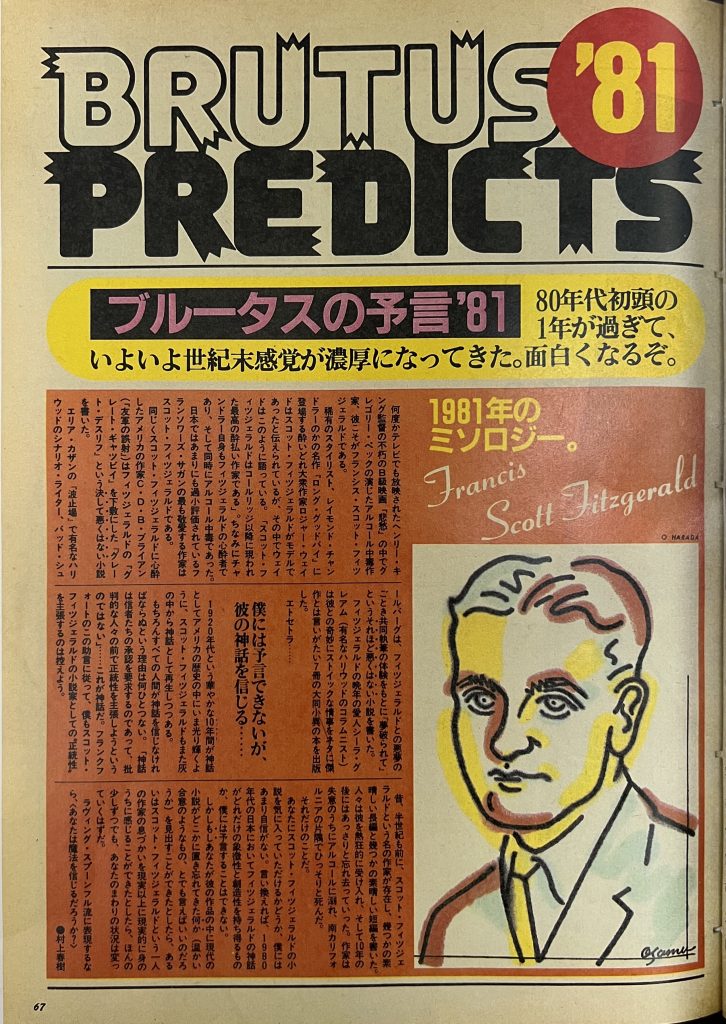
This week I’m looking at one of Murakami’s earliest appearances in the culture magazine Brutus. Murakami was featured in the February 1, 1981 issue, which had the title ブルータスの予言’81 (Brutus’ Predictions for ’81).

Murakami was one of several writers who contributed a page-long “prediction,” with his titled 1981年のミソロジー (The Mythology of 1981) which focuses on F. Scott Fitzgerald. It’s kind of a strange way to play the assignment, but Murakami is a huge fan of Fitzgerald, so maybe it isn’t a surprise.

The piece starts by discussing all the odes to Fitzgerald in other works of art as well as writers who have admitted their admiration for him. Murakami then gives a short summary of Fitzgerald’s brief rise to the top and quick plummet, after which point he’s forgotten for several decades.

He ends the piece with these three paragraphs:

I’m not confident I can get you to appreciate Scott Fitzgerald’s fiction. To put it another way, I can’t predict whether the myth of Fitzgerald is symbolic or creatively compelling in Japan of the 1980s.

However, if you’re able to detect something (you might even call it a warm sense of understanding) in his works that’s been left out of contemporary fiction or if you’re able to sense something in Fitzgerald’s presence as a writer that’s so real it surpasses reality, to even the slightest degree, then the world around you will start to change.

To borrow a phrase from The Lovin’ Spoonful, “Do you believe in magic?”

あなたにスコット・フィッツジェラルドの小説を気に入っていただけるかどうか、僕にはあまり自信がない。言い換えれば、1980年代の日本においてフィッツジェラルドの神話がどれだけの象徴性と創造性を持ち得るものか、僕には予言することはできない。

しかしもしあなたが彼の作品の中に現代の小説がどこかに置き忘れてきた何か(温かい合意のようなもの、とでも言えばのだろうか)を見出すことができたとしたらあるいはスコット・フィッツジェラルドという一人の作家の息づかいを現実以上に現実的に身のうちに感じることができたとしたら、ほんの少しずつでも、あなたのまわりの状況は変わっていくはずだ。

ラヴィング・スプーンフル流に表現するなら、<あなたは魔法を信じるだろうか?>

It’s a bit of a filler piece, and the ending is basically just a hand wave, but overall it’s not poorly penned. Murakami is relatively early on the Fitzgerald bandwagon, although not the earliest. In the first half of the essays, one of the authors he mentions is C.D.B. Bryan:

Another great admirer of Scott Fitzgerald was the American author C.D.B. Bryan (Friendly Fire) who used Fitzgerald’s The Great Gatsby as the model for his novel The Great Dethriffe, which was not a bad book at all.

同じくスコット・フィッツジェラルドに心酔したアメリカの作家C・D・B・ブライアン(『友軍の誤射』)はフィッツジェラルドの『グレート・ギャツビイ』を下敷にした『グレート・デスリフ』という決して悪くない小説を書いた。

Bryan came up in Murakami Fest 2020 in part of Distant Drums. Murakami was just finishing up his translation of The Great Dethriffe while in Europe. So this is an unexpected way to close the loop on that. The Great Dethriffe was published in 1970. Murakami somehow read it between then and 1981, and then translated it five years later while he was writing Norwegian Wood.

That’s pretty impressive. There’s a good chance Murakami read it well before he became a writer, sat on his admiration of the novel for years, and then once he became a writer, was finally in the position to translate it, 10 years after it was initially published. As I mentioned in the blog post two years ago, the book is pretty widely recognized as being not very good, despite Murakami’s opinion, but it shows impressive dedication on Murakami’s part.

Murakami in the Asahi Shimbun – 日記から – 1982

Year 1: BoobsThe WindBaseballLederhosenEels, Monkeys, and Doves
Year 2: Hotel Lobby OystersCondomsSpinning Around and Around街・町The Town and Its Uncertain WallA Short Piece on the Elephant that Crushes Heineken Cans
Year 3: “The Town and Its Uncertain Wall” – Words and WeirsThe LibraryOld DreamsSaying GoodbyeLastly
Year 4: More DrawersPhone CallsMetaphorsEight-year-olds, dudeUshikawaLast Line
Year 5: Jurassic SapporoGerry MulliganAll Growns UpDanceMountain Climbing
Year 6: Sex With Fat WomenCoffee With the ColonelThe LibrarianOld ManWatermelons
Year 7: WarmthRebirthWastelandHard-onsSeventeenEmbrace
Year 8: PigeonEditsMagazinesAwkwardnessBack Issues
Year 9: WaterSnæfellsnesCannonballDistant Drumming
Year 10: VermontersWandering and BelongingPeter Cat, Sushi Counter, Murakami Fucks First
Year 11: Embers, Escape, Window Seats, The End of the World
Year 12: Distant Drums, Exhaustion, Kiss, Lack of Pretense, Rotemburo
Year 13: Murakami Preparedness, Pacing Norwegian Wood, Character Studies and Murakami’s Financial Situation, Mental Retreat, Writing is Hard
Year 14: Prostitutes and Novelists, Villa Tre Colli and Norwegian Wood, Surge of Death, On the Road to Meta, Unbelievable
Year 15: Baseball on TV, Kindness

I swore I’d look at a shorter piece of writing after reading a lengthy 対談 last week, and to a certain extent I did: Murakami’s writing for the Asahi Shimbun’s 日記から (Nikki kara, From my journal) column are probably less than 400 characters each. The column ran six days a week in the evening edition, and different writers were commissioned for various lengths of time. Murakami wrote 12 pieces over two weeks from March 29, 1982 to April 10, 1982.

The quality of writing varies. There are a few gems, and others where Murakami just spins his wheels.
Rather than pick out one representative, I thought I’d give an overview of each and a few quotes here and there. That feels more helpful to characterize this moment in time. The series as a whole is an interesting look at Murakami early in his career. Before diving in, take a minute to think about the context here. This is Murakami writing a micro-essay in the paper of record (albeit the evening edition) for two weeks straight, six months before A Wild Sheep Chase, his third novel, would be published and draw the attention we saw with the conversation with Itsuki Hiroyuki last week. I imagine the editors had a need to fill word count, but it’s still pretty remarkable.

March 29, 1982
力の論理 (The Logic of Power)

Murakami begins by talking about how discrimination in Japan is invisible until you actually experience it. As an example, he writes about trying to rent an apartment as a bar owner and being associated with prostitution. This transitions to a discussion of public vs private power, and that the fight for power is what inevitably led to the atom bomb. He quotes from Itoi Shigesato here (「そーゆー意味なら、原爆がいっちゃん強いわ」, “By thaaat reasoning, the A-bomb is the trumpiest card”), but I can’t track down where it’s from.

March 30, 1982
まねき猫 (Maneki-neko)

This is one of my favorites. Here’s the first paragraph with a deep Murakami v Murakami trivia:

The Abyssinian kitten I got last summer from Murakami Ryū has become enormous. Its appetite and physical strength are astounding, which has given the other cats a bit of a complex.

昨年の夏に村上竜のところから来たアビシニアンの仔猫がすっかり固太りして大きくなった。食欲も体力も相当なものなので他の猫は少々ノイローゼ気味である。

Murakami goes on to talk about his maneki-neko collection and how he responds to people who ask about what the raised hand means (“A raised right hand means they take cash, and a raised left hand means they take checks.”)

March 31, 1982
アイシテマース (Ai shitemaasu)

Murakami was listening to a record of Quincy Jones at the Budokan, and toward the end Jones turns to the audience and says:

“Ai shitemaasu, ai shitemaasu, dōmo, dōmo”
「アイシテマース、アイシテマース、ドーモ、ドーモ」

Murakami has opinions about this; he understands why Jones is saying it and what the goal is, but: “It’s courtesy, but it’s a little strange” (「愛敬ではあるが、ちょっと変だ」)

When musicians say “I love you” it’s “I love you” as recognition of a shared experience. Basically it’s sexy. “Ai shitemaasu” isn’t sexy. It’s fundamentally a mistake. “Ii yo, Ii yoo” is actually closer.

ミュージシャンの発する“I LOVE YOU”は共有体験を確認するための“I LOVE YOU”である。要するにセクシーなのだ。「アイシテマース」はセクシーではない。そこが根本的に間違っているのだ。「イイヨ、イイヨオ」の方がまだ近い。

In a typical essayistic 展開, Murakami shifts this to a bigger picture idea:

For something on the level of “Ai shitemaasu,” courtesy is the conclusion. However, taking something that isn’t an equivalent and giving it a place as an equivalent is a dangerous line of thinking. “Japanese spirit with Western learning” is the most extreme example. The extreme Europeanism in modern Japan and the ultra nationalist response are, at once, the cost of mistakenly hitting this button.

「アイシテマース」程度なら愛敬で済む。しかし等価に置き得ないものを等価に置いて対峙させるというのは危険な発想である。たとえば「和魂洋才」などという座標軸はこの最たるのである。日本近代における極端な欧化主義とその反動としてのウルトラ・ナショナリズムは、ともにこのボタンのかけちがえの代償である。

April 1, 1982
感性の思想 (The Idea of Taste)

A pretty boring piece here. Murakami talks about different senses/aesthetics/tasets and how he hates when people shut down conversations by saying, “We have totally different tastes.” His main point here:

Taste isn’t a status symbol, but rather an entrance ticket to wider self recognition. The act of taking that step is the same for everyone. Everything after that is the problem.

感性はステータス・シンボルではなく、より開かれた自己認識への入場券である。入場するという行為は等価である。それから先が問題なのだ。

April 2, 2022
不思議猫の存在 (The Strange Existence of Cats)

I think this is probably my favorite piece. It reads like a piece of fiction. In the first paragraph, Murakami claims his Siamese cat was talking in her sleep and said, “Didn’t I tell you so” (
「だってそんなこと言ったって」).

He goes on:

You may not believe me, but it’s the truth. I was sitting next to her reading a book and was momentarily taken aback, unable to respond.

When I thought about it later, I realized it must have just sounded that way. There’s no other explanation.

信じてもらえないだろうが、これは事実である。僕は隣で本を読んでいたのだが、しばらく呆然として口もきけなかった。

あとになって考えてみれば、偶然そんな風に聞こえたんだろうということになってしまう。それ以外に考えられないからである。

The rest of the piece is dedicated to cats’ strangely surreal presence.

April 3, 1981
表札とモラトリアム (Name Plates and Moratoriums)

Murakami starts by noting three things he doesn’t like spending money on: cars, TVs, and nameplates for houses, so he’s never purchased any of these. (There’s a funny aside on picking up a TV off the street only to return it.) He goes on to describe how a friend guilts him in to buying a nameplate (“You don’t go to cabaret clubs or travel abroad. That’s too extreme. The least you can do is buy a nameplate.”) He goes to a department store but doesn’t find any he likes, so:

There wasn’t anything else to do, so I had a Shōkadō bento and went home. As I sat there by myself eating a Shōkadō bento in a department store, I felt keenly that I’d become an adult. However, I still didn’t have a nameplate.

仕方ないから食堂で松花堂弁当を食べて帰ってきた。デパートの食堂で一人で松花堂弁当を食べていると、僕も大人になったんだなとつくづく思う。しかし表札はまだない。

A nice little Murakami moment.

April 5, 1982
山羊座の宿命 (The Fate of Capricorns)

Murakami’s take on horoscopes. He’s a Capricorn, which always gets him characterized as hardheaded. Here’s the main line:

I’d be fine with, I don’t like that you’re hardheaded. However, people who say, You’re hardheaded because you’re a Capricorn and I hate it, are completely hopeless.

ムラカミは頭が固くてダメだ、というのはいい。しかし、ムラカミは山羊座だから頭が固くてダメだ、というのでは救いようがないではないか。

April 6, 1982
グンニーリク田島

This is a funny little meditation on Japanese font printed on vehicles. I had so much trouble deciphering the title until I started reading and realized that it’s spelled backwards. The essay has a funny final line about the dry cleaners referred to in the title:

However, it would be a surprise if it was actually a second-generation Norwegian.

しかし意外に本当のノルウェーの二世だったりするのかもしれない。

April 7, 1982
長距離型せっかち (The Long-distance Impatient)

Murakami writes about how he’s impatient/hasty (せっかち, sekkachi) by nature. He always meets deadlines, sometimes writes articles before leaving on a trip to do reporting, is always early for appointments, etc. He divides impatient people into two categories – long-distance and short-distance – claiming that he’s in the first category. He’s not short tempered. He likes running marathons and prefers writing novels to short stories. His wife is short-distance impatient. For example, she checks the garden the day after planting seeds.

This is a nice little essay, but I didn’t feel the need to quote anything.

April 8, 1982
教師という存在 (The Idea of Teachers)

Murakami writes that he’s always had a distrust of teachers because his father was one. He has studied more as an adult than as a student, but he does remember two particularly good teachers. The first was a high school English teacher:

In high school, my grades in English were bad, but I had a teacher who explained the meaning of the word “appreciate” so incredibly lucidly that it opened my mind and I thought, “So that’s what English is.” After that, I learned how to read English.

高校時代は英語の成績が悪かったのだが、ある先生がappreciateという単語の意味を極めて明快に解説するのを聞いて「そうか、英語とはこういうものか」と目の前がさあっと開ける思いをしたことがある。それ以来英語が読めるようになった。

And the other was his thesis professor, whom he met for the first time when he turned in his thesis (those were the times, he notes):

That teacher said, “Have you considered a career involving writing?” At the time I thought it was impossible, so I laughed it off, but when I turned 29, I happened to remember what he said and felt like trying to write. When I tried, I somehow managed to write.

その先生に「君は文章を書く職業についたらどうだい」と言われた。まさかと思ったからその時は笑ってごまかしたのだが、二十九になった時にふとそれを思い出して文章を書いてみる気になった。書いてみたら、なんとか書けた。

In the final line, he shouts out the teachers by name. I wonder if they ever saw it!

April 9, 1982
図書館雑観 (Thoughts on Libraries)

Murakami starts by talking about how embarrassing it is to find a book you wrote in a library (not to brag, lol), but then says he loves libraries and goes on to say he prefers paying taxes for services like that as opposed to the JSDF. He ends by wondering if the guards at bases have guns with live rounds and whether they have the authority to fire them.

Eh, it’s fine. No need to quote it.

April 10, 1982
モラル・マジョリティー (Moral Majority)

Murakami writes about how Reagan’s “moral majority” has started to go after The Catcher in the Rye. The explanation is basic but necessary for a Japanese audience. He talks about curse words, how the rhythm and meaning are difficult to translate into Japanese, and then introduces a line from the Japanese translation of Vonnegut’s Slapstick that he thought captured the original. The translation includes the word おまんこ, which I would not recommend Googling at work. He thus ends his two week in a pretty vulgar way. Here’s the final sentence:

The word “Omanko” is pretty cute, don’t you think? Maybe not?

「おまんこ」という言葉はなかなか可愛いと思いませんか?駄目かな。

So that’s where Murakami is as a writer, almost three years exactly since he won the prize for his first novel (May 1979). He’s ironing out his sense of humor (arguably), but he’s got a knack for capturing the ennui of modern Japan in very little space.
Kindness

Year 1: BoobsThe WindBaseballLederhosenEels, Monkeys, and Doves
Year 2: Hotel Lobby OystersCondomsSpinning Around and Around街・町The Town and Its Uncertain WallA Short Piece on the Elephant that Crushes Heineken Cans
Year 3: “The Town and Its Uncertain Wall” – Words and WeirsThe LibraryOld DreamsSaying GoodbyeLastly
Year 4: More DrawersPhone CallsMetaphorsEight-year-olds, dudeUshikawaLast Line
Year 5: Jurassic SapporoGerry MulliganAll Growns UpDanceMountain Climbing
Year 6: Sex With Fat WomenCoffee With the ColonelThe LibrarianOld ManWatermelons
Year 7: WarmthRebirthWastelandHard-onsSeventeenEmbrace
Year 8: PigeonEditsMagazinesAwkwardnessBack Issues
Year 9: WaterSnæfellsnesCannonballDistant Drumming
Year 10: VermontersWandering and BelongingPeter Cat, Sushi Counter, Murakami Fucks First
Year 11: Embers, Escape, Window Seats, The End of the World
Year 12: Distant Drums, Exhaustion, Kiss, Lack of Pretense, Rotemburo
Year 13: Murakami Preparedness, Pacing Norwegian Wood, Character Studies and Murakami’s Financial Situation, Mental Retreat, Writing is Hard
Year 14: Prostitutes and Novelists, Villa Tre Colli and Norwegian Wood, Surge of Death, On the Road to Meta, Unbelievable
Year 15: Baseball on TV

For Week 2 of Murakami Fest this year, I’m looking at the February 1983 issue of 小説現代 (Shōsetsu gendai), which includes a 対談 (taidan) conversation between Itsuki Hiroyuki and Murakami with the translation-defying title 言の世界と葉の世界 (Koto no sekai to ha no sekai, perhaps, “The world of deeds and the world of leaves”?).

Itsuki is an interesting writer. He’s a member of the rapidly dwindling 焼け跡世代 (Yakeato sedai, Generation of Ashes). He turned 90 this year and put out a new book of essays titled 捨てない生き方 (Sutenai ikikata, Living Without Getting Rid of Things), which seems like a sort of direct challenge to Kondo Marie.

He was born in Fukuoka but grew up in colonial Korea. He dropped out of Waseda and ended up working in radio and advertising in Kanazawa, but eventually lived in Russia and wrote about his travels a lot. He’s been prolific, mostly as a nonfiction writer, but he’s written some fiction as well.

In 1983, Itsuki was 50, an established presence, and Murakami would have been 34, having just published A Wild Sheep Chase, which won an award and took his writing to an entirely different level. Murakami uses keigo throughout the interview, and Itsuki is polite but doesn’t use keigo.

The conversation starts with Murakami’s background (he’s clearly the focus here), but quickly shifts to the jazz bar/cafe that Murakami is still running.

Itsuki I got a postcard once from a reader who was so happy. He’d been a huge fan of this cafe off the Chuo Line, I forget the name. He was a regular, and then it disappeared and he felt so lonely, like he’d lost a home. Then one day he stumbled into a cafe in Sendagaya and had this sense that the guy from the other store had to be the one running it. After looking into it, he realized that you were the one running it. I think that reader had good instincts, but things like that happen. Like running into a girl somewhere who suddenly disappeared on you in point in the past.

Murakami About the cafe—I’m actually really looking forward to closing it.

Itsuki Really now.

Murakami From the start, I always thought I’d close it after a few years. About two months ago I decided to close two months from now. And I’ve actually really been looking forward to it (laughs).

Itsuki It must be a cruel pleasure (laughs)

Murakami Well, I think it’s what my customers want as well. With music, and things surrounding music, everything keeps changing, and change is the truth; sometimes it’s a real kindness to let things go away rather than showing them in their changed state. I might be a little extreme with this line of thinking.

Itsuki That happens. It happened when we were in college. People are more passionate about the places that were around when we were in college and have disappeared than they are about the places that are still around now.

Murakami When I started my cafe, it was a major turning point for jazz cafes.

Itsuki A turning point how so?

Murakami The era of listening to jazz to appreciate it as music had just ended. I started right around ’74, and after that point mainstream culture had shifted to places where jazz was something to listen to while drinking.

五木 中央線沿線の何とかっていう喫茶店が好きで、そこに通っていたら、それがなくなちゃって、自分の居所がなくなったような淋しい思いをしていた。と、ある時たまたま千駄ヶ谷で喫茶店に入ったら、その店は絶対にあの店の人がやっているというふうに思えた、それでいろいろ調べたら、村上さんがやっていた店だったということがわかって、とってもうれしかったという葉書をもらったことがあってね。その読者の人の勘もいいけれども、そういうことがあるんだね。昔の、途中で消えっちまった女に、偶然にほかであったようなもんだったんでしょう。

村上 店というのはね、閉店しちゃうのが楽しみなんですよね。

五木 ほう。

村上 はじめから何年か経ったらもうやめちゃおうと思っているわけです。ふた月くらい前に、二ヶ月後にやめますっていうわけですよね。それがね、わりにたのしみなんですよね(笑)。

五木 残酷な楽しみだな(笑)。

村上 というか、お客の方もね、それを望んでるんじゃないかっていう気がするんですよね。結局、音楽にしても、その周辺のものにしても、どんどん変わっていきますし、変わるのが本当だと思うし、変わったものをみせられるよりは、なくしちゃったほうが本当の親切というもんじゃないか、という気がするんです。まあ、ぼくはわりに極端な考え方する方かもしれないですけど。

五木 それはあるだろうな。ぼくらの学生時代の頃にあって、いまなくなっちまった店を語るのほうが、今も残っている店のことを語るよりは熱があるものね。

村上 ぼくがはじめた頃はちょうどジャズ喫茶の大転換期だったんですよね。

五木 転換期っていうのは、どのへんですか。

村上 いわゆる鑑賞音楽としてジャズを聴く時代がちょうど終わった時だったんです。ぼくがはじめたのは七四年ぐらいで、あとはもう、酒飲みながら聴くと言う感じの店に主流が移っちゃった時代だったんですよね。(223)

Murakami introduces this word 親切 (shinsetsu, kind) that he ends up coming back to throughout the conversation. They talk about “city novels,” and Murakami’s development as a writer, where the word pops up again.

Murakami Even after my first and second novels, I didn’t feel like a novelist. I really wondered whether they were enough or not. Novels should be kinder toward the world. When Murakami Ryu wrote Coin Locker Babies, I found myself thinking the same thing again.

村上 一作目二作目を書いても、自分が小説家という感じはなかったですね。ただ、それだけでいいのか、よくないんじゃないかという気持ちはすごくあったんですよね。小説というものは世界に対してももう少し親切であるべきじゃないかってことですね。ちょうど村上龍が『コインロッカー・ベイビーズ』を書いて、やはり同じようなことを考えていたんじゃないかと思いました。 (225)

The conversation shifts to storytelling vs monogatari, “the world of deeds vs. the world of leaves” – artists living separately from the world to maintain their autonomy (?), the Japanese Constitution and how each generation experienced it differently, the death of the student movement, overcoming ego as a writer, and then how Itsuki began as a writer with an international view and became more focused on Japan. Murakami likens himself to this in an very interesting passage:

Murakami When I myself first started writing, I started by taking the techniques from people like Vonnegut, Brautigan, and Chandler and putting them into Japanese, but I really do feel like I’m heading toward something very Japanese.

Itsuki Looking at how you’ve progressed from Hear the Wind Sing to A Wild Sheep Chase, I think I’ve you’ve really changed a tremendous amount in a short period. Maybe it doesn’t appear that way on the surface, but I can tell that your awareness as a writer is changing.

Murakami I don’t know what that Japanese thing that I’m heading toward is. But I have this vague sensation that I’m working toward something inherent about Japan. Not a return to the Japanese roman or anything like that. I have, at the moment, this extreme desire to first assimilate it into my body. Only things that I’m able to touch are real, and everything else is just an illusion. So I’d like to be as kind as I can to the things I’m able to touch. And then I want writing to be the conclusion of that series of actions.

村上 ぼく自身も、最初に書いた時は、アメリカのボネガットだとかブローディガンとか、チャンドラーとか、そういうものの手法をただ日本語に移し替えるというところからはじまったんですけど、自分自身が非常に日本的なものに向かっているんじゃないか、という気持ちがものすごくあるんですよね。

五木 『風の歌を聴け』から今度の『羊をめぐる冒険』に至るまでの小説を見ていると、よく、これだけの短い期間でこんなに変わってきたな、と思うぐらい変わってきているよ。表には、そんなにはっきり見えないかもしれないけれども、作家の意識が変わってきているというのは、すごくよくわかります。

村上 その日本的なものが何か、というのはね、よくわからないんですけれどね。でも、なにか自分が日本の固有のものを目指しているんじゃないかということは、ぼんやり感じるわけです。ただ日本的浪漫への回帰とか、そういうんじゃなくて、自分の体にまず同化したいというところが、今、すごくあります。自分の体がじかに触れているものだけが本来のものであって、それ以外のものは結局のところ幻想なんじゃないかっていうことですね。だから、ぼくは自分が手を触れることができるものに対してはできる限り親切でありたいと思います。そして文章というのはそういった一連の行為の帰結でありたいと思うんです。 (233)

An interesting read. Not sure there’s anything truly groundbreaking, but it was a fun read, and we see Murakami shifting away from the kind of carefree, ironic attitude toward the world that characterized his early novels. At the end, Murakami notes that he “can’t” have kids but then immediately adds that he doesn’t have the confidence (確信がないんです) to have kids, which accounts for another piece of his biography.

It is interesting to see someone of Itsuki’s stature praising Murakami this heavily this early in his career. I think A Wild Sheep Chase deserved the praise, clearly, but Murakami wouldn’t be a truly mainstream writer for another four years when he put out Norwegian Wood. Itsuki must have seen something.

Baseball on TV

Welcome to Murakami Fest 2022! This is my first Murakami Fest in Japan since 2009, which is pretty wild. I kept this ridiculous project going for 12 years outside of Japan. At times it was the driving force behind this blog and a motivation to keep writing. I think it’s paid off. This is also Year 15! Completely bonkers. Here are the past posts:

Year 1: BoobsThe WindBaseballLederhosenEels, Monkeys, and Doves
Year 2: Hotel Lobby OystersCondomsSpinning Around and Around街・町The Town and Its Uncertain WallA Short Piece on the Elephant that Crushes Heineken Cans
Year 3: “The Town and Its Uncertain Wall” – Words and WeirsThe LibraryOld DreamsSaying GoodbyeLastly
Year 4: More DrawersPhone CallsMetaphorsEight-year-olds, dudeUshikawaLast Line
Year 5: Jurassic SapporoGerry MulliganAll Growns UpDanceMountain Climbing
Year 6: Sex With Fat WomenCoffee With the ColonelThe LibrarianOld ManWatermelons
Year 7: WarmthRebirthWastelandHard-onsSeventeenEmbrace
Year 8: PigeonEditsMagazinesAwkwardnessBack Issues
Year 9: WaterSnæfellsnesCannonballDistant Drumming
Year 10: VermontersWandering and BelongingPeter Cat, Sushi Counter, Murakami Fucks First
Year 11: Embers, Escape, Window Seats, The End of the World
Year 12: Distant Drums, Exhaustion, Kiss, Lack of Pretense, Rotemburo
Year 13: Murakami Preparedness, Pacing Norwegian Wood, Character Studies and Murakami’s Financial Situation, Mental Retreat, Writing is Hard
Year 14: Prostitutes and Novelists, Villa Tre Colli and Norwegian Wood, Surge of Death, On the Road to Meta, Unbelievable

This year I’m taking a little break from 遠い太鼓 (Distant Drums). In June, I had the chance to go to the National Diet Library…twice.

I was partially motivated to go because of the food there. While the famous sixth-floor 食堂 (shokudō, cafeteria) is gone, the other cafes provide an extremely close approximation. My usual pattern is to have a late second breakfast of あんバター (anbatā, anko and butter) toast and then an even later lunch of some sort of 洋食 (yōshoku, western food). This time I did an omelette curry and a Napolitan on my two visits.

Getting back to the main point, I spent my days there digging around in Murakami’s early, largely uncollected bibliography. For me, this is really the most interesting part of Murakami’s history as a writer. From 1979 to 1992, Murakami was insanely prolific. He wrote random one-off essays, articles, profiles, interviews, travel writing, etc, etc. The pace ended up exhausting Murakami and drove him out of Japan to Europe. This much we know from reading Distant Drums. Over the next five weeks, I’ll introduce a few of the pieces I dug up from this period.

Heading to the National Diet Library in search of Murakami is something I probably would have done on my own at some point, but I had a very specific catalyst this year. David Marx shared this Instagram post in his stories a few months ago. Scroll on through to the last image in the post. Recognize that picture?

I managed to zoom in on the image and…what did I happen to see? Well, let me show you.

This is a June 1981 interview/profile of Murakami in the magazine “Checkmate” with the title 二つのことを両立させるのは難しいけど、自分で決めたことだから (It’s difficult to balance both [writing and running a jazz cafe], but that’s what I chose).

The interview finds Murakami at a crossroads. In June 1981, he had written two novels and was, presumably, working on A Wild Sheep Chase, which would be published just over a year later, but he was also running Peter Cat, his jazz cafe, full time. He mentions in the interview that he has almost no downtime. Just enough to go out drinking every now and then. He dreams of paying off his loan and owning the cafe and his house so he wouldn’t have to pay for rent. In ten years or so he wants to live in Hokkaido (sounds like he’s at least started thinking about A Wild Sheep Chase!). He doesn’t want to put out low quality work – he hates amateurism. He doesn’t even watch high school baseball. He wants to break down literature that’s too carefully crafted and move the art forward.

This is all fine, and sounds an awful lot like the Murakami we’re all familiar with, but there’s one thing from this interview that stands out. Here’s the first question the interviewer asks Murakami:

What was your most immediate motivation for writing a novel?

Well, it was basically that I thought I might be able to write one. I was watching baseball on TV. It was a pleasant, sunny April day. I was 29 years old. I wanted to do something before I turned 30.

I got married as a student when I was 21. For the seven years I was studying at Waseda, when I thought about getting a job, it felt like I’d have to hate my wife to not find some kind of work. I loved jazz, and a had I ton of records, so I felt like I might be able to run a jazz cafe, which is why I started one. I really worked to save up money.

——— He responds so nonchalantly: I thought I might be able to write a novel, run a jazz cafe. As the interviewer, I wanted to draw a little more out of him, but when I’ve been interviewed myself in the past, I gave similar responses. I finally was able to see that he embodied the desire to live without a care in the world.

小説を書いた触接動機?

ふとね、書けるかなと思った訳です。TVで野球見ていたんです。気持ちの良い、四月の晴れた日。二十九歳でした。三十になる前に何かやりたかった。

二十一歳のときに、学生結婚したんですよ。早稲田に七年通って、就職のコト考えていたときカミさんがイヤなら就職しないでいいって言う訳。ジャズが好きで、レコード数多く持ってたし、ジャズ喫茶ならやれるかなって、始めた訳です。一生懸命、お金ためましたよ。

――小説は書けるかなって思って、ジャズ喫茶も出来るかなって思って、と答える彼。インタビューをする僕としては、もう少し聞きだしたい気がするのだが、かつて僕自身がインタビューされた時も似た様な答え方をしている。さりげなく生きていこうという気持ちの表れであることがやがて理解できた。

Holy Destruction of the Murakami Myth, Batman! He was watching baseball on TV?! That upends the story that Murakami has been telling about himself for decades. That he was sitting at Jingu Stadium, having a beer, watching the Swallows, and Dave Hilton hit a double, prompting Murakami to think that he could write a novel.

Obviously this could be the interviewer’s fault. The article is very clearly a composite. Sections of more or less quoted/lightly paraphrased material Frankensteined together with the occasional comment from the interviewer. It’s been edited for space, and sometimes the transitions don’t make complete sense. It’s highly unlikely the interviewer recorded the conversation, so they were probably going by whatever notes they took.

That said, it’s pretty wild to see the story change. A year earlier, for example, in a conversation with Murakami Ryū he had said he saw the game live, which is the story he’s stuck by since.

The only other notable element is that Murakami takes a moment at the end of the interview to show off his feminist bona fides and notes that the Murakamis split the chores in their household, just like John Lennon did.

I’ll leave you with the interviewer’s final comment, which is pretty nice:

Murakami admits that he doesn’t like writing, which I take to mean that he can’t go easy on himself. The novels this man writes are, at the moment, quietly drawing in readers.

文章を書くことは好きじゃないと漏らしていた村上氏、自分にあまえてはいけないという意味だろうか。そんな彼の書く小説が今、静かに読者をひきつけている。

Podcast Appearance – Translation Chat on Hard-Boiled Wonderland and the End of the World

I was on Translation Chat, Jenn O’Donnell’s new podcast about translations! Check out the podcast here.

This was so much fun. We talked about Alfred Birnbaum and Elmer Luke’s 1991 translation of Haruki Murakami’s 1985 “Hard-Boiled Wonderland and the End of the World,” so I had a chance to review my six-year Hard-Boiled Wonderland Project—my close blogging of a comparison with the original Japanese and a look at the changes that Murakami made in revision for his Complete Works edition.

Looking back at my close reading, it’s clear that I was working on limited information. Of note, I did not know when the translation was completed in relation to the Complete Works edition.

Well, I have that information now. David Karashima mentions it in his book, and apparently I missed it my first time through. I re-read the chapter about HBW in preparation for the podcast, and it’s very clearly stated that the translation was completed in 1991 and actually took longer than anticipated. At that point, the Complete Works version had already been published. Actually, Murakami mentions in his pamphlet essay included with the Complete Works volume that the book was in the process of being translated but had not yet been published. He also notes that the publisher wanted to title it “Hard-boiled Wonderland,” and of course he said no.

This has pretty cool implications: Birnbaum and Luke were translating based on two versions of the original text. I’m fairly certain that they had access to the 1985 original and Murakami’s revisions. Take a look at Chapter 15, for example. There’s a short stretch in English that includes lines from the 1985 version that were cut from the 1990 version and a sentence from the 1990 version that was not originally in the 1985 version.

This makes me very curious to see what Jay Rubin does with his translation. Yes! He’s working on a new translation. I somehow neglected to mention this during the podcast.

It’s so cool to get all of my HBW knowledge out there in audio format. I did a re-read of the book for the episode, and it was the first time in over ten years that I actually did a relaxed read of (mostly) just the English translation. It really is an incredible piece of art. It’s not perfect, but neither is the original. That’s actually something that really struck me: Murakami’s original is very flawed, but I’d also argue it strikes a better balance between ambition and execution than The Wind-up Bird Chronicle.

Murakami admits the book has flaws. In the Complete Works commentary, he writes about recognizing the 参ったな部分 (literally: “the places where I thought ‘Oh damn’”) as he was re-reading it and about its 完成度 (degree of completion) not being what it could be. So he couldn’t stop himself from making revisions. But by and large they are cosmetic changes.

Thanks so much to Jenn for having me on. She was on the second season of the How to Japanese podcast earlier this year.

And I would be remiss if I didn’t mention that I discussed the Murakami Complete Works on the How to Japanese podcast episode with Molly Des Jardin. We didn’t get into it too deeply, but it’s fascinating to think what a true Murakami Complete Works could look like. There would be so much MORE writing in it!

Fortunately for us, Osakabe Yoshio is (was?) the biggest Murakami fan on the planet and kept a very detailed track of everything that Murakami published early in his career. (I believe he even ran a marathon with Murakami at one point!) His Geocities website is gone but is archived on Archive.org (see here: 村上春樹全作品リスト Part 1 and Part 2). I would recommend saving a PDF copy if you want to make sure it sticks around. I have one that maybe I’ll try to translate and put online sometime. Maybe a good project for a vacation sometime next year. For now, I’m going to give it another close look and cross my fingers that I have a chance to make it to the National Diet Library if and when I make it to Yokohama.

Takeaways from “Who We’re Reading When We’re Reading Murakami”

I resisted the call to read David Karashima’s Who We’re Reading When We’re Reading Murakami for too long.

I read a few of the excerpts online, which were interesting, and I laughed at quotes that I saw on Twitter (one from David Mitchell, which I include below), but I think I finally bit the bullet when I realized that the Chicago Public Library had a copy. Once I started reading, I knew I needed to own a personal copy just a few pages in: It’s an incredible book.

Karashima mines personal correspondence from Murakami, Alfred Birnbaum, Elmer Luke, Jay Rubin, and tons of folks on the publishing side. He’s looking at faxes, emails, and edited manuscripts. He speaks with Junot Diaz, David Mitchell, and Tess Gallagher amongst other famous writers. My only complaint about the book is that it ends with the publication of The Wind-Up Bird Chronicle. There’s so much more to look at. But I’m sure that the publisher had him on a tight word count.

Here’s a running list of takeaways I kept while I was reading the book. I’m not sure if these qualify as “spoilers,” but if you haven’t read the book yet, you may want to do that before reading these:

– Birnbaum translated Pinball, 1973 before Hear the Wind Sing. He also had no formal translation training. Karashima makes it sound like he just submitted the manuscript and then the bunkobon KI version of the translation showed up in the mail later on! This seems like the way Murakami submitted his only copy of the Hear the Wind Sing manuscript.

– Norwegian Wood was published in September 1987 and sold 800,000 copies by January 1988. By the end of that year it was 3.55 million. Those are crazy numbers.

– Elmer Luke fasted twice to avoid the draft. There has obviously been a lot of “bone spurs” talk in recent years, which I think has done a disservice to conscientious objectors during the Vietnamese War: the passages in the book—Elmer Luke riding with a bus full of others who all had excuses to get out of the draft—really emphasized to me how unjust it was, as a war, as a strategy to man a war, and especially for those who weren’t able to avoid it and ended up dying in Asia. What art have we lost or nearly lost because of war?

– Shigeo Okamoto, the designer who did the cover for 回転木馬のデッド・ヒート (Dead Heat on a Merry-go-round), designed the cover for the English translation of A Wild Sheep Chase. This is pretty wild to me because they’re so totally different. The former is so abstract while Sheep is more surreal. I actually own a copy of both. A friend got me A Wild Sheep Chase years ago, and the Dead Heat first edition was one of the first purchases I made when I moved to Japan…I imagine it was significantly less expensive. You can see more of Okamoto’s work here.

– A Wild Sheep Chase was a Book-of-the-Month Club pick. Jay Rubin mentions the $50,000 advertising budget in his book Haruki Murakami and the Music of Words (Karashima notes $46,000), but the book club was new information for me and seems like a pretty big deal.

– Murakami writes about an early trip to New York at the end of 遠い太鼓 (Distant Drums) apparently. Karashima includes a note about this, so now I’m looking forward to getting through the rest of that book.

– The details about how “The Windup Bird and Tuesday’s Women” was edited for The New Yorker are fascinating (major revisions that border on censorship). Also very, very interesting is Karashima’s suggestion that Murakami decided to expand it into a novel because it had been translated and was well received upon publication in 1986. Murakami expanded into a novel when he took up his position as writer-in-residence at Princeton in 1991.

– It becomes more and more apparent that Elmer Luke has earned his acknowledgment inside the cover of Hard-boiled Wonderland and the End of the World. He doesn’t get top billing, but there is the line “The translator wishes to acknowledge the assistance of editor Elmer Luke.” His name was familiar from Jay Rubin’s book, but Karashima does an exceptional job of bringing him to life through his back story as well as quotes like this, where he explains why he edited Hard-boiled Wonderland the way he did:

“I think the larger concern for me was that there was (in my humble opinion) chaff that was cluttering the picture—stuff that was repetitious or tangential or less than critical to the narrative or worked against it—the chaff needed to be culled, so that what we had was germane or, if not, appealingly whimsical or amusing or deep. … There was also the awareness that Japanese editors did not, do not, edit much. For whatever reason. In translation that lack becomes clear. So—my hubris, perhaps—I felt I had to do what had not been done.” (113)

Oh, if only someone had done that to his more recent novels. It’s clear that The New Yorker is still editing Murakami somewhat heavily (all you have to do is compare the Japanese version of the piece about his father with the English), but his novels no longer get this treatment in translation.

– Several of the sexy parts from Hard-boiled Wonderland with the Girl in Pink are provided courtesy of literature professor Hosea Hirata.

– Birnbaum is quoted saying they “must have ended up cutting around a hundred pages” (112), but it’s not nearly this much. It must have felt that way because he and Luke would work on the book five to six hours a day! Luke adds that when “the true Murakami believers” find out about the edits they “will be horrified. But that’s okay too. I made the choice. Or we did.”

I wouldn’t say I was horrified (if you didn’t know I was a Murakami true believer by now, surprise!). I did a five-blog post series on some of these cuts from Chapter 21 when the pair are running around underground (1, 2, 3, 4, 5). I think that some of the sections needed to go (especially the bicycle song she sings), but others could have been kept. There’s a scene where they make out in the dark that’s compelling, and one at the end of the chapter where Watashi reflects on life that are probably worth keeping. Hell, even the scene where he shows her his erection in Chapter 31 could probably stay. But the translation does stand on its own, so I’m not too torn up.

– There’s no mention of the edits that Murakami made to the Complete Works edition of Hard-boiled Wonderland. I’m so curious to know more about how the changes came to be made, and WHEN they were made.

– Jay Rubin finished his book The Sun Gods in 1989. The book was published by Chin Music Press in 2015, and I don’t think I realized he’d written it much earlier. I am halfway through this book. I’ve been reading off and on for a few years, which I don’t mean as commentary—sadly, I have a lot of books in this state of limbo.

– Karashima has a fantastic callback to Murakami’s fiction when he tells the story of Jay Rubin encountering Murakami. Rubin got a call from an editor at Vintage, asking him to read Hard-boiled Wonderland and evaluate its potential for translation. Rubin no longer remembers this person’s name, so it’s almost like he received a phone call from a stranger…much like a Murakami narrator.

– This is an incredible quote from Murakami about being edited for The New Yorker:

“What can I say—The New Yorker has a large number of readers and they also pay really well,” he tells me, laughing. He says that if the editor of a Japanese magazine had made similar suggestions, “of course I would change things that I agree with, but in principle I would say no. Not just with The New Yorker, but in foreign markets in general, I think you have no choice but to go along with their rules. There are people who criticize me for this, saying, ‘I bet you let them do what they want because it’s The New Yorker.’ Yes, that’s exactly right! But like I said, I reverse the changes when the story is published in book form.”

This is just an incredible, mind-blowing view on the role of editing in writing. It’s almost like he doesn’t see the point of it. I can imagine that he might be skeptical of it, having been edited so heavily earlier in his career only to receive a lighter touch once he made it big. It must feel like those initial edits were all made mistakenly. But as mentioned previously, The New Yorker is still editing him. Even his nonfiction.

– I’m amazed by how many faxes Murakami and Luke (and everyone else!) were sending to each other. I think that’s something that my generation missed. My first memories of fax machines are the daily spam marketing advertisements we would receive at the first part time job I ever had. Email killed off the practicality of the fax (but not the security) pretty quickly. I imagine there was a period in the 80s and 90s after email started being used more widely when fax still made the most sense as a communication channel.

– There are several mentions of very early publications of Murakami translations, notably Philip Gabriel’s translation of “Kangaroo Communique” published in ZZYZYVA and (new to me) “On Meeting My 100% Woman One Final April Morning” by Kevin Flanagan/Tamotsu Omi. I’ve always wonder how Gabriel worked out the translation rights to publish this one. It isn’t mentioned here.

– Murakami says he doesn’t like “The Last Lawn of the Afternoon.” That story has such a mood. I haven’t read it for a while but remember enjoying it.

– Karashima does a nice job of emphasizing how Murakami arranged translation of The Wind-Up Bird Chronicle before it was published in Japanese. This reduced the publication time between his translations to the three years from Dance Dance Dance (1994) to WUBC (1997).

– Fascinating: “Murakami also tells me that he is particularly keen on seeing new versions of the works originally translated by Birnbaum for the American market.” (213)

– Even more fascinating! “The unabridged translation [of The Wind-Up Bird Chronicle] donated by Rubin to the Lilly Library [at Indiana University] will be made accessible in 2026.” (227) The book doesn’t seem to specify how this will happen, and Knopf seems hesitant but open to the idea, based on a few quotes in the book.

– The book takes the publication of The Wind-Up Bird Chronicle as its endpoint, so the criticism of the book gets quoted somewhat liberally, and I find myself impressed with Michiko Kakutani’s thoughts at the time of publication: “‘Wind-Up Bird often seems so messy that its refusal of closure feels less like an artistic choice than simple laziness, a reluctance on the part of the author to run his manuscript through the typewriter (or computer) one last time.” Karashima follows this quote with other critics who seem to admit that WUBC is messy but say that it doesn’t matter. I’ve made it clear that I think WUBC only looks worse as Murakami continues to put out long novels that are poorly edited.

I’m noticing from those links that I predicted a short Murakami book in 2021 or a long book in 2024/2025. He put out a collection of short stories this year, so maybe that tides us over for a 2022/2023 publication of a longer novel. Will be interesting to see, and to see if it sheds any light on the rest of his works.

– One of the quotes that convinced me to read this book was David Mitchell’s quote: “[A Wild Sheep Chase’s] characters were existentially untethered. They lived in bars, coffee shops and tiny rooms with no view to speak of. They worked, had odd conversations, drank beer, slept, and worked. Family rarely entered the picture. They made no plans for their futures. Not unlike English teachers in Japan, now that I think of it.” (235)

– Philip Gabriel and Ted Goosen get short thrift! I imagine this is mostly due to a page/word limit, but I found myself super curious about their backgrounds. I think Mr. Karashima owes us a sequel, or at the very least a lengthy piece in The New Yorker or The Atlantic.

– HUGE REVEAL IN THE ACKNOWLEDGMENTS: Murakami has asked Jay Rubin to do a new translation of Hard-boiled Wonderland and the End of the World! This is really exciting. I can’t wait to see how it ends up.